
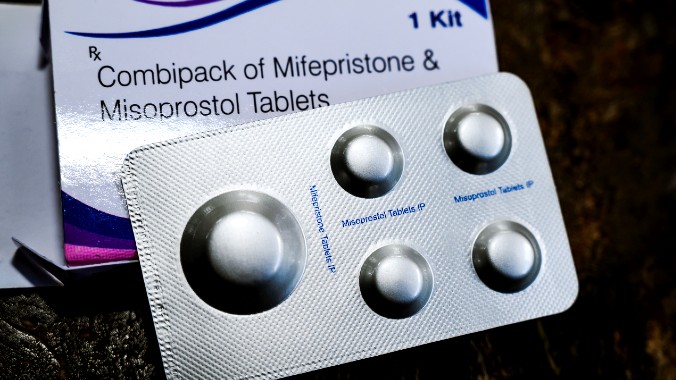

For months now, countless lawsuits, scientists, and peer-reviewed studies have reemphasized what was true for years before this cursed administration reentered office. Mifepristone, the first of two pills taken in a medication abortion, is safe. It’s safer than Tylenol and Viagra; more than 10 years of FDA studies deeming it safe have been backed by real science; and there’s no real reason it shouldn’t be an over-the-counter prescription.
Of course, none of these hard-science, evidence-backed instances of proof have gotten past the thick skulls of anti-abortion lawmakers and administration officials—and rather, these ignoramuses have been more interested in what Sen. Josh Hawley (R-Mo.) amplified for nearly all of 2025: A bogus, non-peer-reviewed study by the Ethics and Public Policy Center claiming mifepristone wasn’t safe.
As a result, the FDA has launched a needless investigation into the pill—a study that we’ve known next to nothing about, except for the possibility that Marty Makary got the boot for dragging his feet too much on its progress.
As things stand, that study is still ongoing—despite the administration’s efforts to hit pause on its anti-abortion agenda, given a perilous midterms season ahead. So, most recently, 322 leading reproductive health researchers filed an amicus brief defending the science behind telehealth abortion, and affirming in a 57-page document—once again—that mifepristone is safe, and pointing out the several flaws of the EPPC study.
“It’s like a long laundry list, really, of flaws with this analysis that means that it can’t be relied on,” Dr. Daniel Grossman, Director of the University of California San Francisco’s Advancing New Standards In Reproductive Health, and one of the researchers who signed the brief, explained to Jezebel. “This brief plays an important role in that it just clearly lays out the scientific evidence and how clear it is.”
In one such case, explains Grossman, the “serious adverse events” that the CPPC—a co-author of Project 2025—reported was a “vague, catch-all category of other abortion complications.”
“There’s very little explaining what those codes were, whose these experts were, how they made this determination,” he warns. Per Grossman, the CPPC study included in its “adverse” examples instances of miscarriage—providing another reason the results shouldn’t be relied on.
“Another thing that’s really concerning,” he continues, “is that it seems they might have included cases where people received mifepristone for miscarriage. We know that mifepristone and misoprostol is also the most effective treatment in the case of miscarriage, to hasten the expulsion of the pregnancy, and it’s being used more and more for that.”
Currently, mifepristone is facing legal battles on multiple fronts—including in Louisiana, where the Fifth Circuit is preparing to hear oral arguments this month in Louisiana v. FDA, which began because the state’s anti-abortion Attorney General Liz Murrill (R) wanted the agency to rescind its 2023 decision removing the in-person requirement for mifepristone. (She’s claimed this led to people using the abortion pill to poison women, and coerce them into having abortions.)
Post-Roe, telehealth has become a crucial lifeline for access to care—accounting for about 29% of abortions, per data from #WeCount, an ongoing project by the Society of Family Planning. This is a trend that can largely be attributed to shield laws, which protect providers from states without bans, and allow them to prescribe the medication in the 13 states where abortion is totally banned. Currently, 22 states and Washington D.C. have some kind of shield law in place.
“I hope that the courts will really look to the evidence, instead of pointing to these reports that really do not rely on good scientific methods,” Grossman explained. Here’s to hoping.
Like what you just read? You’ve got great taste. Subscribe to Jezebel, and for $5 a month or $50 a year, you’ll get access to a bunch of subscriber benefits, including getting to read the next article (and all the ones after that) ad-free. Plus, you’ll be supporting independent journalism—which, can you even imagine not supporting independent journalism in times like these? Yikes.


