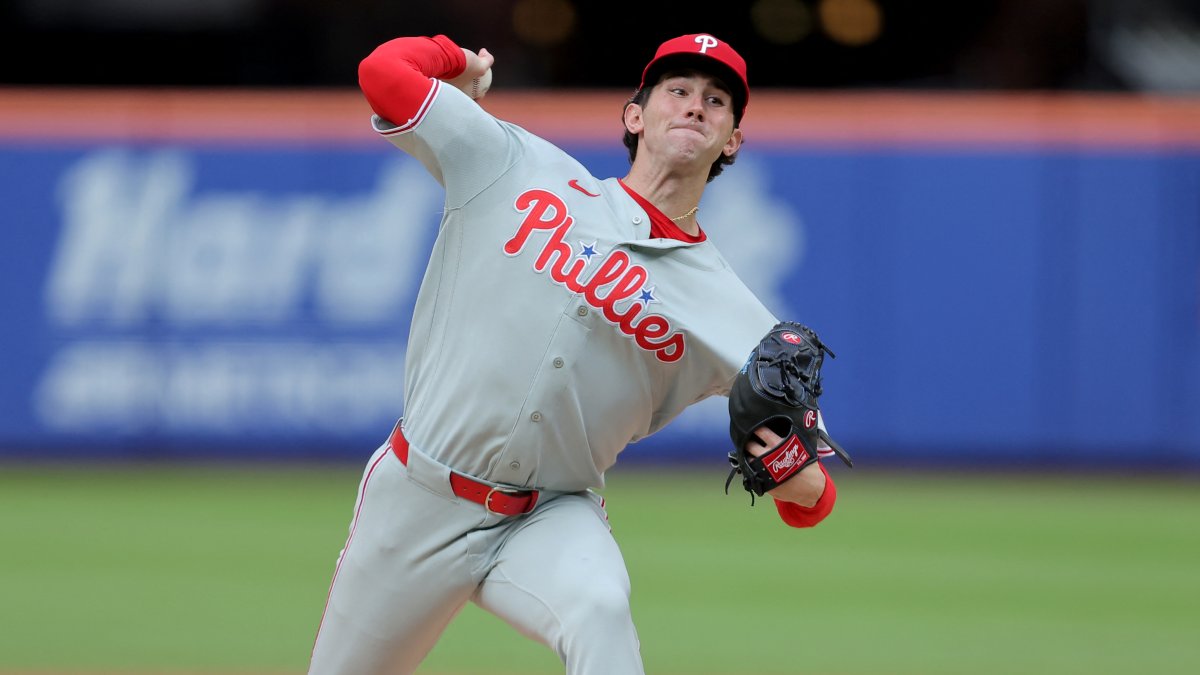
QUEENS, N.Y. — Francisco Alvarez tagged an Andrew Painter fastball that caught the outer edge up and away.
The three-run homer put New York ahead 4-3 in the fifth, one half-inning after the Phillies had taken the lead.
Philadelphia had grabbed the momentum in its eighth-to-last game of the regular season. Painter watched it fly over the wall.
But the inning had started four batters earlier with something that has hurt him before: a leadoff walk.
Four pitches. None competitive.
A single followed, then Alvarez made him pay.
Before Alvarez even reached home plate, Painter was already back on the rubber, hands held high near his face and eyes locked toward home.
A frustrating moment for the rookie in the Phillies’ 10-3 loss to the Mets on Saturday at Citi Field.
His next pitch was his hardest of the night at 99.4 mph, which Ronny Mauricio fouled away. Painter then battled Mauricio for nine pitches before striking him out with a changeup.
He followed by striking out Francisco Lindor for the second time, then Juan Soto to end the inning.
Don Mattingly sent Painter back out for the sixth, where he struck out Bo Bichette. With left-handed hitter Carson Benge coming up, Mattingly went to the bullpen.
On the surface, there was plenty to like. Painter struck out seven and walked one. His four-seam fastball had plenty of life.
But the issue that has followed him throughout his rookie season showed up again.
All four runs he allowed came on home runs.
IN BUNCHES
When Painter has allowed homers lately, they have tended to come together.
In the nine starts since his July 31 return to the majors, Painter has allowed six home runs. All six have come across three multi-homer outings.
Location was the biggest issue early in his season, particularly before his demotion. The pitch to Alvarez was different.
Painter wanted the fastball a little farther inside, but didn’t view the pitch itself as the biggest mistake of the inning.
“The main thing is looking back on the four-pitch walk to lead off the inning,” Painter said. “It’s more so the spiral effect of it.
“It’s four non-competitive pitches right out of the gate after a long inning. It just sets its own tone. We score a couple runs there, we take a lead. My job is to go out there and have a shutdown inning. That’s just not what I did.”
Home runs have accounted for 48 percent of the 75 earned runs Painter has allowed this season.
His 1.48 homers allowed per nine innings ranks 20th-highest among 108 starters with at least 20 starts. Before his demotion, he ranked eighth-highest.
But what happened after the Alvarez homer also stood out.
Painter responded with four consecutive strikeouts, beginning with Mauricio and carrying into the sixth.
“When stuff like that happens, it lights a little bit of a fire,” Painter said. “That’s not to say I was on cruise control or anything like that. Every pitch I make is full intent and trying to execute it. But it lights a little bit of a fire.”
Mattingly wasn’t surprised by the response.
“I don’t worry about Paint’s toughness, honestly,” he said. “Bouncing back and continuing to make pitches. I don’t worry about Paint from the standpoint of growth, handling situations.”
HIS ROLE AHEAD?
Mattingly said Saturday that Jesús Luzardo continues to feel better each day, which is encouraging.
But Luzardo still has not thrown a baseball in more than a week.
There are several steps ahead before he could return to a major league mound. He first has to resume throwing, progress to mound work and continue building from there.
With Luzardo looking increasingly unlikely to start early in a potential Wild Card Series, Aaron Nola could be pushed into a possible Game 3 if the Phillies are able to line up their rotation the way they want.
That leaves an interesting question for Painter.
He has started throughout this season and essentially his entire career, but his stuff could make him an intriguing option to bridge a game to the later innings.
Mattingly acknowledged Saturday that a shorter role is still among the possibilities the Phillies could consider.
“There’s a lot of things you think about as you’re going through it,” Mattingly said. “So, yeah, that’s something that you would think about and have that for sure.”
Painter doesn’t believe the adjustment would require much of a trial run beforehand.
“Postseason baseball and that atmosphere, the adrenaline’s going to be flowing,” he said. “I don’t really think there’s too much of an adjustment that’s going to be. I think the adrenaline would just take over from that point.”
Saturday offered another reminder of why the Phillies may need someone capable of covering those innings.
Brooks Raley allowed two runs in the sixth after replacing Painter, extending the Mets’ lead.
Phillies relievers working from the fifth through seventh innings this season have combined for a league-worst 5.28 ERA. It is the club’s highest mark in those innings over a full season, excluding 2020, since 2005.
Mattingly called that part of the bullpen a “trouble spot.”
“We haven’t been able to keep the game in check in that middle,” Mattingly said. “Even though Paint gives up the homer on a previous pitch after we score, it’s still 4-3 at that point. You keep the game in check, you feel okay.”
Painter hasn’t exactly been dominant from the first pitch of every start, either.
But the routine would be different in relief. His ramp-up would be different. His fastball could play up in shorter bursts.
And considering how much the Phillies have struggled in the middle innings, the bar isn’t particularly high.
Jonathan Bowlan’s uncertain status because of his right groin injury only makes the possibility more intriguing.
TOO LITTLE, TOO LATE
It felt like the Phillies had a chance to take control when they went ahead 3-1 in the fifth.
Then Alvarez changed the game.
The Phillies actually went 5-for-10 with runners in scoring position, but still stranded nine.
A large part of the problem came from the bottom of the lineup.
Phillies hitters in the seven-through-nine spots entered the night batting .186 in September, the fourth-lowest mark in the majors.
They haven’t consistently been setting the table for a top of the order that carried the offense for long stretches in August.
Mattingly saw better signs from the top Saturday, pointing to several well-struck balls that found gloves.
“Trea having really good at-bats. Top four of the order was good,” Mattingly said. “Luis gets a couple knocks. Harp with that ball against the double. Schwarber’s having good at-bats. But we just haven’t been able to cook through the other side of that.”
There are only seven games left to find an answer.
BOHM’S UNIQUE YEAR
The Phillies got multi-hit games from Trea Turner, Luis Arraez and Alec Bohm.
Bohm has quietly been one of their steadiest hitters for months, which makes it fair to wonder what his season might have looked like without a forgettable first month-plus.
He drove in his 85th run Saturday.
Considering where he started, that’s no small number.
Mattingly gave Bohm a pair of reset days before his two-homer game on May 9. Since then, his production has looked much more like the hitter the Phillies have known in recent seasons.
Over a 162-game pace since May 9, Bohm’s numbers translate to a .280 average, 20 home runs, 57 extra-base hits and 102 RBI.
Sound familiar?
Bohm recorded at least 50 extra-base hits and 97 RBI in both 2023 and 2024.
His regular season has already undergone a significant recovery.
If that carries into October, the way his 2026 season is remembered could look much different — with an interesting offseason still waiting on the other side.
KERKERING KEEPS STRUGGLING
The Phillies went back to Orion Kerkering in the eighth, one night after he allowed a three-run homer to Juan Soto.
There was logic to it.
Philadelphia needs Kerkering to get right before the postseason, and with the Phillies trailing by three, Mattingly wasn’t going to turn to one of his highest-leverage arms.
He believed Kerkering was the best option.
Saturday only made the situation more complicated.
Kerkering allowed four earned runs in the eighth as the game turned into a rout. He has now surrendered seven runs in two nights and owns a 15.43 ERA over his last seven outings and a 10.29 ERA over his last 15.
Mattingly didn’t downplay where things stand.
“It seems to be spiraling a little bit,” Mattingly said. “I’d say a pretty high degree of worry about him.”
The Phillies could attempt to find Kerkering lower-leverage situations, but even that has become difficult.
“You have to be able to use him there,” Mattingly said of Saturday’s situation. “In a game like that, I’m not going to try to chase a three-run deficit in that inning.
“It’s hard to find any places to use him.”
The stuff that has made Kerkering one of the Phillies’ most important relievers hasn’t disappeared.
But right now, the results have.
And with seven games remaining, the Phillies are running out of time to determine where he fits when the stakes get even higher.