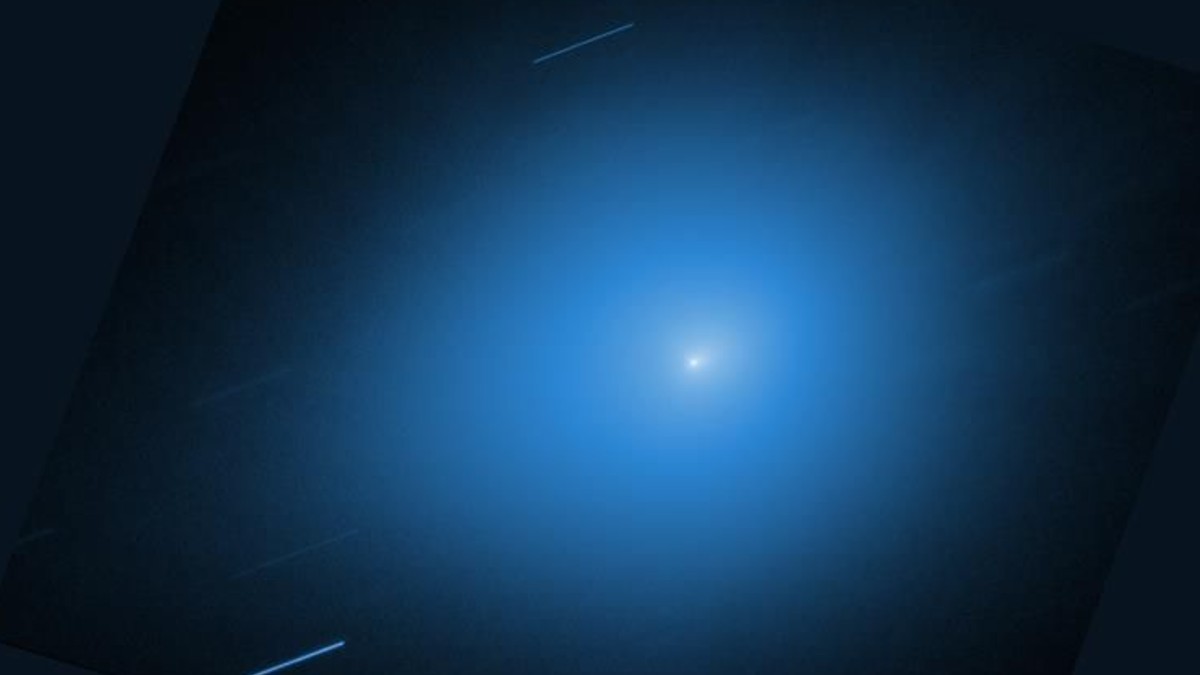
On Friday, an object that formed outside of our galaxy passes close enough to Earth that we have a chance to see it in the night sky.
It’s taken the astronomy community by storm. What is Comet 3I/ATLAS and why is it such a big deal?
“It’s exciting, right?” says Brian Koehler, Associate Director of Treworgy Planetarium at Mystic Seaport Museum. “The idea that something is coming from a direction we’ve never seen something coming from.”
Comet 3I/ATLAS gets its name for being the third interstellar object ever discovered–by the telescope “ATLAS.” That stands for “Asteroid Terrestrial-impact Last Alert System.” ATLAS is already living up to its acronym.
“Its purpose is to detect things well in advance and to determine whether or not they are on a collision course for Earth,” Kohler said. “We can confirm 100% that this object is in no way posing a threat to planet Earth.”
The object will stay a very safe distance away, but as it’s gotten closer and closer to Earth, we’ve been able to learn about the chemical composition of it.
“It’s got some ice water, water vapor, carbon dioxide and carbon monoxide, so it is in many ways similar to comets in our solar system,” says Kohler.
The high carbon composition is what will create a green glow that you’ll want to look for in the southeast sky near the constellation Virgo.
“You’ll want to look for this fuzzy green-looking object,” Kohler said. “It can be seen with either a small telescope, even a really good pair of binoculars, but it will be very hard to see with an unaided eye.”
While clouds will be a factor on Friday, you will have a chance to see Comet 3I/ATLAS through spring 2026. The best chance will just be as close as you can get to Friday since it will move further and further away as time goes on.
The best time for viewing will be about an hour or two before sunrise, and it will be worth waking up early to try to view this spectacle.
“Unlike comets, which take periodic journeys through our solar system, this object will not be returning to our solar system,” Kohler said.
Comet 3I/ATLAS will pass closest to Earth on Friday at a distance of 167 million miles. That’s almost twice the distance between the sun and the Earth.