The first time Mary McFarland saw the “Sister” sketch that aired on “Saturday Night Live” on Nov. 14, she laughed. She sent it to her siblings on impulse, thinking it was funny.
“Then nobody responded. I’m like, ‘What have I done?’” she tells TODAY.com.
But the more McFarland watched the sketch, the less funny it became. It resurfaced the story that played out 20 years before, when her mother moved in with her as McFarland herself was navigating Stage 3 cancer.
Watching the sketch and thinking back to the turmoil between her and her siblings toward the end of her mother’s life, she wondered: “Maybe somebody should have been taking care of me.”
The sketch landed on “Saturday Night Live” on Nov. 14 with a culture-moving thud. The gist? An advertisement for a product that will swoop in and solve all caregiving issues — a sister. The sketch points to the burden of caretaking that so often, but not always, falls on women. One of the three writers, Streeter Seidell, dedicated the sketch to his sister Heidi.
“Sister is a live-in, 24/7 elder care provider that is completely free and also your sister,” host John Mulaney says in the spoof commercial. “Now I don’t have to worry about dad getting the care and attention he needs, because my sister will do it, and I can get back to my life.”
Since its debut, “Sister” has provoked a seismic response, both publicly and in family group chats. One Threads user said the video is causing chaos.
“I started an entire family fight over this video today by sending it to my uncle,” the post read.
The painful reality
For many, “Sister” is exposing or affirming pre-existing (and sometimes painful) dynamics between siblings. Psychologist Adriana DeAmicis said in an email to TODAY.com “every single one” of her female clients has brought up the sketch in their sessions since it came out.
“The humor gave women permission to laugh at something that is often deeply frustrating: being expected to take responsibility for everyone else’s needs while watching their brothers receive praise for doing far less,” DeAmicis said.
“However, many women have been discussing this week how quickly they moved from laughing into feeling the true pain of a deep-seated and rarely acknowledged wound,” DeAmicis added.
In sibling group chats, what’s meant to be a funny re-share is sparking real conversations and escalating tensions over the share of the caregiving load. Christine Pruden, who spent six years caretaking for her parents, sent her brother the sketch.
“Ha!” his reply said. “Happy Sunday.”
Pruden, who had been “blown away” by the sketch, says his reaction seemed small compared to hers.
“It says everything so many of us women feel and never were really allowed to express, because if you do, you’re a troublemaker or a drama queen,” Pruden says of the sketch.
Pruden wrote back, “I think there’s gonna be a lot of families talking about that skit over Thanksgiving dinner. Hits way too close to home for some of us eldest daughters and sisters.”
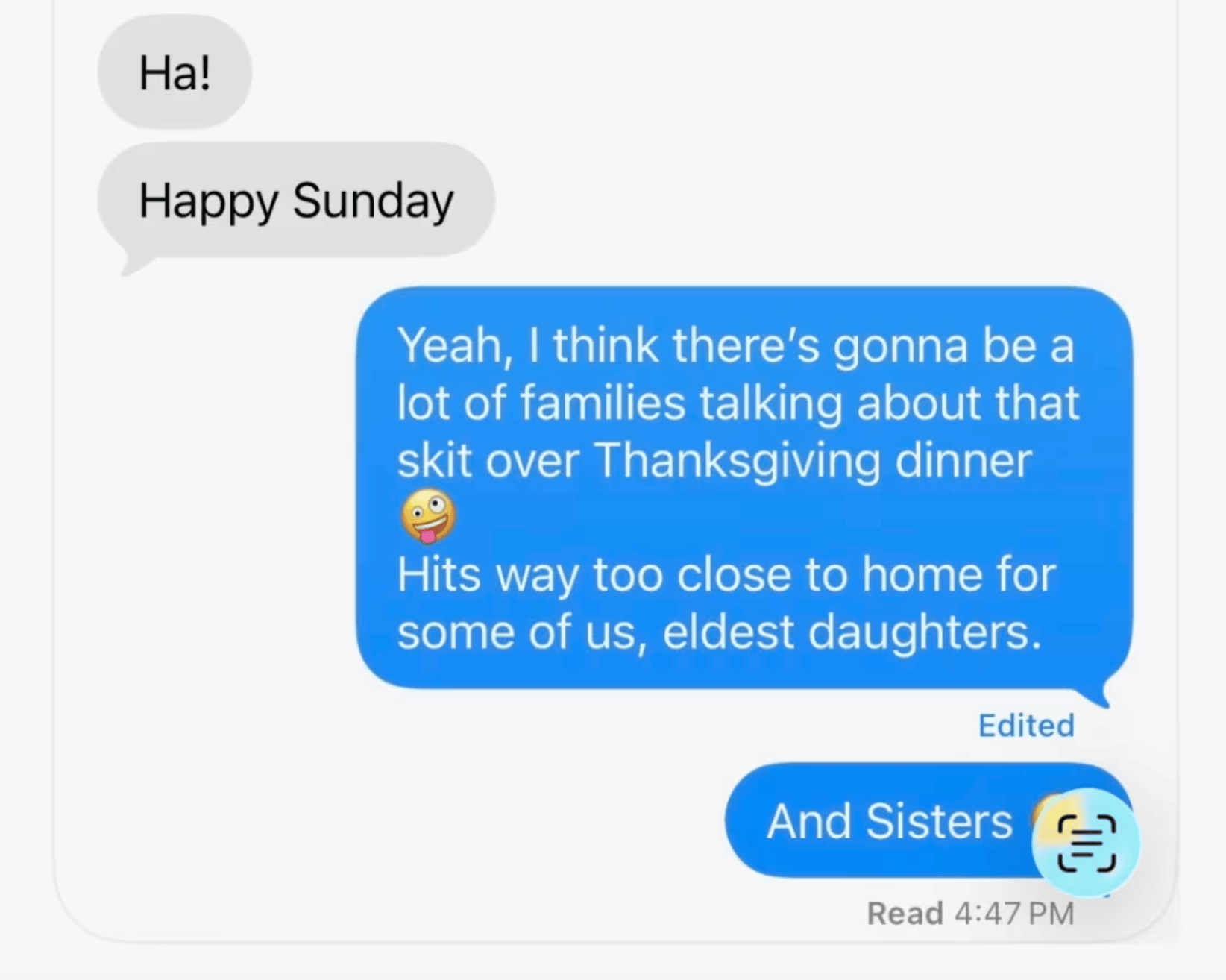
“He didn’t have any response to that,” she says.
Kimberly Wiener, who quit her job four years ago to care for her disabled elderly mother, sent the video to a group chat that included her seven siblings. She got no response other than a few laugh emoji and a private message from a sister-in-law who asked her if “the boys” would feel guilty by the sketch.
“My reply was, ‘Don’t care — I am at the “see you at the funeral” stage,’” Wiener wrote in an email to TODAY.com, referencing a line from the sketch.
Stacie Kowalski, who took a year of leave from her job while her father was dying, felt a tinge of worry after sending it to her brother.
“I sort of thought, ‘Oh I hope he doesn’t get mad.’ Then I thought just how ridiculous that thought was — once again putting someone else’s feelings before mine,” she said in an email to TODAY.com.
Kowalski’s brother did not respond, which, she said, “is a response.”
Heather Lister said her brother laugh-reacted to the video. She hopes it provided “some eye-opening perspective” for other brothers.
“What is so funny to me is how it is just assumed by the older generations, as well, that we daughters will do it,” she said in an email.
Sparking conversation — and hopefully, change
For others actively caring for their parents, “Sister” is inspiring change. Kathryn Hinchey Wise said in a statement to TODAY.com that “Sister” “gave her the nerve to say what I’d been carrying for months.”
She texted “Sister” in a group chat with her brothers, asking, “Did you watch the whole thing?” When she got no response, she wrote again, saying she wanted her brothers’ assistance moving their father to an assisted living floor in his building.
“That message started a knock-down, drag-out fight,” she said, one that ended in her stepping back from being her father’s primary caretaker.
“It wasn’t the outcome I wanted, but it was the one I needed,” she said.
Rebecca Cynamon-Murphy, a 49-year-old from the Chicago suburbs, gathered the courage to text her brothers to have a meeting about what had to change moving forward. She shared the text exchange on Threads.
“The text was an impulsive, inspired action after watching the sketch a second time,” Cynamon-Murphy said in a statement to TODAY.com. “My 2 sisters-in-law jumped into the group chat immediately to hold them accountable and they are rock-stars.”
A meeting, Cynamon-Murphy says, has been set.
Tanya Eby, meanwhile, received a text from her brother the day after she sent him the “Sister” sketch, specifically to talk about care for their mother, who has Alzheimer’s disease. Together, Eby says, they “came up with a plan” that eases her load and increases his.
“What the sketch did for me was affirm that I wasn’t imagining these assumed roles. I wasn’t being hysterical. It really wasn’t fair,” she tells TODAY.com. “It empowered me to be really firm in boundaries. Instead of saying, ‘Oh, I know you’re going through a lot. Don’t worry, I’ll take care of it.’ It allowed me to say, ‘I hear you. This is hard. I still need help with this.’”
Eby, who was developing resentment toward her brother, says she hopes the conversation sparked by the sketch can improve their relationship moving forward.
Meanwhile, for those navigating sibling estrangement, “Sister” is a reminder of the siblings who aren’t there anymore.
Lia Prusha, a therapist, texted it to both of her half-brothers from whom she is estranged, in part because of her experience caring for their late parents. Prusha says she hasn’t received a response.
“I think my sending it is being defiant. You can’t make me invisible. I’m a worthwhile person and I exist,” she says.
The caregiver crisis
It’s worth noting that not all “sisters” are actually sisters. Scott Lerman told TODAY.com in an email that his father turned to him after watching the sketch and said, “Oh my God, you’re the sister.”
“They know exactly who I am in our family,” he said.
Eliza Salerno, president and COO at Medical Guardian, a company that helps older adults live safely and independently at home, isn’t surprised by the earthquake this sketch caused.
“It’s inevitable that the caregiver crisis and the things going on with caregivers (becomes) a broader conversation topic because of the amount of people in the country having to step into the role,” she says.
According to an AARP survey, 63 million Americans are caregivers in 2025, up 50% since 2015.
Salerno says the crisis is due to the “silver tsunami” — the rapid aging of the U.S. population — healthcare issues, and the changing structure of the family unit, due to two-party working households.
“There’s not enough time in the day to work, take care of kids, live your life and manage this now really new thing that’s occurring,” she says.
It’s making younger women factor the reality of the “Sister” sketch into their future plans.
At 31, Olivia Landon has already done her fair share of caretaking, sitting by her grandma’s and great aunt’s deathbeds and putting her life on hold for her mother’s spinal surgery recovery for two weeks, even though her dad was at home.
She told TODAY.com in a statement she texted “Sister” to her family, who “ignored it.” Landon is now deliberately living in New Orleans, too far for her to keep caretaking.
“Leaving is the only way out,” Landon said.
McFarland, meanwhile, spoke to her own daughter in the aftermath of “Sister” about their future. McFarland moved to Oklahoma to be closer to her daughter and grandkids and says she now has a “lovely” family dynamic.
“She’s like, ‘Mom, of course I’m here for you, and I want to be here for you,’” McFarland says.
This story first appeared on TODAY.com. More from TODAY:
- Mike Schur Has Created Some of the Best Names on TV. Here’s What He Named His Kids
- So Your Teen Wants to Play ‘GTA VI.’ Here’s What Parents Need to Know
- What Happens When Your Kids Become Teenagers? Adam Scott Tells Adam Brody His 1 Takeaway
This story uses functionality that may not work in our app. Click here to open the story in your web browser.