D.C.’s newest memorial on the National Mall is about to open, 16 years after work on the Desert Shield and Desert Storm Memorial began. Organizer Scott Stump said there were plenty of times its creation was in doubt.
“I would be a complete fabricator or liar if I said that there weren’t a number of times, maybe even a few this week, where I just wanted to walk away and say, ‘You know, I just, I can’t do this anymore,'” he said.
Far from a naysayer, Stump has dedicated years of his life to creating the memorial, adding that effort to his service as a Marine lance corporal in the desert in 1990.
“People had pretty much all but forgotten what had happened back in 1990 and 1991. We had about 700,000 people deploy,” he said.
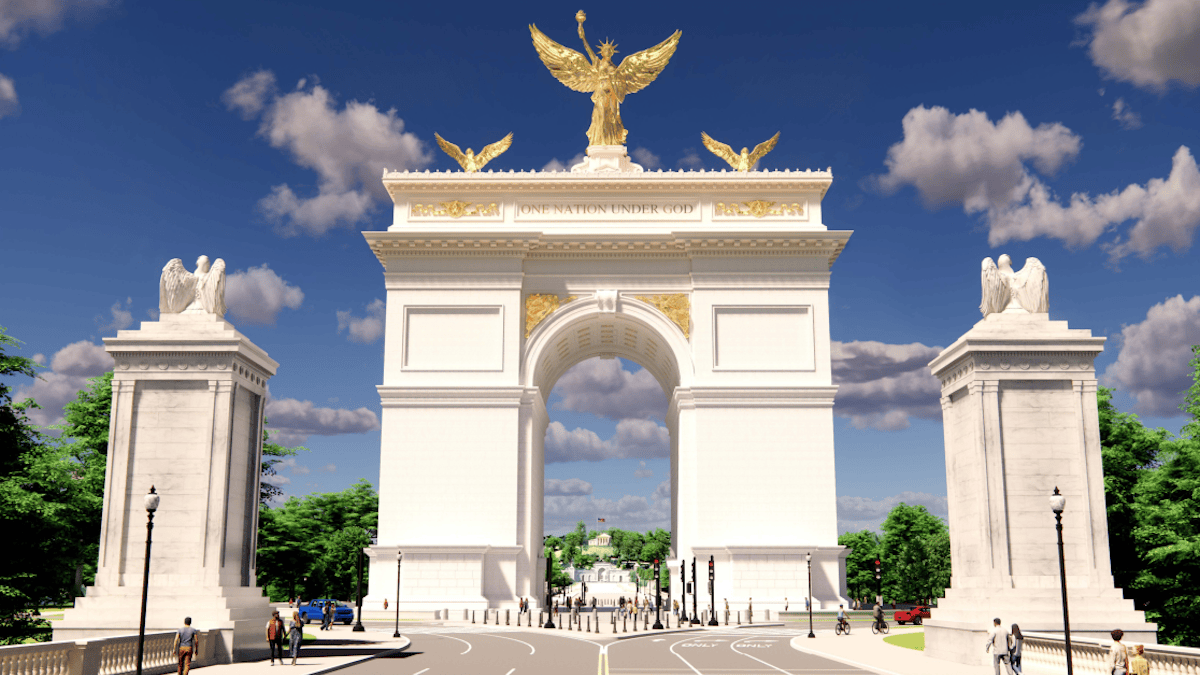
Across the Potomac River, President Donald Trump’s Triumphal Arch project is approaching final approval, just five months after its first appearance before the National Capital Planning Commission.
A former chair of the group, Teri Hawks Goodmann, said officials should give the arch project more scrutiny.
“The speed with which the administration is working on new structures, like [the] ballroom, like the arch, is disturbing. Because again, these monuments emerge from the American public. They emerge from a sense of reverence and awe,” she said.
News4 got an up-close look at the Desert Shield and Desert Storm Memorial, what it took to make it happen and what those we spoke with said Americans should consider about any new monument. It sits at the corner of Constitution Avenue & 23rd NW. It is shaped like a giant left hook, a tribute to the maneuver ground forces used to surprise the Iraqi army. It surrounds a fountain with the names of all coalition nations that participated in the war.
The ‘lightbulb moment’ behind the creation of the Desert Shield and Desert Storm Memorial
On the Mall, Stump pointed to elements of the memorial.
“I really like these figures at the rear because they have the gas masks on and people tend to minimize, ‘Oh, it was a video game,’ or ‘It was about a 100-hour war.’ They forget all about the air campaigns,’” he said while also remembering the months of build up spent in the desert dealing with fear and concern of chemical weapons.
In 1990, Stump was a 23-year-old Marine Reserve lance corporal called up and sent to the desert to push Iraq out of Kuwait during Operation Desert Shield and then Operation Desert Storm.
“I didn’t do anything special. I was just a Marine reservist. The only distinction I probably have is I’m probably the only person out of the 700,000 that completed my final three-hour college course in a foxhole by correspondence,” he said.
Stump spoke about how he got the idea for the memorial.
“I guess the lightbulb moment, if you call it that, was reflecting on the 20th anniversary of Operations Desert Shield and Desert Storm back in November of 2010,” Stump said.
“We liberated a country. We did it in a way that is extremely foreign in the minds of Americans. Now, in a divided world that we live in, you have these 30-some-odd coalition countries come together and work together,” he said.
News4 asked why he thought he was someone who could try to make a mark on Washington forever, with a new monument.
“Well, I’ve asked that question a lot of times, and I’m really just an average citizen. An average American. I’d been to Washington, D.C., one time during the eighth-grade trip. I had another very abbreviated trip on an Honor Flight,” Stump said.
“I had no connections. I’m not a lobbyist, don’t want to be a lobbyist, don’t want to have a job in Washington, D.C.,” the North Carolina resident said.
Stump recalled being told repeatedly that the project would never happen. News4 asked whether he needed congressional approval.
“Yes, sir,” Stump said.
Asked who explained that to him, Stump said: “Well, I just intuitively knew that it had to be in Washington, D.C. And I knew that anything happening here would have to go through Congress.”
How military deaths factored into the memorial’s creation
Stump approached Rep. Phil Roe of Tennessee in 2013. A year later, Congress passed a bill authorizing the memorial, and President Barack Obama signed it into law. Roe retired seven years later, and the memorial had not yet broken ground.
“He subsequently told me, he asked me, he said, ‘Scott, do you know why there are 24 steps to construct a commemorative work or a memorial?’ I said, ‘No, I don’t. Why?’ And he said it’s so people don’t build memorials,” Stump said.
Stump said he was often told the war was too short to warrant a memorial.
“I was told a lot of things. One of the things that you had just hit on, you know, that it was a very short duration. And my argument for that is, so is a heart attack, but it has lasting implications,” he said.
Asked whether the number of military deaths factored into conversations about the memorial, Stump said it did.
“I had people say that there weren’t enough people that died during this conflict to warrant a memorial and then my follow-up question was, well then what is the right number? What’s the magic number? Is it 500? Is it a thousand? Is it 5,000?” he asked.
A 16-year effort
Stump said it still has not sunk in that the memorial will be dedicated on Oct. 24. By that time, nearly 16 years will have passed since his effort began.
When asked whether he could believe it when he said it out loud, Stump replied: “I don’t want to believe it. I don’t want to think about how long it has been. You know, it extracts quite a toll.”
The war in 1990 and 1991 lasted 210 days, including just 100 hours of ground combat. Getting the memorial approved by the committees responsible for memorials on the National Mall took nearly six years, with construction taking even longer.
“We had final approval, I believe it was about two and a half years ago, for the design,” Stump said.
To win approval took almost six years.
“That’s an astronomically long time,” Stump said.
Still, Stump said he is pleased with the final result.
“I’m very, very happy with the outcome of what we have here.”
What the Desert Shield and Desert Storm Memorial represents
The memorial received no federal funding for construction. The Veterans of Foreign Wars and chapters across the country were major donors. The largest donor was Kuwait, the country U.S. forces liberated, which donated nearly half the budget.
“I think we have put together a really great representation of the war effort. You’ve got the clouds where the planes are and they kind of meld into the desert-type environment. I’m just very, very happy with the work that has been done with this to depict all of these different, you know, the sea, land and air,” Stump said.
“Then at the very end is where the sun is rising. It’s the liberation, you know, to symbolize the new day.”
Stump said the designers intentionally avoided filling the memorial with quotations. One exception is a quote from President George H.W. Bush.
“That was Bush 41 when he stated before a joint session of Congress on March 8 of ’91: ‘They set out to confront an enemy abroad and, in the process, they transformed a nation at home,’” he said.
The memorial sits on Constitution Avenue, about a block from the Lincoln Memorial and across the street from the Vietnam Veterans Memorial.
Asked whether there was historical significance in being located between those landmarks, Stump said there was. Tens of thousands of names on the Vietnam Veterans Memorial influenced how the Gulf War was planned and fought.
“It sure did,” Stump said. “And I remember that. I remember coming home. They wanted to make a big fuss. We were embarrassed. We didn’t want to do parades. We just wanted to go home. We felt like we just did what we were asked to do. And I remember we did the parade and at the end, the commanding officer said, ‘And I dedicate this to all of the Vietnam folks that never got it.'”
Stump made another point about the memorial’s location.
“The other connection is right behind me here on Constitution. That’s where the victory parade, or whatever we called it, was on June 8 of 1991. I was not invited to that, but the troops actually marched right past here on the way to Arlington. So, it has a lot of symbolism and connection,” he said.
The process for creating ‘very, very significant memorials’
The Desert Shield and Desert Storm Memorial will open as Trump’s proposed Triumphal Arch moves through an accelerated approval process.
Asked how that process differs from his own experience, Stump pointed to the level of review.
“Well, there’s a big difference. You know, the level of scrutiny, the feedback. This site right here, the mandate, it’s built into its landscape,” he said. “Can’t go vertical. We were told, you cannot block the view shed of (the) Lincoln (Memorial). We respected that. We went through a very arduous and long process. And the idea of something being that vertical, yeah, it is. It’s a departure from what we were hearing and what we adhered to.”
Former National Capital Planning Commission Chair Teri Hawks Goodmann echoed those concerns. She said she first encountered the Desert Storm Memorial project shortly after she joined the commission in 2022.
“It was my first in-person meeting, because I was appointed in January of 2022. And Desert Storm had a history. It had already gone through a process. I think they’d already had seven or eight meetings with the commission prior to my appointment,” she said.
Hawks Goodmann said those meetings reflected the level of review required for significant memorials.
“We were talking about that kind of minutia that goes into looking at these very, very significant memorials to those who have given to our country and who have obviously given their all,” she said.
According to News4’s review of commission records, 16 projects approved since the Desert Storm Memorial first appeared before the commission in 2017 took an average of 621 days to receive preliminary approval. The commission granted preliminary approval to the arch in just 35 days.
Hawks Goodmann said memorial projects traditionally begin with citizens seeking congressional approval under the Commemorative Works Act.
“It begins with a group of citizens who go to Congress. You know, because we have the Commemorative Works Act. And people join together who have a shared interest in memorializing Americans in some way at our nation’s capital. So it’s a grassroots process that reflects the democracy that we live in,” she said.
Hawks Goodmann, who lives in Iowa, was appointed to the commission by President Joe Biden in 2022. She said she was removed from the commission in July 2025 after receiving an email the night before a meeting. She and two other presidential appointees were replaced by allies of the Trump administration.
She rejected the idea that she viewed the position as political.
“Absolutely not. Absolutely not. I never spoke to the president (Biden) about it. We had contact, but it was about family. It was certainly not about my role in this commission, and I never would have expected to be directed in any way by the president,” she said.
Hawks Goodmann said deliberation is essential because the capital’s planning framework is built around the L’Enfant and McMillan plans.
“It’s slow and deliberative because the planning that surrounds the Capitol and the desire to stay within the parameters of the L’Enfant plan and the McMillan plan are very specific and so it takes significant deliberation,” she said.
She added: “I think, for anyone who’s visited the Capitol and understands the feeling you have when you enter the Mall or enter the Capitol itself or the White House, everything is planned to reflect something bigger than ourselves.”
Asked about the rapid pace of the arch proposal, Hawks Goodmann said public participation is essential.
“These monuments emerge from the American public. They emerge from a sense of reverence and awe at acts of bravery or acts of outstanding performance by Americans, and it’s not something that just comes about overnight and it certainly not one person’s idea. It’s the collective that comes together,” she said.
She cited the arch’s goal of celebrating 250 years of American democracy.
“For example, the Arch, it’s intended to celebrate 250 years of democracy. That’s a wonderful idea. I think that’s an idea, though, that demands public engagement and sharing of ideas, and letting us really imagine that incredible celebration. So, it’s not something that just happens overnight and comes from a single source. It would be something that’s coming from the collective,” she said.
Asked about the risks of moving too quickly, Hawks Goodmann said: “Well, the danger is, number one, no congressional approval. Number two, the architecture itself doesn’t actually reflect the intended purpose or message. Number three, you have citizens objecting to it. It becomes controversial, as opposed to celebratory.”
“I think there is a reason for the deliberative process, and I think that it’s always a benefit to have it,” she said.
Trump defended the proposal during an Oct. 8 address.
“Fifty-nine major cities in the world. We are the only one of the 59 cities and capitals without a triumphal arch. In Paris, you have the Arc de Triomphe, we have one much more beautiful, slightly larger,” he said.
News4 said it reached out to the White House for an interview with the president about the arch but did not receive a response. A spokesperson said, “President Trump is moving at lightning speed because we don’t have time to waste in our mission to make America greater than ever before.”
A spokesperson for the National Capital Planning Commission said the agency regularly works with applicants to understand timelines and align its review stages.
The commission is expected to take a final vote on the arch soon but faces multiple legal challenges, including a lawsuit filed by the Arlington County Board opposing construction and objections from some neighboring jurisdictions.
Asked whether the project should simply be allowed to proceed, Hawks Goodmann pointed to public response.
“When you have 100,000 responses, majority of those negative from American citizens from throughout the country, if I were on the commission as chair, I would say, ‘Hmm, let’s slow down. Let’s just slow this down.’ To me, that would be a logical response,” she said.
‘I wanted to honor those who died’
Stump said the memorial is intended to inspire curiosity.
“The task that we have is for a visitor to come here and be inspired and then subsequently look up on their phone or whatever to learn what all of this means. That’s our job,” he said.
He said public feedback improved the final product.
“You have to respect the commentary and then work through it and then show why it doesn’t work. But there have been some very good commentary that has led to, again, the overall collaborative process,” he said.
Asked whether public comment and preservation laws truly matter, Hawks Goodmann responded: “Yes, the process matters, and citizen input matters, and the process protects the future of the capital and its intended reflection of democracy in the Constitution.”
“It’s really about preserving the built environment and the landscape so that it does tell that story, the greatness of America and the United States and the people who live here. That’s why it’s important,” she said.
Stump acknowledged the toll the project has taken and said he’s unsure if he’ll ever return to see the memorial again. After spending 16 years changing a corner of D.C., he is left wondering whether the same standards and process apply to other projects.
“Stay true to why you’re doing it in the first place,” he said. “I wanted to honor those who died. I wanted to honor those that served.”