Concerns are growing in D.C. that some voters might not have all votes counted in key local races. The issue stems from D.C.’s first use of ranked-choice voting in a general election.
In the at-large race, voters can choose two candidates. But, depending on which candidate is ranked first, their second choice might not count.
The D.C. Council has four at-large members. By law, two of those seats must be held by a minority party, meaning any party other than the Democratic party, which holds an overwhelming majority in the city.
In past elections, the general election ballot for at-large races indicated voters could choose two candidates.
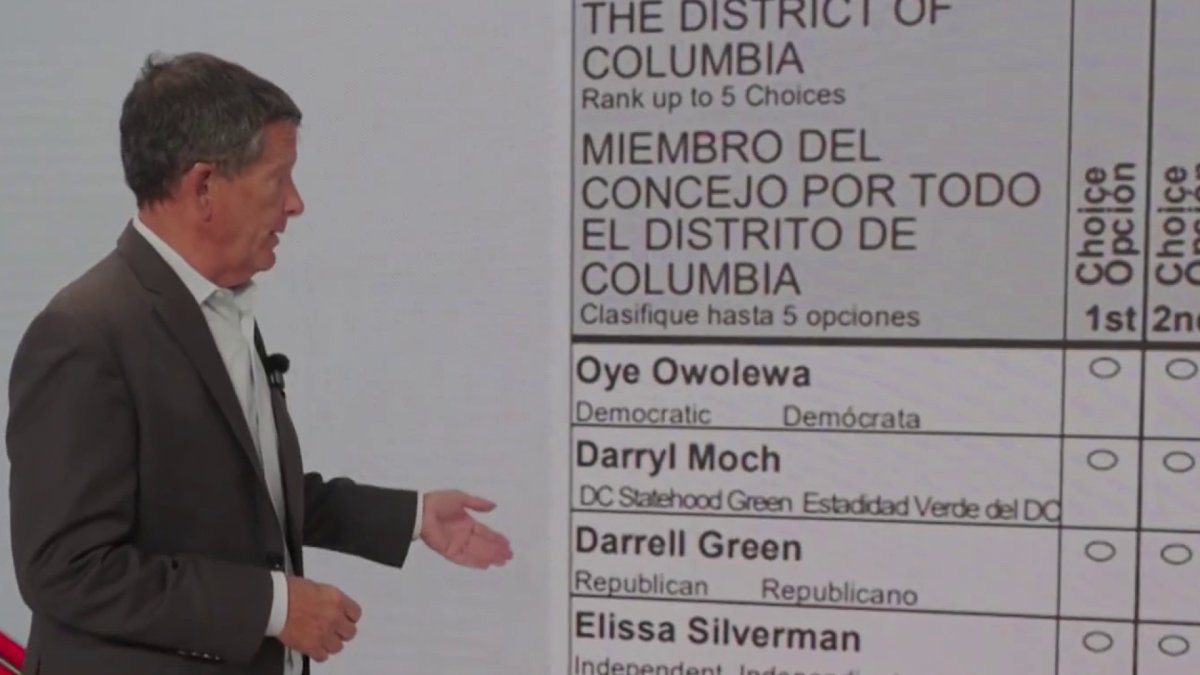
Now, because D.C. now uses ranked-choice, voters on the current ballot are instructed to rank up to five. But nowhere on the ballot does it indicate there will be two winners.
That’s problematic because ranked choice does not account for two winners in the same race.
The way ranked-choice voting works, if your first choice wins, the rest of your choices are not counted.
Because D.C. is majority Democrat and the only Democrat running for at-large is also in the number one ballot position, it’s more than likely that Oye Owolewa will win the first round.
Any resident who voted for Owolewa as their first choice won’t have their second choice counted. That will likely be tens of thousands of voters.
That’s why Independent candidate Ellisa Silverman is asking her supporters to rank her number one.
“Voters have good reason to be confused. They no longer have 2 votes for the 2 At-Large Council seats. That’s not explained on the ballot. Now they have one ranked choice vote, and how voters rank really matters. We’re asking our supporters to rank Elissa 1st,” a spokesperson for Silverman’s campaign said in a statement to News4.
In July, D.C. Council Chair Phil Mendelson raised concerns about the problem in a memo and tried to pass emergency legislation to fix it. But he couldn’t get enough support on the council as the election cycle had begun.
Councilmember Christina Henderson, one of the four at-large members, shares Mendelson’s concerns.
“So effectively under ranked-choice voting for the at-large race, as opposed to folks having the opportunity to vote for two candidates, their vote essentially will only be cast for one,” Henderson said.
“I wouldn’t say that they are being disenfranchised. They’re still having the opportunity to vote, but this is a change as opposed to voters being able to cast their ballot for two at-large members, which has been traditionally done, they’ll only have the opportunity to essentially cast their ballot for one at-large member,” she said.
Henderson said she’s hopeful the council will fix the issue for future elections.