

A Chicago developer believes the more than 70-year-old Emanuel Congregation synagogue is on the largest, and only, lakefront site of its kind in the neighborhood.
And developer Fern Hill is partnering with the synagogue to overhaul the property at 5959 N. Sheridan Road, making it larger with new commercial uses.
During a Thursday night virtual meeting with the congregation, the development team shared an updated design of what the property’s transformation could look like. Sixteen different design concepts have been shared with the congregation since plans were introduced in September 2025.
Andrew Degenholtz, co-president of Emanuel Congregation's executive committee, is leading the redevelopment with Fern Hill. Fern Hill is behind the 36-story tower in Old Town that drew heated neighborhood discussions before its approval last year by the Chicago Plan Commission.
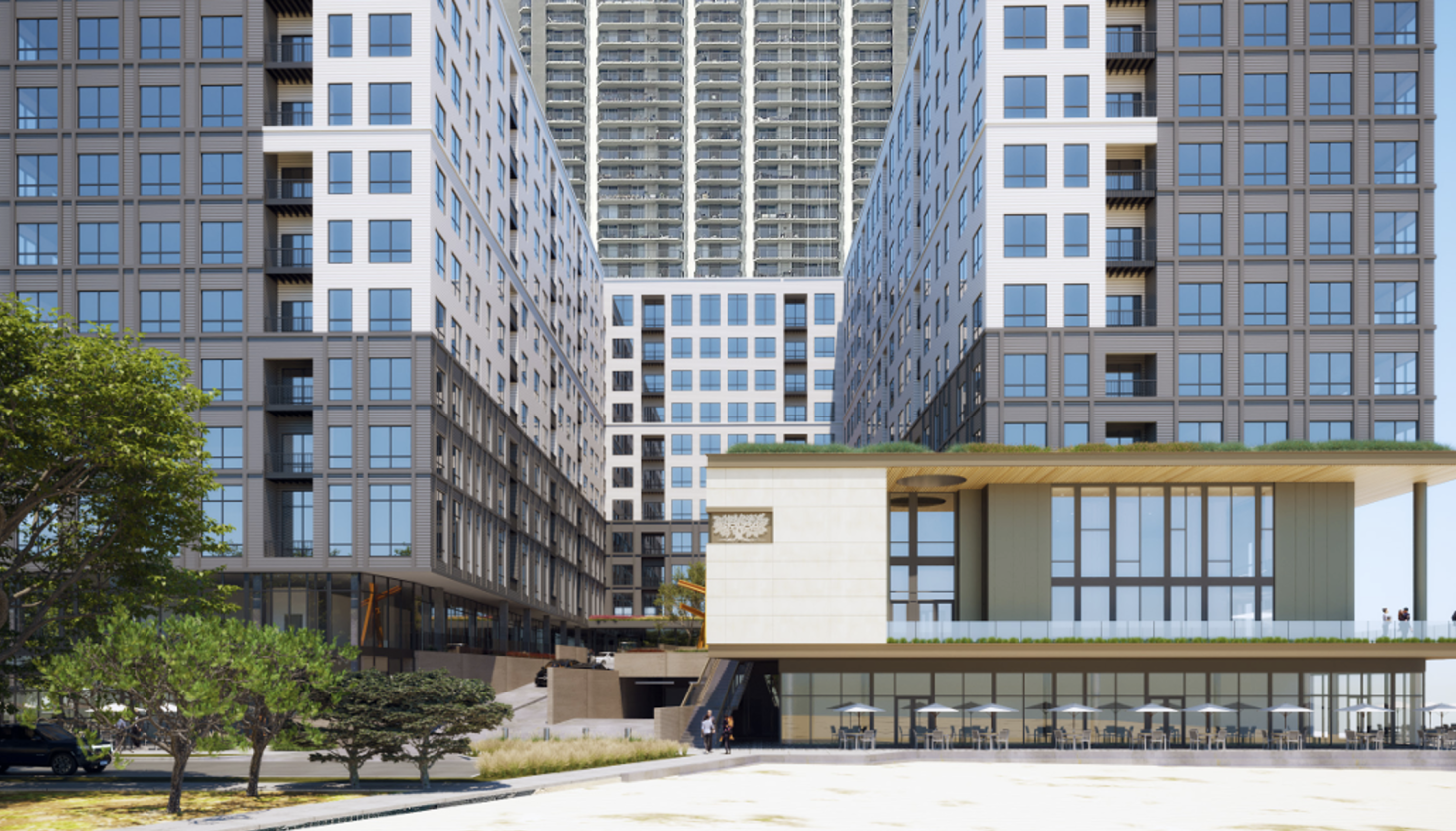
During Thursday's meeting, Fern Hill and architecture firm Eckenhoff Saunders pitched a 12-story U-shaped building that would house Emanuel, as well as parking, commercial space and apartments. There would also be an additional five-story building on the west side of Sheridan Road with apartments and event and classroom space. The two buildings would have a total of 400 apartments.
“Putting it in context [of] all of the buildings along the lakefront, we feel like we're fairly conservative, frankly, in terms of the height,” Nick Anderson, founder and president of Fern Hill, said. “The density of this site compared to all of the properties along Sheridan Road … [means] this would actually be the least dense project.”
When Emanuel was built in 1954, it was expected that DuSable Lake Shore Drive would be extended north to reach some of Chicago’s suburbs. While that never materialized, it was “a driving force” in the synagogue’s design, Anderson said.
There’s only one driveway to enter and exit the synagogue, off Sheridan Road. The new design will feature a circular motor court for pickup and drop-offs. It will also create more parking for the congregation, in addition to parking for future residents.

The apartments would include studios, one- and two-bedrooms. Anderson said there will be 80 affordable units under the city’s Affordable Requirements Ordinance, available for those earning an average 60% of the area median income. For a family of four, that’s an annual income of $71,940.
Retail space would be below Emanuel, with expansive views of Lake Michigan. Matt Wylie, principal at Eckenhoff Saunders, said the tenant could be a cafe or “a function that is allied with the synagogue.”
“An active function at that ground level works synergistically with the surrounding neighborhood and has the side benefit of getting Emanuel space up in a more secure location,” Wylie said.
For Emanuel, the taller building would hold its chapel and sanctuary space, plus social halls and offices. The congregation would also have access to a balcony overlooking the lake.
Fern Hill stressed that the concept isn’t finalized. Congregants showed some hesitancy to the plans, as well as traffic concerns on Sheridan Road, security and the increased density in the area.
“This is a working process,” Anderson said. “These are meant to elicit comments and feedback and thoughts, so don't see an image and sort of think, ‘This is what it's going to be.’ The point is this process is iterative, and we want to hear from the members, and, of course, the community at large.”
Fern Hill has submitted a zoning change request to Ald. Leni Manaa-Hoppenworth (48th), the alderperson said in a Friday newsletter to constituents. Her office will hold a community meeting in February to gather feedback on the proposal, but a date has not been set.
Anderson said if it's approved, there will be a phased construction approach, starting with the building on the west side of Sheridan. The building’s ground floor would serve as a temporary synagogue for Emanuel, as the 12-story tower is constructed.
The shorter building would take at least 12 months to build, according to Anderson. If the team proceeds with the 12-story design, it would take at least 15 months to complete.


