Five West Hartford residents asked questions to town officials as they prepare to remove 38 trees on Farmington Avenue next week.
It’s the next step in the town’s $10 million revitalization project for the Center.
At a public hearing, residentsasked West Hartford town leaders why the towering honey locusts planted four decades ago must come down and whether anything could be done to save them.
“It’s going to change that feeling dramatically,” said West Hartford resident Jenn Bauman.
Residents questioned whether the removals were tied solely to the larger project and if the trees could otherwise remain in place.
“If this overall project was not going forward, would we be taking out the trees?” one attendee asked.
John Phillips, the town’s director of public works, said the removals would have been necessary regardless
“Oh, we’d be aggressively taking them down,” Phillips said.
He noted that several trees have dieback (a gradual decline in tree health) and would be targets for removal. In 2022, a report classified the trees in and around the center:
- 9% good: “Tree health and condition are acceptable.”
- 66% fair: “Parts of the canopy display undesirable leaf color, inappropriate leaf size, and inadequate new growth. Parts of the tree are likely to fail.”
- 24% poor: “Most of the canopy displays dieback and undesirable leaf color, inappropriate leaf size, or inadequate new growth. A tree or parts of a tree are in the process of failure.”
Town officials said 38 honey locusts will be replaced with 47 new native trees from five different species.
“We didn’t want anything that would grow berries or fruit, create other issues,” town engineer Gregg Summers said.
The public hearing was in front of the town’s tree warden, John Phillips, who also serves as the Director of Public Works. He has been with the town for decades.
The tree warden has three days to make a decision after hearing public comment and the town’s justification for taking down the honey locust trees.
Some residents asked whether the town could invest in larger replacement trees.
“I was here to question if perhaps larger trees could be invested in,” said West Hartford resident Ken Graham, referencing the new trees on LaSalle Road, which are significantly smaller.
Summers said the town would speak with the contractor.
“That’s something we can revisit and check in with them,” he said.
A major reason for removing the trees is that their roots are causing buckling issues on the pavement, making it difficult for mobility devices and strollers.
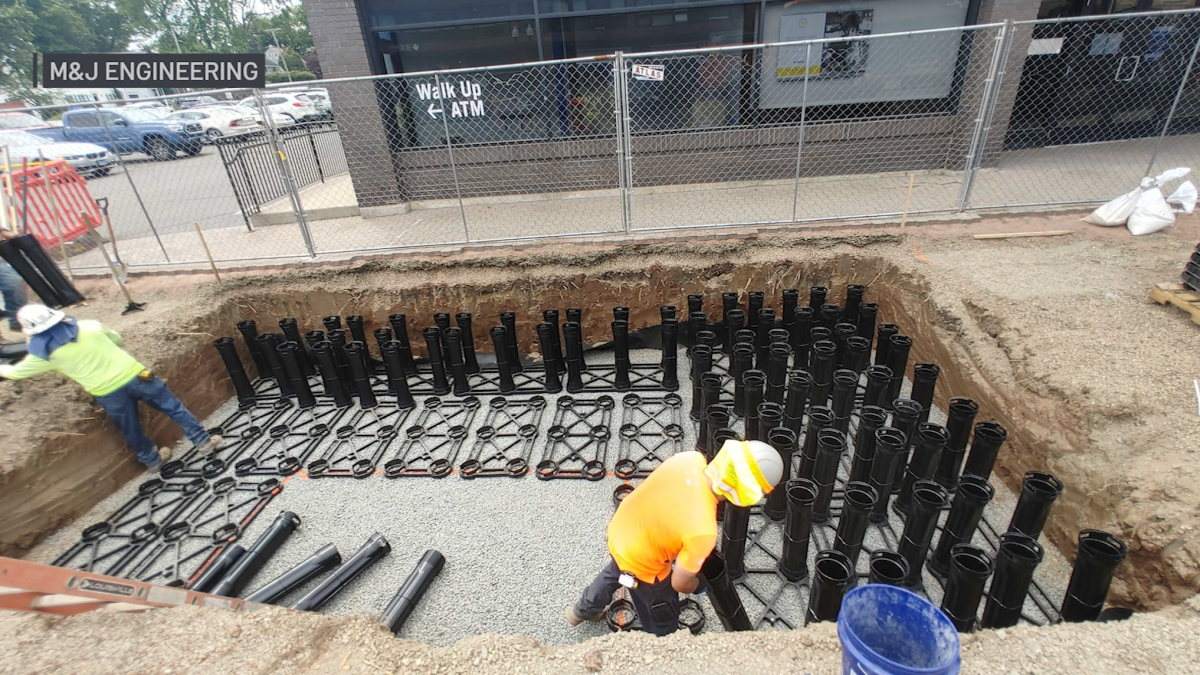
New soil-cell installations beneath the sidewalks will reduce the chance of that issue in the future.
Kyle O’Connor is the chief inspector for M&J Engineering, the town’s consultant for the $10 million infrastructure improvement project.
He said the devices provide uncompacted soil space for roots to grow, reducing the chance they will push upward toward pavement.
“It gives them an easier path for them to be able to germinate,” O’Connor said. “So the chances of them pushing up is way less because, you know, they’re going to find the easiest path of resistance.”
The technology has been used in Canada, Europe, and certain spots on the West Coast, he said. Summers said it provides three times as many cubic feet for root growth as a typical tree pit, while still allowing utilities to be stored among the roots.
O’Connor said it’s an innovative solution to allow green life in an urban area.
“Since the trees have such room to grow, they should be very healthy,” O’Connor said.