The risk of properties labeled by the city as unsafe and imminently dangerous is that they could collapse at any point – like the one on Hansberry Street in Germantown earlier this month.
That home had been deemed unsafe in 2021 and upgraded to imminent dangerous – the most severe category – in December. The owner had until Jan. 9 to correct the most recent violation but two days prior – the whole facade of the house came crashing down onto the sidewalk, spilling onto the street.
An NBC10 Investigators review of city records found that Philadelphia continues to struggle to bring property owners into compliance, even after Mayor Cherelle Parker split the Department of Licenses and Inspections into two divisions in 2024.
“We are being very intentional that there is a person focused on building compliance and safety – along with those quality of life issues,” Mayor Parker said then.
The New York-based owner of the Hansberry property, Brent Boyce, told the NBC10 Investigators the day following the collapse that he didn’t know the property had fallen down. He declined to speak further, saying he wanted to speak with city officials first.
In addition to Hansberry, the city has 170 imminently dangerous properties – the most severe category. According to the city code, an imminently dangerous classification means there is an immediate risk of failure or collapse.
The NBC10 Investigators found that half of the so-called ID properties in Philadelphia have held that designation for more than a year.
There’s even more in the unsafe category – those deemed to be “dangerous to the life, health, property or safety of the public or the occupants of the structure,” according to the city code. Of the more than 3,300 unsafe buildings in the city, 70 percent have had the unsafe designation for at least one year.
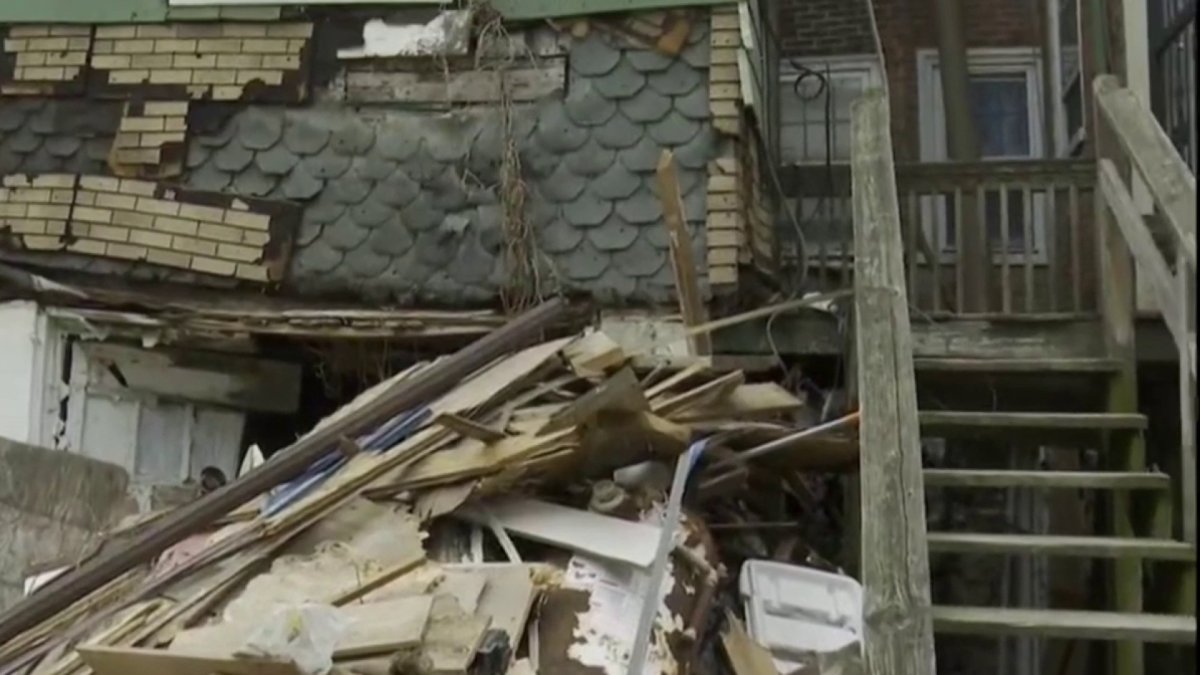
The property next to Brenda Glover’s West Philly home is one of them.
“This is about ready to come down,” Glover said, pointing to the porch roof that is caving in and has a large hole in the middle.
City records show residents have contacted 311 for years to report concerns about the property. L&I deemed the home unsafe in 2022. Since then, it has failed four re-inspections and currently has 15 outstanding violations, including roof deficiencies and exterior structural wall issues.
“I think it’s horrible,” Glover said. “The city and the mayor and L&I, they need to do their job. I mean, what are you waiting for — for it to collapse?”
Basil Merenda, L&I’s commissioner for inspection, safety and compliance, said the department is in the process of going to court to against the owner – nearly three years after the first unsafe designation.
“Seek a court order to take down the porch,” Merenda said.
When NBC10 reached the property owner by phone, he said he is in the process of obtaining permits to make repairs.
Drexel University civil engineering professor Abi Aghayere said unsafe buildings can deteriorate rapidly, especially when maintenance issues go unaddressed.
“It can go very quickly,” Aghayere said. “If you don’t fix your roof and there’s a leak, water gets into the building, into the wood, and rots the wood.”
Aghayere said delayed action can put neighboring properties at risk, and buildings offer no warning before failing.
“The building is not going to warn us when it’s going to go,” he said.
Merenda placed the responsibility on property owners.
“They have to take responsibility for their properties,” he said, adding that L&I does not have the resources to fix unsafe property. It has a demolition budget for the most dangerous buildings.
But it can’t get to all of them.
When asked why buildings deemed an imminent risk remain standing more than a year later, Merenda asked for a list of addresses to review. NBC10 shared a link to L&I’s own publicly available database of imminently dangerous properties and is still awaiting a response.
City code allows L&I to issue daily fines when property owners fail to correct violations within a specified timeframe — a tool intended to force compliance. However, Merenda said fines are applied on a case-by-case basis.
“Does that property owner have the resources to pay those fines and fix the property?” Merenda said. “You want compliance. You want the property fixed.”
He says it’s a challenge to get owners to fix their properties before it’s too late.
“That’s the six-million-dollar question,” he said. “That requires resources. It requires policy beyond what L&I has in its repertoire.”
Merenda said he is working with the mayor’s office to secure more inspectors, allowing the department to respond to complaints faster and improve compliance across the city.