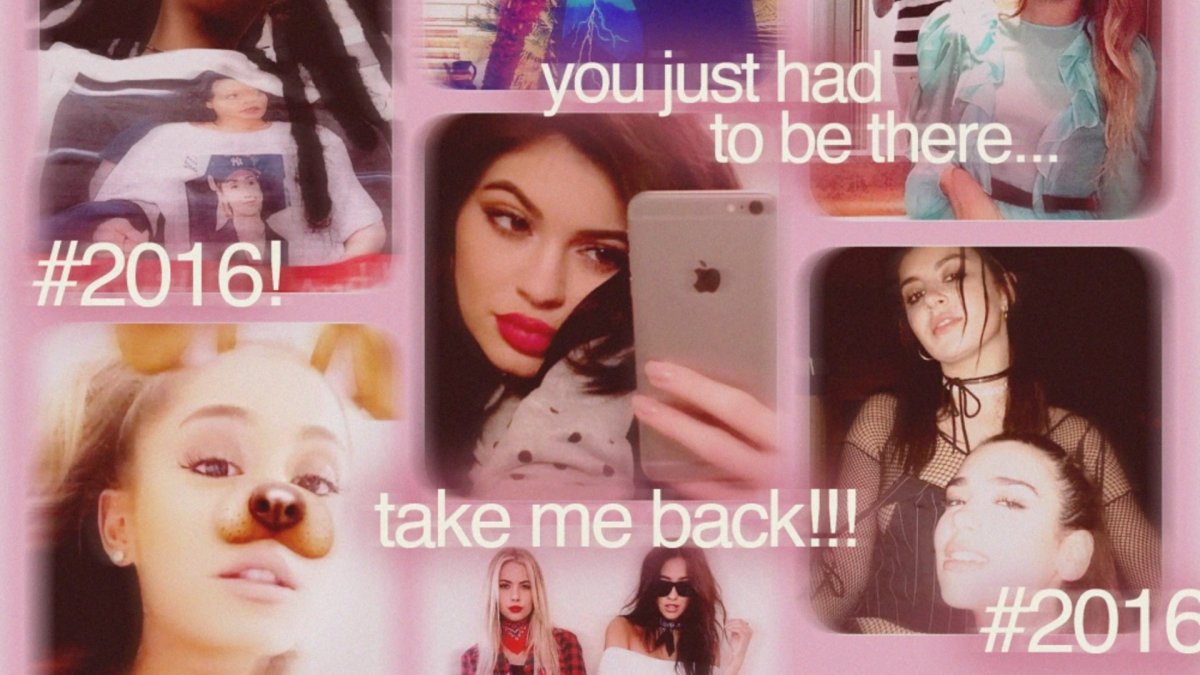
VSCO filters, Kylie lip kits and the summer of Pokemon Go.
The year 2016 is making a comeback in 2026 as people flood Instagram with throwback posts reminiscing about what they viewed as an iconic year for popular culture and the internet.
In the past two weeks, many people online — from celebrities to regular Instagram users — dug through their camera rolls and Snapchat memories to unearth hyper-filtered photos of themselves a decade ago.
Many of the photos share common themes now emblematic of the era: a matte lip and winged eyeliner, bold eyebrows and glamorous eye shadow. Acai bowls and boxed water. Chokers, aviator glasses and boho outfits made trendy by Coachella.
“When I’m seeing people’s 2016 posts, even if they were in different states or slightly different ages, there’s all these similarities, like that dog filter or those chokers or The Chainsmokers,” said Katrina Yip, one of many people online who posted 2016 throwback photos. “It makes it so funny to realize that we were all part of this big movement that we didn’t really even know at the time was, like, just following the trend of that time.”
The trend has become the latest example of people online romanticizing a different time as a form of escapism. Last year, Gen Zers, typically defined as those ages 14-29, posted videos expressing love for the charm and “cringe” of millennials. There has also been a recent surge in millennial-focused pop culture, which has been celebrated online.
To many millennials and older Gen Z, 2016 was a year when community flourished on social media. People dumped their entire camera rolls into messy Facebook photo albums, sent each other silly Snapchat selfies and eagerly posted what they ate for brunch.
“If you’re older, like maybe you were 50 in 2016 and you weren’t on Instagram or a heavy internet user, you might be like, ‘Why does everyone care about this random year?’” said Steffy Degreff, who shared her own throwback photos last week.
Degreff, 38, said that for those who’ve been on social media for more than a decade, there’s nostalgia for the way social media used to function — with chronological feeds that focused only on the users people followed. There used to be an end to scrolling (specifically, when you ran out of updates from your friends). Platforms back then felt “a little bit less malicious” in their design, she said.
“I do think that 2016 was the beginning of the end of a golden era of when people felt really good about the internet and social media and politics,” she added. “And then, obviously, the pandemic happened.”
Many online who voiced their nostalgia described the overall energy of 2016 as “colorful” and “carefree.”
People often went out in crop tops and jeans with a flannel tied around their waist. They’d snap pictures of an outfit laid out carefully on their bed or of a giant acai bowl. Then, they’d pore over VSCO (a popular photo editing app) filters with their friends, debating which preset to choose.
“Now, we’ve gone very neutral-toned, like quiet luxury aesthetic, very minimal,” said Paige Lorentzen, who shared throwback photos featuring some of the trendiest brands of the time, such as Boxed Water Is Better and Triangl Swimwear. “Whereas back then, it was the brighter the saturation on your photos, the better. Everything felt like summer.”
The new year marked exactly 10 years since 2016; therefore, many online began posting the phrase “2026 is the new 2016,” according to the database Know Your Meme.
But “as the trend carried on, some social media users began posting videos denouncing the idea of making 2026 the new 2016, citing problems with living in the past and pointing out bad things that happened in 2016,” Know Your Meme added.
“Why is everyone trying to bring back 2016? Please don’t actually,” wrote an X user.
“i thought we all agreed that was a terrible year,” another X user wrote.
The publication The Cut even titled its recent article about the trend, “Who would want to relive this?”
The author of the article said the year had a multitude of lows, including, but not limited, to: Brexit (referring to the United Kingdom’s leaving the European Union); the mass shooting at Pulse nightclub in Orlando, Florida, in which 49 people were killed and 53 were wounded); the police shootings of Alton Sterling and Philando Castile; and a Zika outbreak.
Still, some who look back fondly on the era, especially those who were in their teens in 2016, said life felt more carefree then.
“I know people’s perceptions of 2016 are based on their own experiences, but for me it was senior year of college. I lived by the beach; I didn’t have many college classes left,” said Lorentzen, 31. “It was before adulthood. So it kind of just embodied that carefree young California girl era.”
It was also before the concept of content creation began to dominate. While YouTubers and Instagram influencers existed, they seemed fewer and further away. And TikTok wasn’t around yet, although people would achieve stratospheric Vine stardom from time to time.
Some, like Yip, said that nowadays, her non-content creator friends and acquaintances rarely post online anymore unless it’s for a major life milestone.
“It was OK to be cringey, you know?” Yip said. “People were just posting for their friends. The people you followed on social media were just people you knew in real life. They weren’t celebrities or educational accounts, and so everything just felt like you were more in a little personal bubble.”
Content creator Teala Dunn, who grew a massive YouTube following sharing morning routines and vlogs in the mid-2010s, was one of the era’s trendiest influencers, particularly for teenage girls. She said that when she thinks of 2016, she recalls “fun and freedom and lightheartedness.”
“The internet was so popular, like a lot of things were starting to become really viral and fun,” Dunn said. “And I feel like a lot of people, especially influencers and YouTubers and all of my friends, we didn’t take things too seriously.”
Dunn said that the dynamic online has shifted to become drastically more parasocial and that harassment from strangers comes much more easily now than it did before. While Dunn still creates content now, she said she has scaled back how much she’s willing to reveal about her personal life.
And she, like many others, noted that 2016 seemed like one of the last years when life felt “normal.”
“I didn’t realize how much we took for granted normal life pre-Covid. Like, pre-Covid was a completely different time,” Dunn said. “I feel like the news was still crazy, but it was definitely not as crazy as the news is now. I feel like we can all agree to that. Things were just a lot more fun.”
This story uses functionality that may not work in our app. Click here to open the story in your web browser.