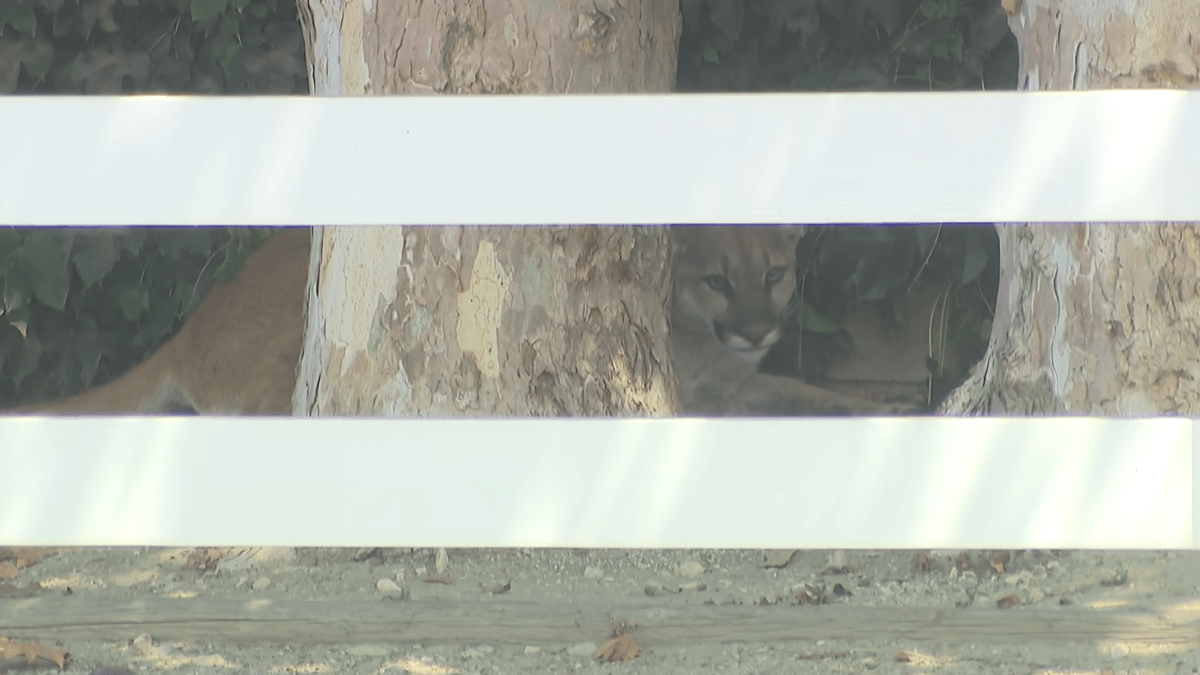
An injured mountain lion who was seen in a San Dimas neighborhood Thursday was tranquilized and transported to a veterinarian for examination.
The mountain lion showed up Friday morning in a residential neighborhood in the San Gabriel Valley community along Foothill Avenue between San Dimas Avenue and San Dimas Canyon Road. Authorities asked people to avoid the area.
“Please avoid the area this morning until the mountain lion has been safely relocated,” the Los Angeles County Sheriff’s Department posted on social media. “Residents in the area are encouraged to secure all pets and remove or secure any outdoor food that could attract wildlife to residential properties. Runners, pedestrians and residents are asked to remain vigilant.”
At about 10:30 a.m., the mountain lion appeared to be nestled in some brush alongside a road. By midday, a wildlife official tranquilized the big cat.
The mountain lion was loaded into a state Fish and Wildlife Department vehicle and transported out of the residential area. The agency said the female mountain lion showed signs of external injuries, but was being transported to a veterinarian for a more thorough examination.
“Although preliminary assessments have been inconclusive on the cause of the injuries, CDFW would like to remind the public that vehicles are one of the leading causes of wildlife mortalities in Los Angeles County. Drivers are highly encouraged to report incidents of vehicles striking wildlife in order for the department to provide a more expedient response,” CDFW said in a statement.
About mountain lions in California
There are about 4,000 to 6,000 mountain lions in California, but wildlife officials call that a crude estimate without an ongoing statewide study. More than half of the state is considered prime habitat for the big cats, which can be found wherever deer are present.
The California Department of Fish and Wildlife receives hundreds of mountain lion sighting reports each year. Few result in mountain lions being identified as posing an imminent threat to public safety, the department said. Mountain lion attacks on humans are extremely rare and their nature is to avoid humans.
Here’s a full list of recommendations from the California Department of Fish and Wildlife of what to do during a mountain lion encounter.
- Do not hike, bike, or jog alone. Stay alert on trails.
- Avoid hiking or jogging when mountain lions are most active – dawn, dusk, and at night.
- Keep a close watch on small children.
- Off leash dogs on trails are at increased risk of becoming prey for a mountain lion.
- Never approach a mountain lion. Give them an escape route.
- DO NOT RUN. Stay calm. Running may trigger chase, catch and kill response. Do not turn your back. Face the animal, make noise and try to look bigger by waving your arms, or opening your jacket if wearing one; throw rocks or other objects. Pick up small children.
- Do not crouch down or bend over. Squatting puts you in a vulnerable position of appearing much like a 4-legged prey animal.
- Be vocal; however, speak calmly and do not use high pitched tones or high pitch screams.
- Teach others how to behave during an encounter. Anyone who runs may initiate an attack.
- If a lion attacks, fight back. Research on mountain lion attacks suggests that many potential victims have fought back successfully with rocks, sticks, garden tools, even an ink pen or bare hands. Try to stay on your feet. If knocked down, try to protect head and neck.
- If a mountain lion attacks a person, immediately call 911.
- Report unusual mountain lion behavior to your local CDFW regional office.