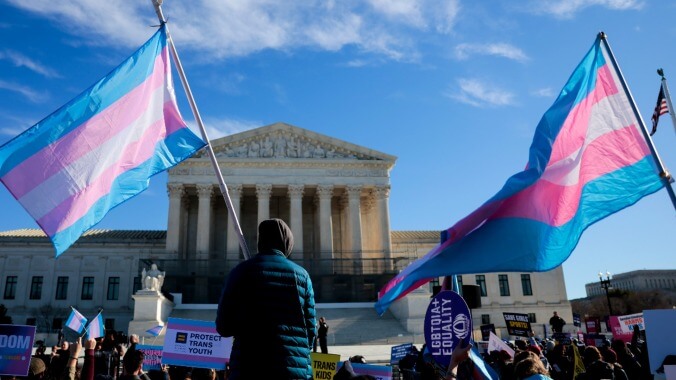
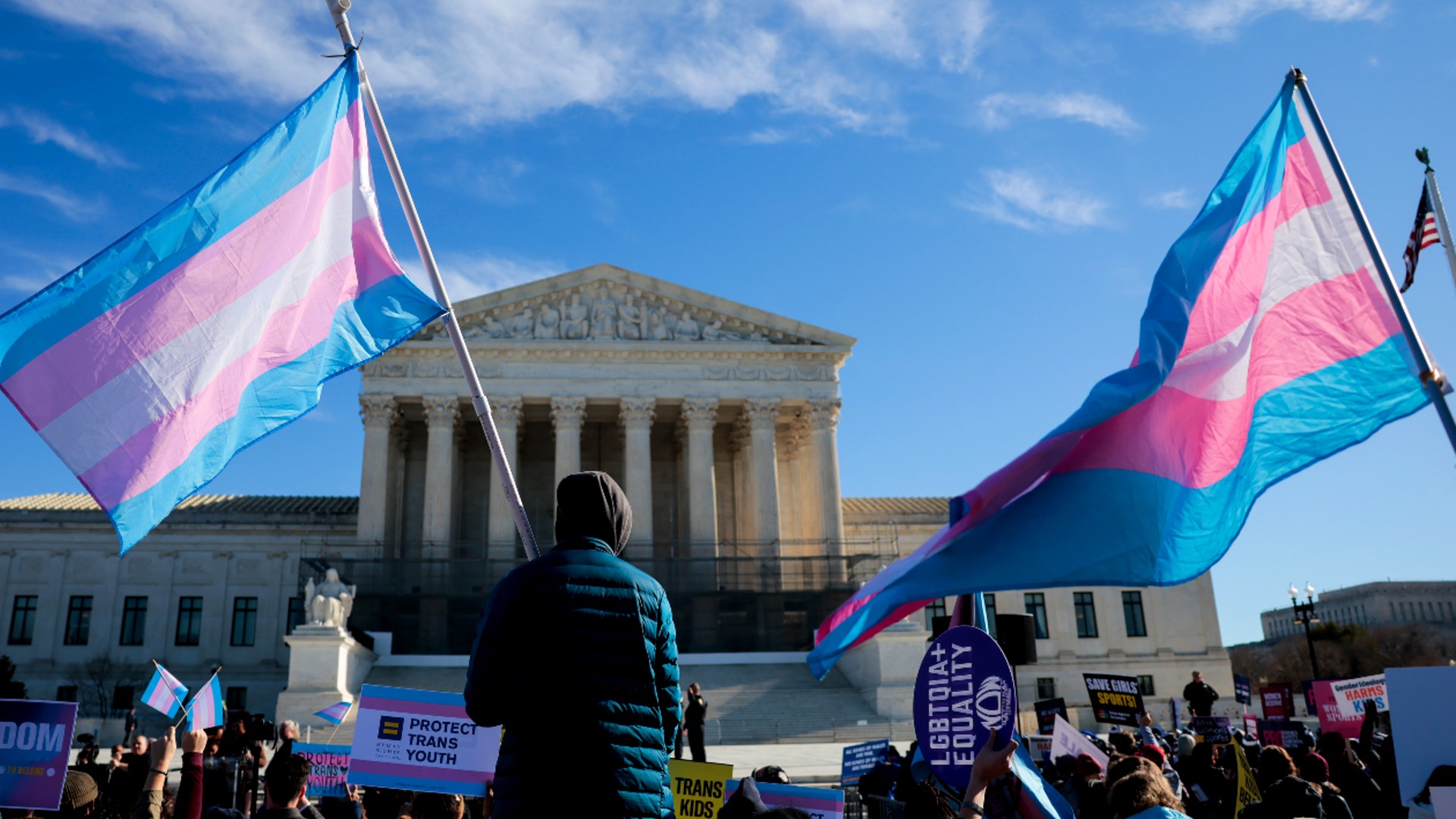
On Tuesday, the Supreme Court heard arguments in two cases where transgender girls challenged state prohibitions on their ability to participate in public school sports—from elementary to college.
Idaho and West Virginia have blanket bans against trans girls from playing on girls’ teams, even if they took puberty blockers and have testosterone levels in line with those of girls assigned female at birth. Both states claim the laws don’t discriminate on the basis of sex or gender identity, but are merely about preserving women’s equal opportunity in sports. They say trans girls are free to join the boys’ teams.
Things got very dumb during the arguments. Several conservative justices claimed they were worried that, if they ruled for the challengers, boys who aren’t talented enough make the boys’ teams would just try out for girls’ teams instead. One justice, who moonlights as a girls’ basketball coach, whined about being asked to set a national standard rather than just leaving this whole thing to the states to decide—as if it’s acceptable to have different human rights based on your ZIP code. Another conservative justice shockingly made some sense, but even if he did vote against the states, it wouldn’t be enough votes for a majority.
Here’s everything you need to know about the arguments, with a sprinkle of Bluesky posts from the inimitable Elie Mystal, justice correspondent for The Nation, who listened live, as I did.
Who is challenging the bans?
Lindsay Hecox is a college student challenging an Idaho law passed in 2020 that bans transgender women like her from playing on women’s teams. Her case is known as Little v. Hecox. In 2023, the 9th Circuit Court of Appeals said the ban was unconstitutional, and the state appealed the ruling to the Supreme Court. Hecox actually tried to drop her challenge in September 2025 after her father died and said she no longer intended to pursue college athletics. But the justices said in October that they would put off deciding her request until after the oral arguments.
The West Virginia law was passed in 2021 and was challenged by a then middle-school girl (who’s currently a high school sophomore), who goes in court documents by the initials BPJ, though she has since spoken to reporters and identified herself as Becky Pepper-Jackson. Her lawyers stated in their briefs to the court that Pepper-Jackson never went through male puberty and, thanks to hormone therapy, did experience female puberty; she argues the ban shouldn’t apply to student athletes like her. In 2024, the 4th Circuit Court of Appeals said the ban was unconstitutional, and the state appealed to the high court. Her case is known as West Virginia v. B.P.J., and the Supreme Court consolidated it with Hecox’s lawsuit in July 2025 when it agreed to hear the cases.
The Trump Department of Justice is unsurprisingly on the side of the states, saying their bans are totally fine.
What do the challengers say is illegal about the bans?
Hecox and Pepper-Jackson argue that the bans are illegal under both the U.S. Constitution, specifically the equal protection clause of the 14th Amendment, and Congressional statute, namely, Title IX of the Civil Rights Act, which guarantees sex equality in education.
Justice Ketanji Brown Jackson deftly explained to the lawyers for both states why trans sports bans are sex discrimination—as they’re banning an activity for some people based on their birth sex.
To the Idaho lawyer, Jackson said: “With respect to two individuals, a cis[gender] woman and a trans woman, who both want to play on a team that reflects their gender identity, this law operates differently based on their sex.” And as she said to West Virginia’s lawyer: “The law actually operates differently, I think, for cisgender women and transgender women. That is, with respect to their desire to play on a team that matches their gender identity, cisgender women can do it. Transgender women cannot.” Jackson is noting that it’s sex discrimination to allow cis women, but not trans women, to play women’s sports because of the trans people’s sex assigned at birth.
That’s it, that’s the whole case! But not on a 6-3 court…
This sounds similar to a 2020 trans rights case?
Yes. In 2020, the Trump-appointed Justice Neil Gorsuch wrote the majority opinion in a case about employers who fired workers after they came out as transgender. That case, Bostock v. Clayton County, said employment decisions based on gender identity are sex discrimination under the law—specifically, under Title VII of the Civil Rights Act. In plain language, if an employer fires a transgender woman because she is wearing a dress, but it wouldn’t fire a cisgender woman for doing so, that’s sex discrimination.
But, last term, Gorsuch was MIGHTY quiet during arguments for U.S. v. Skrmetti, another trans rights case about Tennessee’s ban on gender-affirming healthcare for minors. Even though that case focused on whether such bans violated the equal protection clause of the 14th Amendment, meaning it was a constitutional case, not a dispute over a statute passed by Congress, like Bostock was. (The court upheld the Tennessee ban in a 6-3 vote in June 2025.)
However, on Tuesday, Gorsuch seemed to be concerned that sports bans violate Title IX. Or he was at least worried about the implications of what else could happen in schools if the bans are upheld and states make arguments about inherent biological differences.
Gorsuch asked the Justice Department lawyer to respond to a hypothetical in which the Supreme Court rules against the student athletes and a state takes that ruling and says, “when it comes to high school performance, girls are sure a lot better than boys. And so we’re only going to have remedial classes for boys, and girls aren’t free to attend.” The lawyer, Hashim Moopan, claimed that states that tried to make such claims would be relying on “pseudoscience,” at which point Gorsuch practically exploded.
“I don’t think you’re a PhD in this stuff, and I know I’m not, but I’m asking you to deal with the hypothetical,” he said. “You’re worried about locker rooms, great. I appreciate that, but I’m worried about that math remedial class or the chess club.” Meaning, he’s worried that girls could be excluded from those things in the future.
Unfortunately, even if Gorsuch ends up siding with the athletes, he’d only be the fourth vote, and it takes five to win.
Gorsuch is interested, at least, in giving trans people suspect class status, but he's not gonna in this case and even if he was that would only bring the count up to 4 since Roberts is definitely NOT interested in that.
Who made the most stupid remark?
It’s a tight race! A bunch of people said very stupid things, but namely Justices Clarence Thomas, Amy Coney Barrett, and Brett Kavanaugh.
Thomas and Barrett kept trotting out a hypothetical of boys who are bad at sports trying out for women’s teams instead. American Civil Liberties Union attorney Joshua Block, who argued on behalf of Pepper-Jackson, said that Title IX allows single-sex teams in order to control for sex-based differences after puberty. “We don’t think the boys team is for better athletes, and you have a backup team for athletes that aren’t as good,” Block said. “The whole point is to allow female athletes to have all the same opportunities as men by controlling for the sex-based differential that comes through puberty.”
He then noted that, “by virtue of her medical care, BPJ is already effectively controlled for those sex-based advantages,” so she should be allowed to compete. Block also said that West Virginia’s ban prohibits trans girls from even participating in practices, which seems overly restrictive.
Christ: ACB back to the unathletic boy who wants to be on the girl's team. Block: To be clear, we don't think that there's a boys team for better athletes and a backup team. "They're not being separated for how good you are." Thank you, thank you, thank you.
Coach Kavanaugh got very upset about the possibility that Title IX would somehow be weakened if trans girls can compete as girls. He said that some states, the federal government, the NCAA, and the Olympic Committee “think that allowing transgender women and girls to participate will undermine or reverse that amazing success and will create unfairness.”
But as Justice Sonia Sotomayor later pointed out, the NCAA and Olympics only changed their regulations after Donald Trump returned to office in 2025 and issued an executive order attempting to ban trans girls from girls’ sports in schools and at the Olympic level. (The U.S. is hosting the 2028 Summer Olympics.)
The lawyer for Hecox, Kathleen Hartnett, agreed that the context was important. “We do think that’s worth parsing out again,” she said. “I do think a lot of those things flowed from the executive order. There were some other sports org[anization]s that were doing different things, but I think we have to be careful not to broad-brush that, because some of it may have been political, some of it may have been scientific, and the record really isn’t fully before the court.”
What indignant shit did Sam Alito blurt out?
Justice Samuel Alito, who is less concerned with “the law” than he is about protecting the feelings of conservative Christians, got quite worked up during an exchange with Hartnett.
She argued that a big issue with Idaho’s law is “the way it applies in practice is to exclude birth sex males categorically from women’s teams, and that there’s a subset of those birth sex males where it doesn’t make sense to do so according to the state’s own interest.” The interest being fairness, yet still banning trans girls who’ve undergone medical care to suppress testosterone.
Alito didn’t like that one bit. “There are an awful lot of female athletes who are strongly opposed to participation by trans athletes in competitions with them. What do you say about them—are they bigots? Are they deluded in thinking that they are subjected to unfair competition?” he snapped about two minutes later. Hartnett calmly responded that she would never call someone that who had these questions. Instead, her job is to determine the intent of the law and whether it can pass muster legally.
Alito was not satisfied. He asked, “Do you think that the success of trans athletes in women’s sports is proportional to the percentage of trans athletes who participate in women’s sports?” Hartnett replied that, while there are examples of trans women who have excelled in athletics, that her own client failed to make an NCAA team when the law was blocked because “she was too slow.” Hecox joined club teams for soccer and running instead.
Did anyone say anything scary?
Yes. A chilling moment came after Kavanaugh asked Idaho’s lawyer how many states allow trans girls to play girls’ sports. Alan Hurst said he believed that 23 states do, while 27 have bans. Justice Kegstand followed up to ask whether Idaho believed that, gulp, those 23 states were constitutionally required to ban trans girls.
“Is your position that they are violating the Constitution’s equal protection rights of biological girls and women by allowing that? Or do you say that’s up to each state to decide, and that the Constitution gives discretion to the state whether to allow it or not to allow it?,” Kavanaugh asked. Hurst responded that he didn’t believe the he 14th Amendment’s equal protection clause meant other states had to pass these bans, but with a big caveat, saying only that he had “not yet been persuaded by a constitutional theory” that would allow it.
Kavanaugh later asked the Justice Department’s lawyer, Moopan, about the equal protection clause, plus how Title IX applies to those states. Moopan said he wasn’t sure if DOJ had taken a position on the equal protection argument, but said it’s the government’s view that states without bans are violating Title IX. “We are actively litigating in lower courts, and we are saying that they are violating Title IX,” he said.
Hashim Moopan of DOJ told Kavanaugh in response to this question that the Trump administration is *currently* arguing in lower courts that the 23 states that allow trans girls to join girls' sports teams are violating Title IX. So, yikes
— Susan Rinkunas (@susanrinkunas.com) 2026-01-13T16:30:42.787Z
Kavanaugh also asked West Virginia’s lawyer, Michael Williams, if the states without bans are violating Title IX, so yeah, expect to hear that line of thinking again.
When will the court release a decision?
The justices typically release blockbuster cases at the end of their term, in late June or early July. And a reminder that we’re also waiting for a decision in a case challenging bans on harmful so-called “conversion therapy.”
Like what you just read? You’ve got great taste. Subscribe to Jezebel, and for $5 a month or $50 a year, you’ll get access to a bunch of subscriber benefits, including getting to read the next article (and all the ones after that) ad-free. Plus, you’ll be supporting independent journalism—which, can you even imagine not supporting independent journalism in times like these? Yikes.