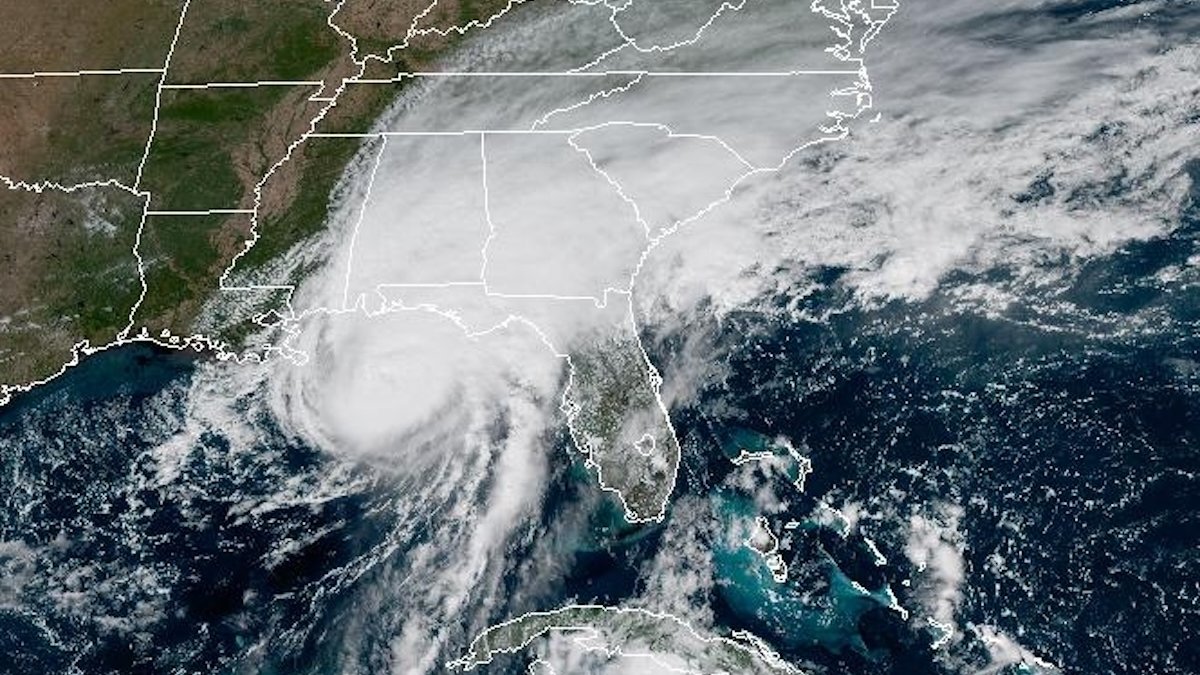
Isaias strengthened Friday into a major hurricane as it headed toward the U.S. Gulf Coast, where final preparations were being made for potentially life-threatening storm surges and high winds.
The hurricane is forecast to make landfall late Friday somewhere along the Alabama-Florida line and create dangerous conditions in the Florida Panhandle, southern Alabama and southern Mississippi, the National Hurricane Center said.
The Category 3 storm was packing 120 mph (193 kph) winds, and was expected to continue strengthening. Category 3 storms, considered major hurricanes, are capable of causing devastating damage, the center said.
Rain began falling along the coast Friday morning, and tropical storm conditions were expected to begin early in the afternoon.
Isaias was expected to weaken quickly as it hits shore and be downgraded to a tropical storm by Saturday afternoon as it moves north and inland along the Alabama-Mississippi line, the center said.
“Preparations should be rushed to completion as the weather will go downhill quickly today,” the hurricane center said in an early morning forecast. “While the storm is not expected to make landfall at peak intensity, it is likely that Isaias will still be a significant hurricane when it reaches the coast.”
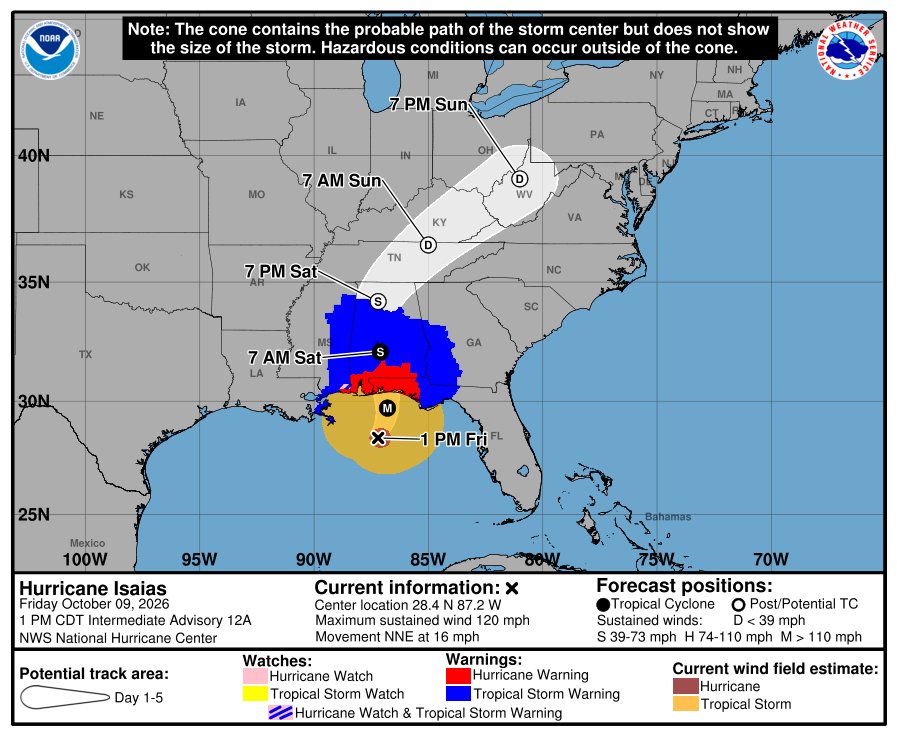
Isaias, the first hurricane of the Atlantic season, was centered about 145 miles south of Pensacola, Florida, and 125 miles southeast of the mouth of the Mississippi River. It’s moving north-northeast at about 16 mph, the center said.
It was expected to make landfall between Mobile Bay on the Alabama coast and Choctawhatchee Bay in the Florida Panhandle in the evening.
Besides wind and storm surges, the hurricane will likely bring flash flooding and spawn tornadoes, the hurricane center said.
A hurricane warning was in place from Ocean Springs, Mississippi, to the western Florida Panhandle. Tropical storm warnings were issued from southeastern Louisiana to Aucilla River along Florida’s Big Bend.
Preparations underway
Coastal communities moved quickly to prepare Thursday, as Alabama Gov. Kay Ivey ordered non-residents to immediately evacuate Gulf Shores, Orange Beach and Dauphin Island. Videos on social media showed traffic at a standstill on a highway leading out of Gulf Shores, where double-red beach flags signaled water access was closed.
Residents boarded up windows and stacked sandbags while thousands of National Guard soldiers were deployed.
Isaias is expected to bring a storm surge as high as 5 to 7 feet (1.5 to 2 meters), with the deepest water hitting immediate coastal areas, along with large and dangerous waves, the hurricane center said.
At least four Florida school districts canceled late-week classes, while several counties announced mandatory evacuations for some coastal areas. The governors of Florida and Alabama declared states of emergency for dozens of counties, with Florida’s Ron DeSantis saying about 5,000 National Guard troops were expected to mobilize by Friday.
On Dauphin Island, a 15-mile (24-kilometer) barrier island off the Alabama coast, officials encouraged voluntary evacuations, particularly on its popular western section, which is vulnerable to storm surge.
Mayor Jeff Collier said he did not anticipate substantial damage, “but at the same time, these things are very fickle and a little jog here or there, or some last-minute increase in strength — we just have to be prepared for the worst.”
Water from the storm surge and high tide could reach heights of 5 to 7 feet (1.5 to 2 meters) in parts of Alabama and Florida, forecasters said. Isaias also could dump up to 15 inches (38 centimeters) of rain on coastal areas and spawn tornadoes overnight Friday into Saturday from Alabama to the Florida Panhandle and southwestern Georgia. The hurricane is expected to quickly weaken after coming ashore.
The National Weather Service warned of possible “long-duration power outages.”
Storm’s impact on oil production, flights and football
Ahead of the storm, oil and gas producers shut down a significant share of offshore production in the Gulf, which accounts for almost 15% of crude pumped annually in the U.S.
As of Thursday, about 63% of the oil production in the region had been temporarily halted, taking nearly 1.3 million barrels a day off the market, according to the Marine Minerals Administration. It said 121 of the Gulf’s 371 manned oil platforms had been evacuated.
With oil prices already high, the production cuts are steep enough to affect markets, though other Gulf hurricanes have caused larger disruptions, said Jim Burkhard, global head of crude oil market research for S&P Global Energy. More concerning, he said, is whether Isaias strikes as a powerful storm near refineries.
As it moves inland, Isaias might also disrupt Saturday’s college football showdown between rivals Georgia and Alabama, a game President Donald Trump planned to attend.
Isaias is also disrupting travel across several Gulf airports. Destin-Fort Walton Beach Airport in Florida shut down Thursday and canceled all flights to and from the airport Friday. Pensacola International Airport also closed Friday morning, cancelling the remainder the day’s flights. Northwest Florida Beaches International and Mobile Regional Airport in Alabama have also cancelled more than 60% of their flights Friday, according to the flight tracking site FlightAware.com.
The hurricane formed late in the season
Isaias developed more than four months into the Atlantic hurricane season and was one day short of tying a 121-year-old record for the area’s latest-forming hurricane. That record dates to 1905, when the year’s first Atlantic hurricane formed on Oct. 8.
The Atlantic hurricane season has been unusually quiet this year because of a strong El Niño, which disrupts storm formation over the Atlantic. Storm activity has been above average in the Pacific, where Hurricane Simon formed. Farther north, Tropical Storm Rachel was expected to reach Baja California, Mexico, and Southern California this weekend.
Isaias is expected to strike a swath of coastline that’s familiar with major hurricanes.
One of the 20th century’s worst storms, Hurricane Camille, killed more than 250 people after hitting land near Waveland, Mississippi, in 1969. Hurricane Katrina in 2005 razed neighborhoods in Mississippi, flooded New Orleans and killed nearly 1,400 people. And Hurricane Michael leveled homes and buildings near Panama City, Florida, in 2018.
Rico reported from Atlanta and Collins reported from Hartford, Connecticut. Also contributing were Associated Press reporters Kim Chandler in Montgomery, Alabama; Hallie Golden in Seattle; Kathy McCormack in Concord, New Hampshire; John Raby in Charleston, West Virginia; Laura Turbay in Little Rock, Arkansas; and Julie Walker in New York.