Wherever star-formation happens, a classic cosmic story unfolds.
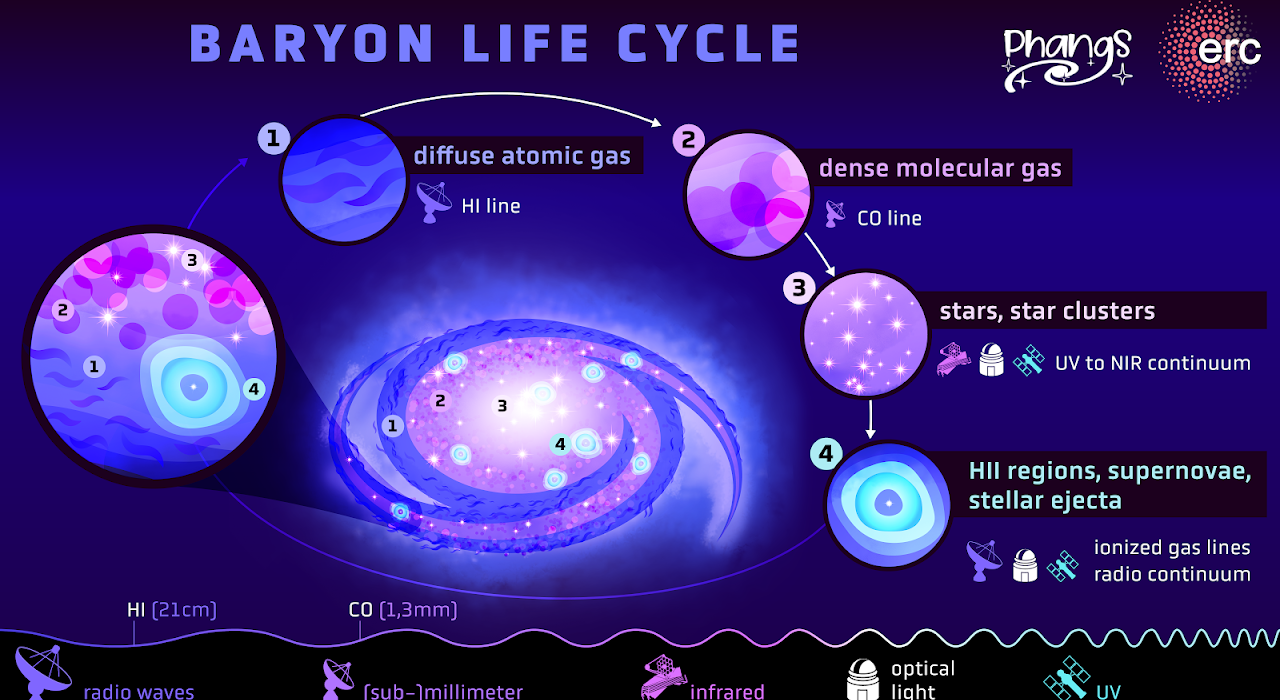
A spiral galaxy typically consists of four main gaseous regions within the disk: diffuse atomic gas, dense molecular gas, stars and star clusters, and ionized regions of matter arising from energy injections from star-forming regions, young stars, and stellar cataclysms. JWST, along with the other PHANGS data sources, helps reveal different aspects of this life cycle, but once a galaxy’s gas is gone and no new gas reservoirs fall inside, star-formation ends permanently.
Initially, a massive cloud of gas contracts under its own gravity.
This amateur astronomy image of dark nebula LDN 1551 showcases the cloud of ionized gas within it: Sharpless 239. Many protostars, surrounded by dusty disks, are located inside, along with numerous Herbig-Haro objects, as the gas cloud has regions within it that have already internally fragmented and heated up, forming protostars and even early full-fledged stars in the process.
Internal gas molecules radiate heat away, enabling further shrinking.
Within the plane of the Milky Way, dark dust lanes are omnipresent, representing dense neutral gas clouds usually found within the galaxy’s spiral arms. Here, nebula NGC 6357, also known as the Lobster Nebula, shows the pink signatures of excited hydrogen, a telltale feature of new star formation, along with the blue glow of the reflected light from hot, newborn stars off of neutral matter. Although it may not be obvious to the untrained eye, these dark clouds of material hide obscured regions of new star-formation within them as the molecular gas inside radiates heat away.
The densest areas fragment first, diminishing further in size.
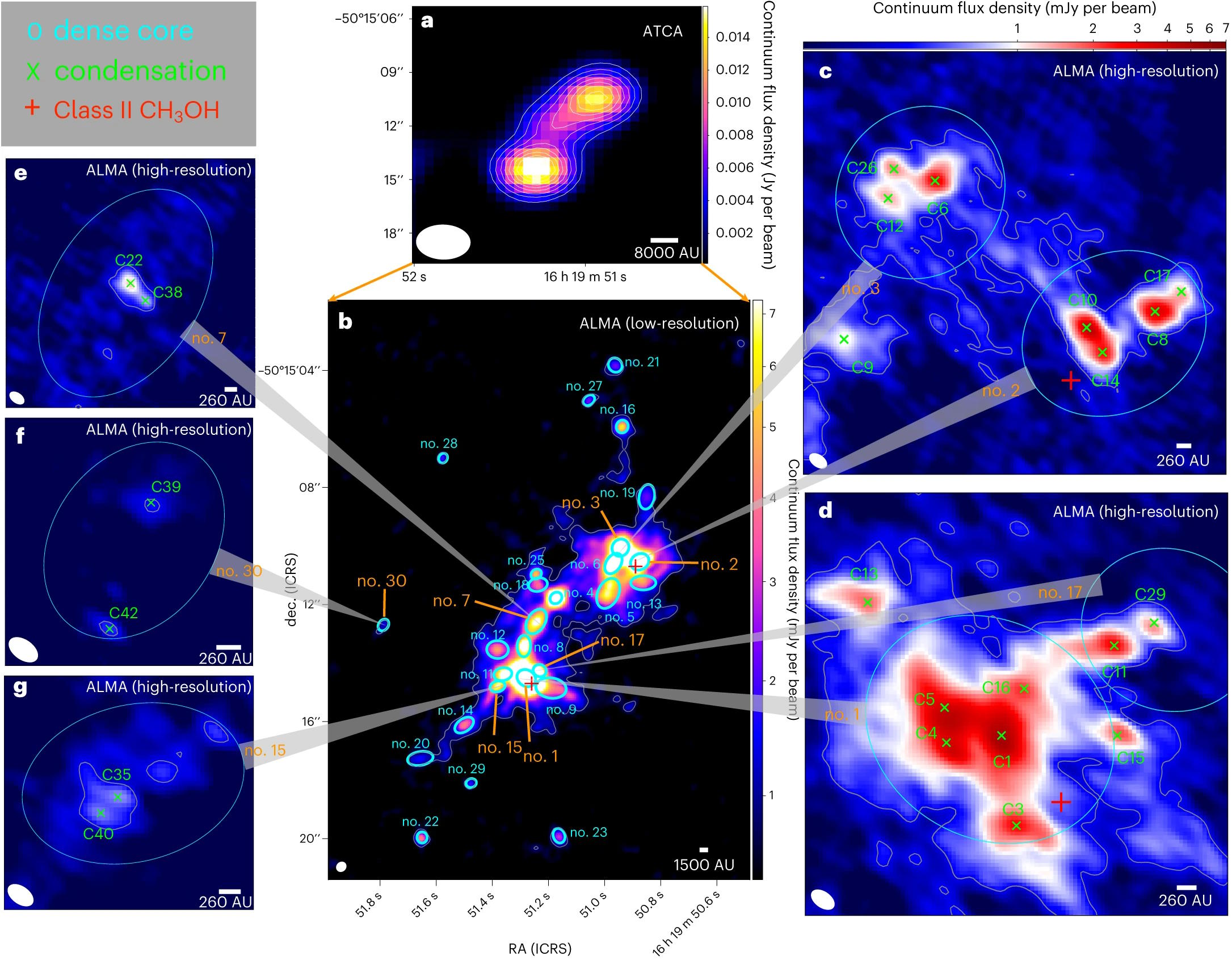
The dense cores of protostar cluster G333.23–0.06, as identified by ALMA, show strong evidence for large levels of multiplicity within these cores. Binary cores are common, and groups of multiple binaries, forming quaternary systems, are also quite common. Triplet and quintuplet systems are also found inside, while, for these high-mass clumps, singlet stars turn out to be quite rare. It is expected that the stars forming in nebulae all throughout the Universe, including in the Eagle Nebula, have similar clumpy, fragmented properties.
This animation that fades between the 1995 Hubble view, the 2014 Hubble view, and the 2022 JWST view shows off the different views of stars, dust, knotted gas loops and outflows, and the presence of protostars. The variety of features at the top of this pillar, the 2nd one in the Pillars of Creation, is particularly notable.
(Credits: NASA, ESA, CSA, STScI; the Hubble Heritage Team; J. Hester and P. Scowen; animation by E. Siegel)
As protostellar growth continues, gravitational potential energy converts into heat.
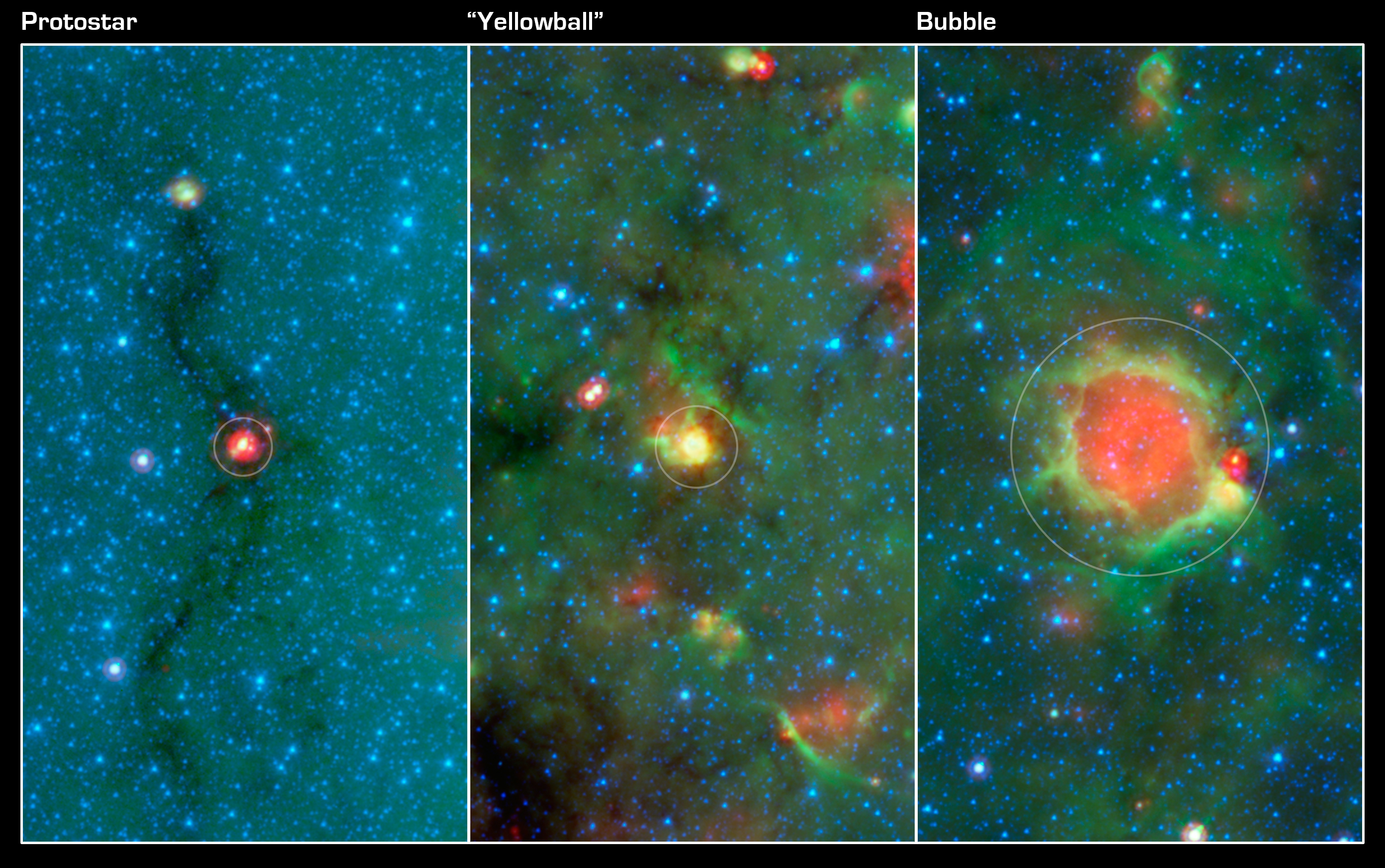
Three separate regions illustrate various stages of a newly forming star’s life, which are totally obscured in the optical and can only be seen in the infrared. At left, a protostar emits radiation that’s shrouded in light-blocking dust. In the center, a ‘yellowball’ occurs after the start of nuclear fusion, but still cannot be seen in the optical due to all the surrounding matter. At right, a more evolved star, with significant fusion output, has begun to blow an ionized bubble in the surrounding region. For high-mass stars, we now know that forming a singlet system, as opposed to a multi-star system, is a relative rarity.
Located roughly 58,000 light-years from the galactic center, Digel cloud 2s, highlighted here, is found in the extreme outer galaxy of the Milky Way. The main cluster, glittering brilliantly, exhibits at least five independent protostellar jets, as highlighted by the white arrows.
Credit: NASA, ESA, CSA, STScI, M. Ressler (NASA-JPL)
Gliese 229 is a red dwarf star, and is orbited by Gliese 229b, a brown dwarf, that underwent deuterium fusion only, never progressing to fusing protons with other protons. Although Gliese 229b is about 20 times the mass of Jupiter, it’s only about 47% of Jupiter’s radius: smaller despite being more massive.
Credit: S. Kulkarni (Caltech), D. Golimowski (JHU) and NASA/ESA
Below 0.075 solar masses, few additional fusion reactions occur: yielding brown dwarfs.
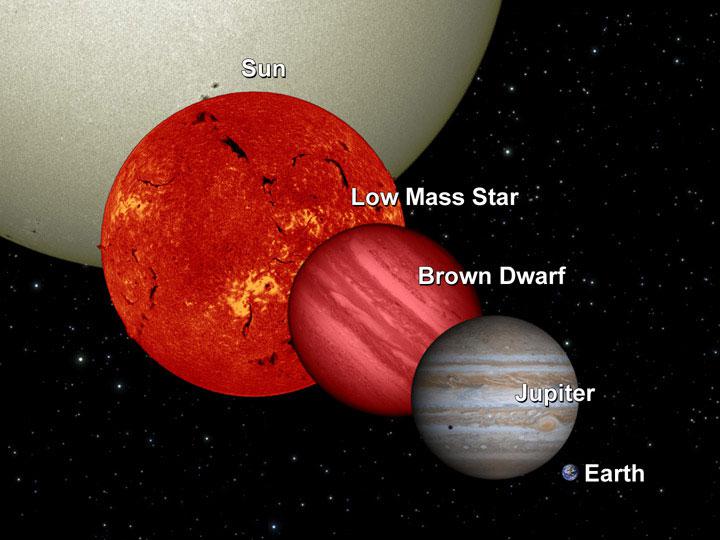
Brown dwarfs, between about 0.013-0.080 solar masses, will fuse protons+deuterons or deuterons+deuterons into helium-3 or tritium, remaining at the same approximate size as Jupiter but achieving much greater masses. Red dwarfs are only slightly larger but do initiate proton-proton fusion, but even the Sun-like star shown here is not shown to scale here; it would have about 7 times the diameter of a low-mass star. Stars can be up to nearly 2000 times the diameter of our Sun within this Universe.
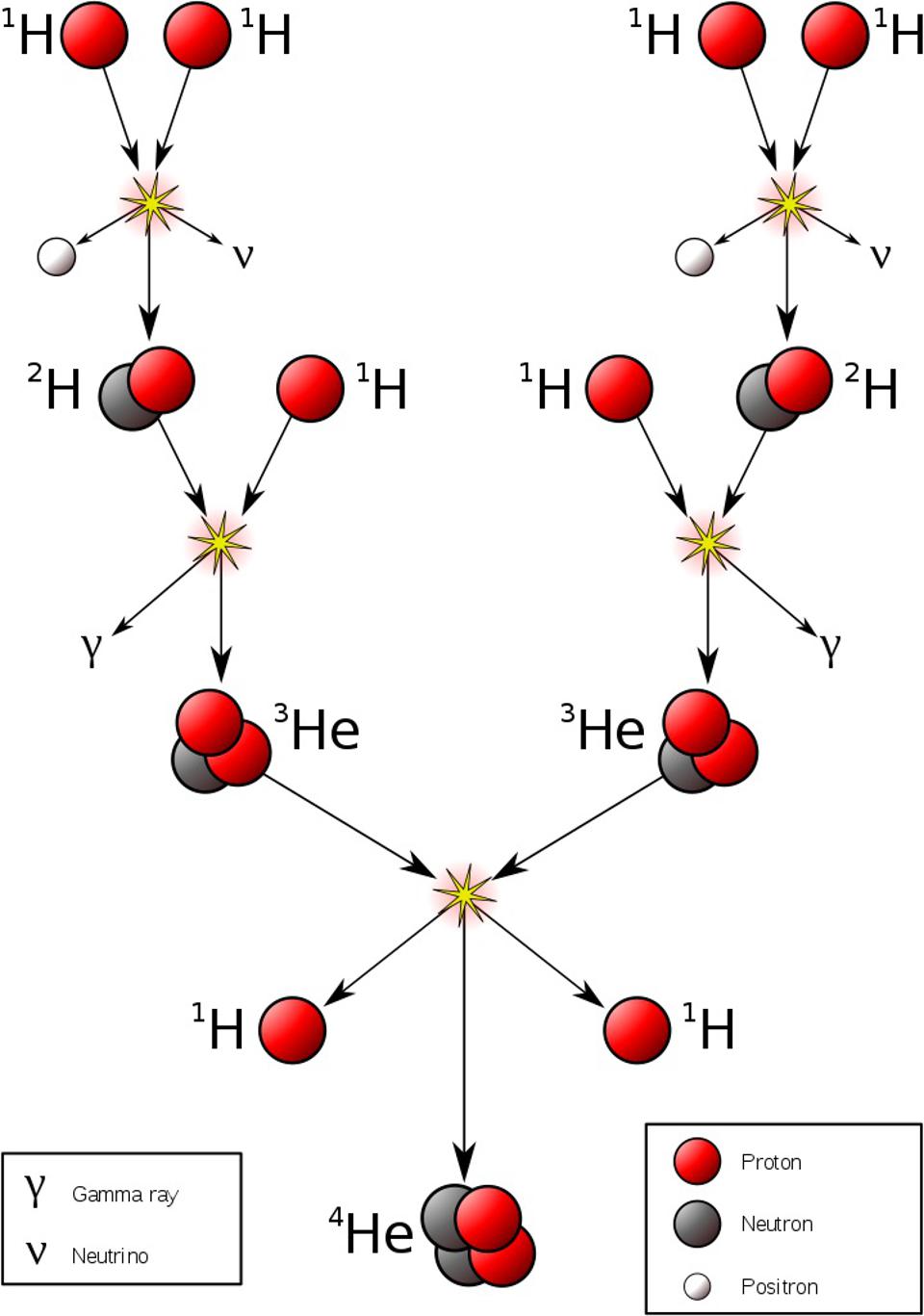
The most straightforward and lowest-energy version of the proton-proton chain, which produces helium-4 from initial hydrogen fuel. Note that only the fusion of deuterium and a proton produces helium from hydrogen; all other reactions either produce hydrogen or make helium from other isotopes of helium. This reaction set occurs in the interiors of all young, hydrogen-rich stars, regardless of mass.
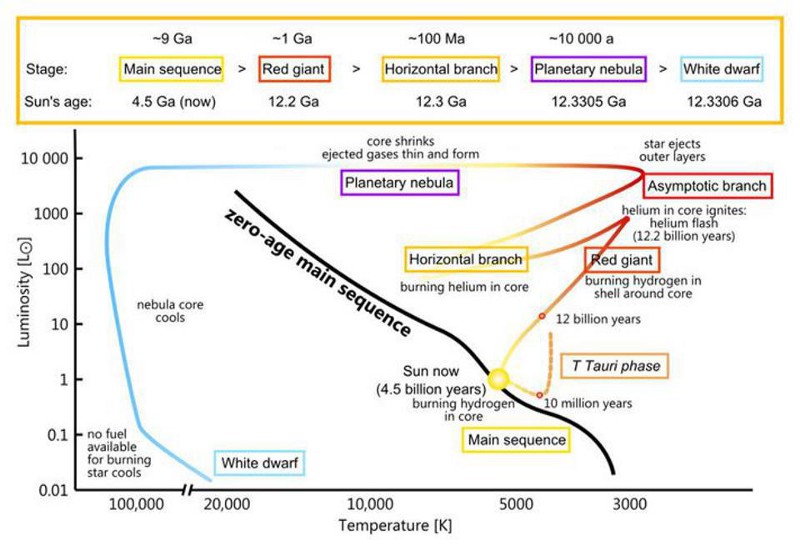
The evolution of a solar-mass star on the Hertzsprung-Russell (color-magnitude) diagram from its pre-main-sequence (protostellar) phase to the end of fusion and its eventual transformation into a white dwarf. Every star of every mass will follow a different curve, but the Sun is only a star once it reaches the main sequence, and ceases to be a star once helium burning (in both the core and in all shells) is completed. Stars on the upper-left of the diagram (on the main sequence) are more massive, hotter, and more luminous than our Sun, but are also the shortest-lived.
However, initiating hydrogen burning alone doesn’t signify stellar “birth.”
From a contracting clump within a cloud of gas, protostars form as gravitational potential energy gets converted into thermal (heat) energy. Initially, protostars are cooler but more luminous than the stars that they will give rise to, and contract and heat up (but become smaller, with less surface area to radiate energy through) as they evolve. When they reach the curve entitled “zero age main sequence,” that corresponds to the official “birth” of the star, with the pathways of stars of different masses (relative to 1 solar mass) indicated at various points along the curve.
For “star birth,” the rate of fusion must balance the star’s luminosity: its total power output.
This illustration shows a size and color comparison of four different main sequence stars: the red dwarf Proxima Centauri (with no CNO reactions inside), the Sun (where only 1% of its fusion energy comes from the CNO cycle), Sirius A (where the CNO cycle outputs more energy than the proton-proton chain), and blue giant Spica (where the proton-proton chain’s energy is negligible compared to the CNO cycle).
This illustration of the lowest-energy component of the CNO cycle, which is the most common mechanism by which it occurs in the Sun, details how hydrogen fuses into helium as a result of chain reactions involving carbon, nitrogen, and oxygen. In stars with more than 130% the mass of the Sun, this, rather than the proton-proton chain, dominates as far as nuclear fusion is concerned.
Such massive stars contract most quickly: a 20 solar mass star is “born” after ~30,000 years.
Stars of lower masses don’t merely live longer by spending more time burning through their fuel at lower rates on the main sequence, but take longer to initially form. Whereas a star born with roughly 20 times the Sun’s mass will leave the protostellar phase after only tens of thousands of years, a star born with a mass similar to the Sun’s will take tens of millions of years before it evolves from the protostellar phase to the main sequence.
Sun-like stars require more time: ~50 million years.
This color-magnitude (or Hertzsprung-Russell) diagram shows a “snapshot” of color vs. magnitude of a wide variety of stars. When stars, which begin as larger, cooler protostars, gravitationally contract and heat up so that they finally emit enough energy through nuclear fusion in their cores to equal the star’s total energy output, they begin life at the bottom of the main sequence (vertically) for whatever their color is. This event marks the “birth” of the star, not the ignition of fusion for the first time, which occurs long before: when temperatures merely reach approximately 1 million K in the protostar’s core. Over a star’s hydrogen-burning lifetime, it migrates upward, becoming brighter but remaining at approximately the same color/temperature, before running out of hydrogen in their cores and evolving first into subgiants, and then into red giants or supergiants, where they then head into the final stages of their lives and approach their stellar demises.
Only after reaching ZAMS — the zero-age main sequence — are new stars officially “born.”
This close-up view of the central portion of the protoplanetary system IRAS 04302+2247 showcases the motion of gaseous material away from the central protostar, while accreting material from within the disk is particularly dust-rich, obscuring even JWST’s views of the central protostar. Even though nuclear fusion is occurring inside, the fact that some significant percentage of the central object’s energy still comes from gravitational contraction keeps it on the “protostar” side of the dividing line between a protostar and a full-fledged star.
Energy balance and growth cessation, not ignition, dictates stellar birth.
This extremely young star cluster began forming stars only within the last 3 million years, making it one of the youngest star clusters known in existence. The orange color, to JWST’s eyes, represents gas that glows with heat in the infrared, powered by outflows from young, massive Herbig-Haro objects. The most massive objects within this nebula have already become stars; the least massive ones are still in the protostellar phase, and may remain there for millions or even tens of millions of years to come.
Credit: ESA/Webb, NASA & CSA, A. Scholz, K. Muzic, A. Langeveld, R. Jayawardhana
Mostly Mute Monday tells an astronomical story in images, visuals, and no more than 200 words.
Ancient DNA just proved that ‘pure genetics’ don’t exist
Harvard geneticist David Reich has spent years extracting DNA from ancient human remains. What the data shows keeps defying every assumption scientists had built. Every population ever studied is profoundly mixed. Britain alone has been…
The most important question to ask yourself about your life’s purpose
Mark Manson argues that modern life has confused comfort and stimulation for genuine fulfillment, and that the ancient Greek distinction between hedonia and eudaimonia might be the most important psychological concept nobody talks about…
The challenge of celebrating Artemis II as NASA cuts loom
Here in 2026, something remarkable has happened: humanity, for the first time since the Apollo era, has returned to the Moon. Despite all of our technological, computational, materials science, rocketry, and manufacturing advances that had…
The particles in the early Universe painted a different picture
Today’s Standard Model describes our Universe’s particles and forces. Although there are many similarities and differences within the Standard Model: between quarks and leptons, between fermions and bosons, between particles…
Ask Ethan: What’s the biggest misconception in astronomy?
Anytime you try and learn something beyond your current understanding, it isn’t as simple as pouring “new knowledge” into an otherwise empty vessel. We come into any new endeavor with a pre-existing foundation: things…
How to recognize when you’re reacting from childhood wounds
Dr. Nicole LePera, the holistic psychologist and NYT bestselling author behind Reparenting the Inner Child, breaks down the 6 archetypes of childhood trauma. LePera explains why insight alone never produces lasting change and walks through…
It’s often said that history is written by the winners. But when you look back on the ancient world, it’s more accurate to say that history is written by historians. Although China has a strong claim, many tend to cite ancient Greece as…
Elon Musk, SpaceX, and the rise of “sovereignty as a service”
“What can be very frustrating is that regulation is often irrational,” Musk told an audience at Stanford in 2003. “It doesn’t make any sense.” He arrived at the following solution: He would be the one to decide what made sense. And he…