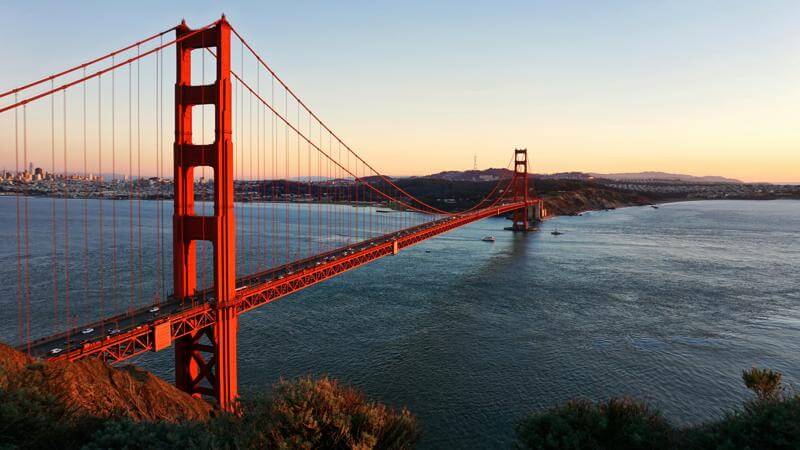
No one truly knows how many people, whether they’re American citizens or global travelers, have met their end by jumping from San Francisco’s Golden Gate Bridge. An official count was once kept of deaths occurring at the iconic Bay Area landmark, which connects the city to the Northern California hills south of Sausalito, but that official count ended just before the 1,000th death by suicide in 1995, in recognition that the publicizing of such statistics by the media might only increase the notoriety and attractiveness of the site as a place for more suicides. The confirmed count since the bridge opened in 1937 is frequently said to be more than 2,000, though a true number will never be known: Not when it’s a certainty that many deaths over the decades have surely gone unwitnessed and unrecorded. For decades, the average yearly count sat around 33 yearly fatalities. It’s beyond notable, then, to be able to say the following: In the final seven months of 2025, there were zero known suicide deaths at Golden Gate Bridge. It’s almost certainly the longest period without a death in the structure’s 88 years in operation, and it’s the result of a concerted effort at suicide prevention that should stand out as a model for activists and governments worldwide.
For as long as the bridge has stood, people had always jumped from it. It was only 10 weeks after its official opening that the first case was recorded, a 47-year-old World War I veteran named Harold Wobber who was a victim of post-traumatic stress disorder. Many more followed, and a certain mystique about the bridge as a suicide destination began to grow in a macabre corner of the public consciousness. On some level, the notoriety was earned in how deadly a jump from the bridge proved to be: At 245 feet above the Bay, a person falling has time to accelerate to about 75 mph by the time they hit the water, causing immediate death on impact in most cases, or immediate drowning. Nevertheless, some small portion of jumpers–about 2%, roughly–have survived the plunge, almost universally saying that the first thought they had after leaping from the edge was one of regret, or a desire to live. In the most well-known cases of survivors, such as Kevin Hines or Ken Baldwin, they went on to dedicate their lives to helping others struggling with depression and suicidal ideation.
In 2000, Kevin Hines survived a Golden Gate Bridge jump thanks to a sea lion. He now speaks globally on suicide prevention, using his story to raise awareness about mental health.
— Digital Brain (@yourdigitalbrain.bsky.social) Nov 30, 2025 at 9:00 AM
For decades, however, city officials and members of the public actively resisted calls to physically alter the bridge in an effort to prevent or at least cut down on suicides, even as the national suicide rate rose. Arguments were made citing the potential damage to aesthetics of the beloved landmark, or the cost of proposed projects, or questioning the ultimate effectiveness of suicide deterrents such as nets. And while people argued and debated, the numbers of deaths only climbed. In 2014, the year that an ambitious netting project under the bridge was finally approved, 46 people died. In 2025, that total number was down to only 4, including the aforementioned zero in the final seven months. The results are conclusive, and as good as that news is, it comes with a simultaneous indictment of past inaction: This is something that could have been done much, much sooner, resulting in more lives saved. It was simply too easy to jump.
With that said, it’s almost a wonder the project got completed at all, given all the legal red tape and construction delays it endured. Despite approval in 2014, construction of the netting project didn’t begin until 2018, with costs ballooning from a projected $76 million to $224 million along the way, funds that came from a variety of sources: The Metropolitan Transportation Commission, California Department of Transportation, Golden Gate Bridge District (from bridge tolls), California State mental health funds, and in small part from public donations. It was finally completed in 2024, taking longer to construct than the bridge itself had in the 1930s, but the effect was immediate: The eight completed suicides on the bridge that year, as the netting was completed and tweaked, were roughly 24% of the typical yearly figure. Last year brought even fewer.
We should clarify that when we’re talking about “nets” on the Golden Gate Bridge, the project in question isn’t some kind of circus netting or network of ropes. The suicide deterrent net is made from 3.5 miles of hard, unyielding, marine-grade stainless steel, installed 20 feet below the pedestrian catwalks and extending 20 feet over the water. They’re designed to hurt, and potentially to injure, but to be less than lethal. Why not something kinder and gentler? Well, it’s because even to those who are seeking death, the threat of pain can be a surprisingly effective deterrent. The Golden Gate Bridge system was modeled after similar steel netting installed at Bern, Switzerland’s Münsterplattform terrace, which had its own issues as a suicide destination. After the netting was installed in 1998, jumps from the terrace effectively stopped, as the surety of death had been replaced by the threat of pain.
“It would hurt to fall seven meters onto steel netting,” said Denis Mulligan, CEO of the Golden Gate Bridge, Highway and Transportation District at the time. “People who are tired of life want to kill themselves, but not injure themselves.”
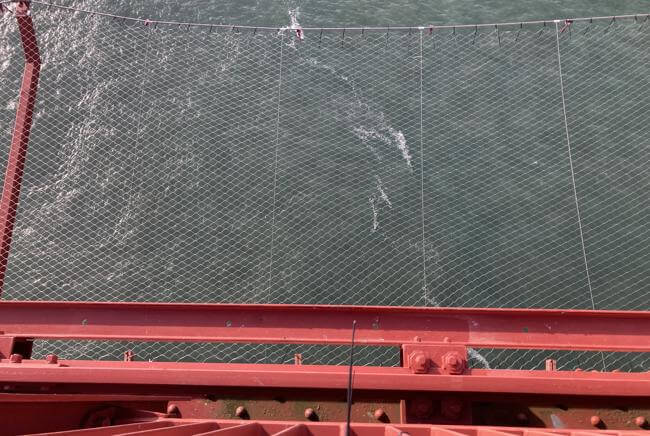
A view of the bridge’s steel netting, looking down as a pedestrian.
The net is thus designed to both shock the people who jump into it into reconsidering their plan, allowing for rescue, and perhaps more importantly to dissuade jumpers from committing to their plan in the first place. Over time, as awareness of the netting has increased, this has resulted in fewer people coming to the bridge to contemplate a jump in the first place. Prior to the netting’s completion, the bridge’s electronic surveillance team and security personnel who are tasked with identifying and stopping jumpers would typically intervene in 200 or more cases per year. In 2025, that number was down to 94–showing considerable progress, but also illustrating that many potential jumpers likely aren’t yet aware of the relatively new netting system until they arrive. Bridge personnel like Mulligan prefer not to publicize some of the other data, such as how many have jumped into the netting and been rescued, or how many have circumvented the netting and committed to their deaths.
The cynical response, of course, is the assumption by critics of the netting project that the suicide prevention system was both expensive and pointless; that those who were turned away at the bridge via intervention or the netting itself would simply find a different method by which to complete the act. The data, however, doesn’t seem to bear this out: A 1978 study at the University of California, Berkeley, tracked 515 people who had gone to the Golden Gate Bridge between 1937-1971 intending to jump but were talked out of it or physically stopped by bridge employees, police or passerby. Of the people in that study, 94% were found to be still alive, or had died of natural causes. Very few had gone on to complete suicide by some other means, evidence of what the study’s author, Richard Seiden, described as the “crisis-oriented and acute” nature of suicide: Just because you consider attempting once, doesn’t mean you ever will again.
The almost mystical call of the bridge itself as a symbol (romanticized in some circles) of suicide also cannot be discounted. For decades, only a four foot railing stood between the pedestrian and the void, lowering the barrier of commitment necessary to complete the act and fueling impulsive decisions. Suicide prevention activists are hopeful that as the number of attempts has sharply decreased, word will essentially spread–including to out-of-town or international travelers who have journeyed to the destination and idealized the act–that resources are available, and that they shouldn’t make the attempt.
“The bridge has exerted a siren’s call for so long for some suicidal people that it might be hard for them to believe that it’s no longer the case,” John Bateson, author of The Final Leap: Suicide on the Golden Gate Bridge, to the New York Times. “The more people who know that the barrier is in place will be discouraged for even thinking about the Golden Gate Bridge as a suicide destination.”
There is ultimately no method of completely preventing the possibility of suicide at a site as huge and complex as the Golden Gate Bridge. If someone jumps into the netting, it is certainly possible that they’re able to gather themself up and jump again, although the fact that some have already been rescued from it speaks to the ability of those experiencing suicidal ideation to change their minds if given the opportunity. Still, there will always be the few who are utterly determined to complete the act. As if to drive this point home, the bridge’s seven month streak from the close of 2025 was recently shattered: A single person reportedly completed suicide on the bridge in the first weeks of 2026, through a means that won’t be publicized for obvious reasons.
With that said, this one person’s decision could never invalidate all the lives that have been saved, which are the direct result of activists and everyday residents of San Francisco and the state of California finally deciding to take every available action to help those in the state who are facing despair. For decades, suicide on the bridge was treated as something that no one could truly affect or change. Now we know better. And it all starts with the commitment to try.