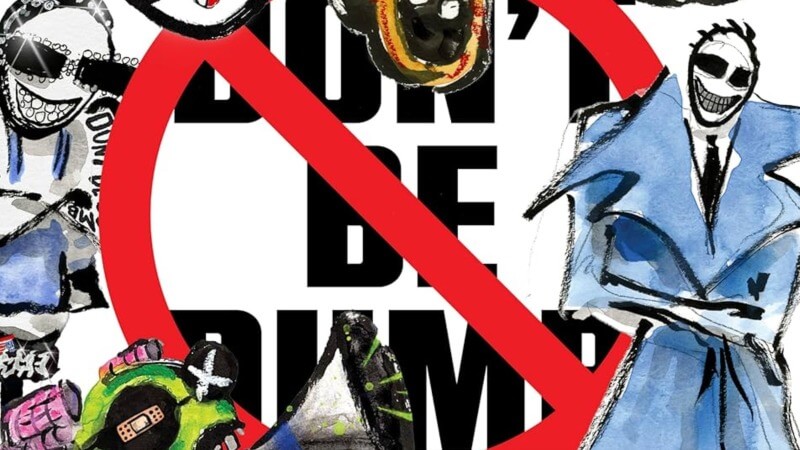
Eight years is a long gap between albums in any genre, but in rap specifically, it’s not even a lifetime; it’s a generational turnover. Whole careers arrive, peak, flame out, and get repackaged as nostalgia in that span. I mean, last time A$AP Rocky released a record, Kanye wasn’t even a Nazi yet. Let that sink in.
Rocky himself has clearly been thinking about the wait. Too much, maybe. It’s understandable; he left off with the most divisive album of his career, 2018’s arguably too-experimental Testing, and by the time he finally shows back up with Don’t Be Dumb—after years of false starts, no less—he’s stepping into an entirely different rap ecosystem than the one he left behind. Worse, it’s an ecosystem that has already canonized his early work, memed his delays, and quietly reassigned his cultural role from hip-hop innovator to aesthetic elder statesman, tabloid darling, and movie star. The wait is doomed to become part of the text whether he wants it to or not, and boy, does he know it.
From the very first lines of the record—“It’s been a lil’ while since I been in the league / A couple lil’ trials, couple of leaks / Still in the field like I’m runnin’ in cleats / Last time I checked, we still in the lead”—it’s evident that this iteration of America’s favorite pretty boy rapper has a massive chip on his shoulder, one that weighs precisely eight wall calendars. At times, Don’t Be Dumb is haunted by the specter of its own delay, with Rocky often sounding far more invested in litigating the album’s context than in deepening its content. The ghosts of those old questions gnaw at the corners, driving A$AP mad in the process: Where’s the album? Why is it taking so long? Are you retired? Are you just a fashion guy now? Rocky hears all of it, and this record is his answer. As he shrugs on snarling Drake diss track “Stole Ya Flow,” “My baby mama Rihanna, so we unbothered.” And that would be the perfect mic-drop—if he didn’t keep picking the mic back up to insist on it. Most unbothered people, after all, don’t write a song like “STFU,” complete with lines like “When are you and Rihanna—(Shut the fuck up!) / Like when’s the new album gonna—(Shut the fuck up!),” which feels less like Zen detachment and more like someone still arguing in the comments. The Flocka doth protest too much, methinks.
The irony is that Don’t Be Dumb is at its strongest precisely when Rocky stops sounding like he’s trying to win an argument. When he’s fully in his bag—smug, cocksure, borderline obnoxious—the album briefly snaps into focus. Did Rocky actually invent rap, as he repeatedly implies across the record (“Word to everything, I invented it / … / Then they run and do it and then forget who did it best”)? No. But when he sounds this comfortable inside his own myth, you almost don’t care.
That version of Rocky has always been the appeal. He’s never been compelling because he’s emotionally transparent; he’s compelling because he owns the room even when he’s barely trying. The problem is that Don’t Be Dumb keeps undercutting that strength by loading so much of its bravado with defensive energy. And while some of Rocky’s beefs are valid or at least entertaining—his vicious takedown of Drizzy on “Stole Ya Flow,” his sneering references to the court cases following his fallout with A$AP Relli on “Stop Snitching”—others feel weirdly self-invented. The Brent Faiyaz-featuring smooth ‘80s funk heavy track “Stay Here 4 Life,” while largely a plush love song, concludes with a bizarre rant defending against fans allegedly disappointed by Rocky settling down with the world’s hottest woman: “Some of you n****s around here that’s, quote, unquote, look up to me / Seem to feel that you’re disappointed / ‘Cause I’ve taken this latest relationship step that I’ve taken / … / Fuck y’all n****s.” It plays less like a response to real criticism than a shadowboxing session with a Reddit comment that lodged itself in his brain years ago. As you said, man, your baby mama is Rihanna. No one thinks you lost.
To be fair, Rocky has never been the guy you go to for lyrical revelation. His pen has always been more “efficiently serviceable” than “holy shit, run that back,” and save for a few clever bars here and there (“Play Nintendo with my bitch / She ain’t never even switch / Just Wii in this bitch” is a silly, pleasant late album surprise), Don’t Be Dumb doesn’t change that. He mostly just repeats the same few sentiments—my girl bad, my kids cool, my flow hard, my face pretty, my genius misunderstood—ad nauseum, and it can get a bit redundant, even line-to-line: “Talk behind my back / Talk all kind of trash / My back, all kind of stabs / You was throwin’ jabs.” I mean, there’s not even the illusion of wordplay there. It’s literally just four synonymous lines.
It’s only on the album’s closer, “The End,” that Rocky tries to gesture toward something larger than himself—and that’s precisely where the album’s lyrical thinness fully catches up with it. Over a somber, spacious beat that leans heavily on Jessica Pratt’s ghostly, pastoral vocals and a will.i.am verse packed with dystopian platitudes (“I saw the Bible upside down today / The only King James they know is 2K”), Rocky reaches for end-of-days imagery—environmental collapse, moral decay, religious confusion—but his own contribution boils down to broad rhetorical questions more than anything else (“How you actin’ the richest, but you lackin’ the wisdom?”). There are plenty of great rap songs about the state of the world. “The End” isn’t quite one of them, especially coming after an album dominated by petty beefs and defensive flexing. The production strains to carry a seriousness the words never fully earn.
That disconnect helps explain why Don’t Be Dumb ultimately lives or dies on its production choices—and why the album feels more lopsided than cohesive. When Rocky locks into a sound and lets it ride, the results are often genuinely great. The first half of the record is where this approach pays off most consistently, stacking some of the album’s strongest material back-to-back and letting Rocky coast on charisma. “Order of Protection” sets the tone with that glassy, half-regal, half-grimy intro—choral swells, weird little synth squeaks, hallway-echo drums; second single “Helicopter” sharpens it, all nervous synth stabs and a bassline that feels like it’s pacing in circles, while Rocky just bounce-flows on top like it’s the easiest thing in the world, turning lines about brand deals and blue checks into something closer to percussion than prose.
The standout tracks, though, are evident: “Stole Ya Flow” is a synth-smeared war march that lets him lean into petty villain mode (eat shit, Drake); “No Trespassing” moves with this greasy Bay-adjacent lilt, all low-end wobble and negative space; “Stop Snitching” goes even darker, the beat slinking while Rocky and Sauce Walka read out affidavits from hell, turning street gossip, RICO whispers, and self-snitching Instagram lives into something halfway between a cautionary tale and a diss track for an entire generation of oversharers. “Stay Here 4 Life” and “Playa” are the somewhat wobblier moments—pretty, plush, occasionally inert—but even there, you can at least see the thesis: grown-man love songs dressed up as luxury mood pieces, a guy trying to convince you that monogamy and dad duties are just another form of flexing (which, you know what? Fuck yeah). When that first run is clicking, the album feels curated instead of overthought—and Rocky’s always been one hell of a curator.
But then the album keeps going. The back half is where the eight years of restlessness fully take over. “STFU” is a somewhat more productive version of Rocky’s experimental itch: a lurching, gnarled noise-rap detour where the drums keep changing shape under your feet and the Slay Squad feature turns the whole thing into a moshpit transmission. It’s weird and loud and lyrically ridiculous, but at least it’s fun. Lead single “Punk Rocky,” on the other hand, is the opposite—a limp emo cosplay built on washed-out guitars and vague diary scrawl (the lyrics are particularly god-awful here: “I thought I fell in love, I thought she felt it too / I thought we was in love, she just another fluke / I thought you was the one, I guess you just the two”). Hearing that first, before the rest of the record, you’d be forgiven for assuming the worst about everything that followed. Lord knows I did: when it dropped, I started mentally storyboarding a full-on execution-style pan. The fact that Don’t Be Dumb mostly clears that very low bar is a relief, undoubtedly, but I still cannot fathom what compelled Rocky to drop it as the first single.
At this point, you start to feel the weight of the record’s runtime. “Air Force (Black Demarco)” piles on hyperactive electronics and jittery drums, three half-ideas fighting for control; “Whiskey Release Me” drifts into woozy late-night haze, but Rocky sounds so sedated that the Damon Albarn and Westside Gunn cameos end up doing more to define the track than he does (and those cameos suck, too; Albarn is rendered practically spectral, and Gunn doesn’t say a single full word the entire song, just “BOOM-BOOM-BOOM” adlibs). At least “Robbery” lands on something new: a goofy, theatrical heist-movie radio play where Rocky leans into cartoon bandit energy and Doechii steals the scene, corny by design but oddly endearing.
That willingness to flirt with failure is, in its own way, the most interesting thing Don’t Be Dumb has going for it. For all its defensiveness, bloat, and half-baked pivots, this is not the sound of an artist phoning it in. Rocky is clearly still restless, still curious, still trying to locate himself inside a rap landscape that no longer revolves around him (although he can’t quite admit that latter part to himself), and that tension animates the album even when it undermines it. When Don’t Be Dumb works, it’s because Rocky sounds unburdened by the need to explain his place in the world, letting beats, tone, and sheer presence do the talking. When it doesn’t, it’s because he can’t stop glancing over his shoulder, checking the scoreboard, arguing with an audience that may or may not even be there anymore. The result is an album that’s compelling in spurts, exhausting in bulk, and oddly resistant to final judgment: it doesn’t rewrite his catalog or vindicate every delay, but it at least makes the lost years legible.