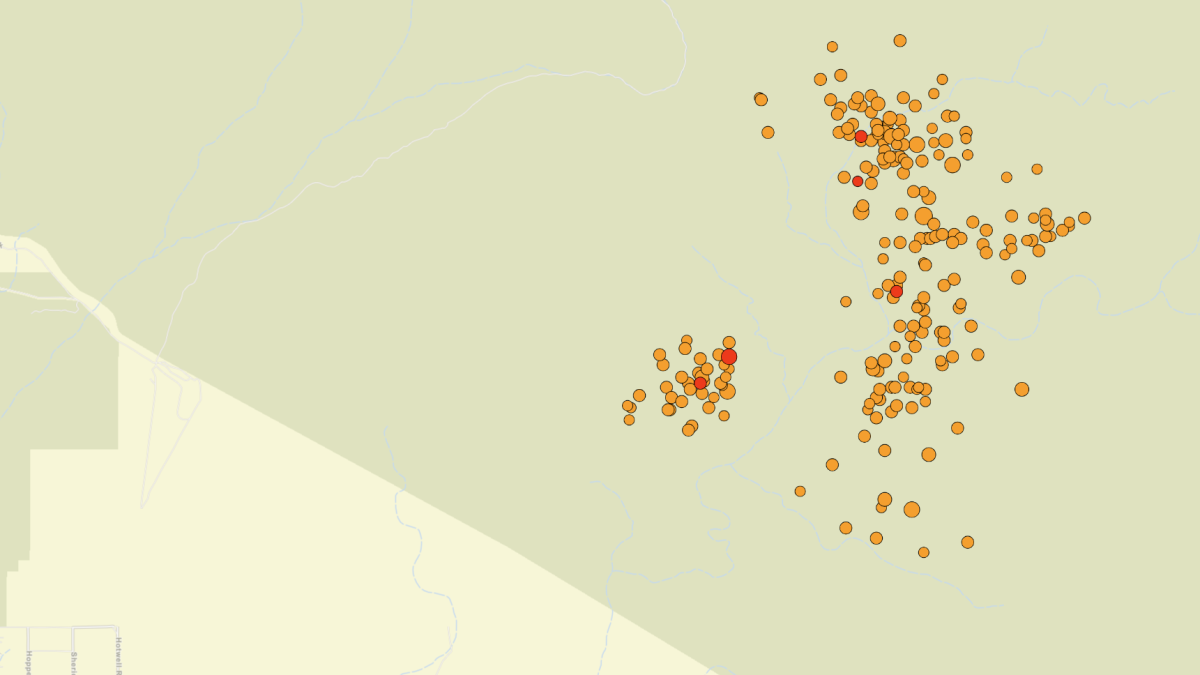
A preliminary magnitude-3.8 earthquake was reported Tuesday near Indio after a day of shaking in the Riverside County community.
The quake late Tuesday morning, initially listed at magnitude-3.6, was one of dozens in the area over the past 24 hours, the strongest of which was of magnitude-4.9 on Monday. That quake, the largest in Southern California since a magnitude-5.2 earthquake near Julian in April, was followed by aftershocks that continued for hours.
Tuesday morning’s largest quake produced shaking Desert Hot Springs, San Jacinto, Palm Desert, Indio, Palm Springs and elsewhere. It was one of about 15 earthquakes of magnitude-2.5 or greater in the past 24 hours in the Indio area.
The Coachella Valley desert community is about 130 miles east of Los Angeles.
Did you feel it?
Whether you feel shaking from an earthquake largely depends on three major factors — magnitude, distance and local soil conditions. Magnitude refers to the strength of the quake. The closer your location to the epicenter, the more likely you’ll feel the effects of seismic waves that become less intense as they move out from the fault. Generally, the looser the soil under your location, the greater the amplification.
Aftershocks
Some earthquakes are followed by a larger earthquake, in which case the first quake would then be called a foreshock. For example, the magnitude-9.1 Japan earthquake and tsunami in 2011 was preceded by a magnitude-7.3 foreshock two days earlier.
Aftershocks decrease over time, but can continue for days, weeks, months and years.