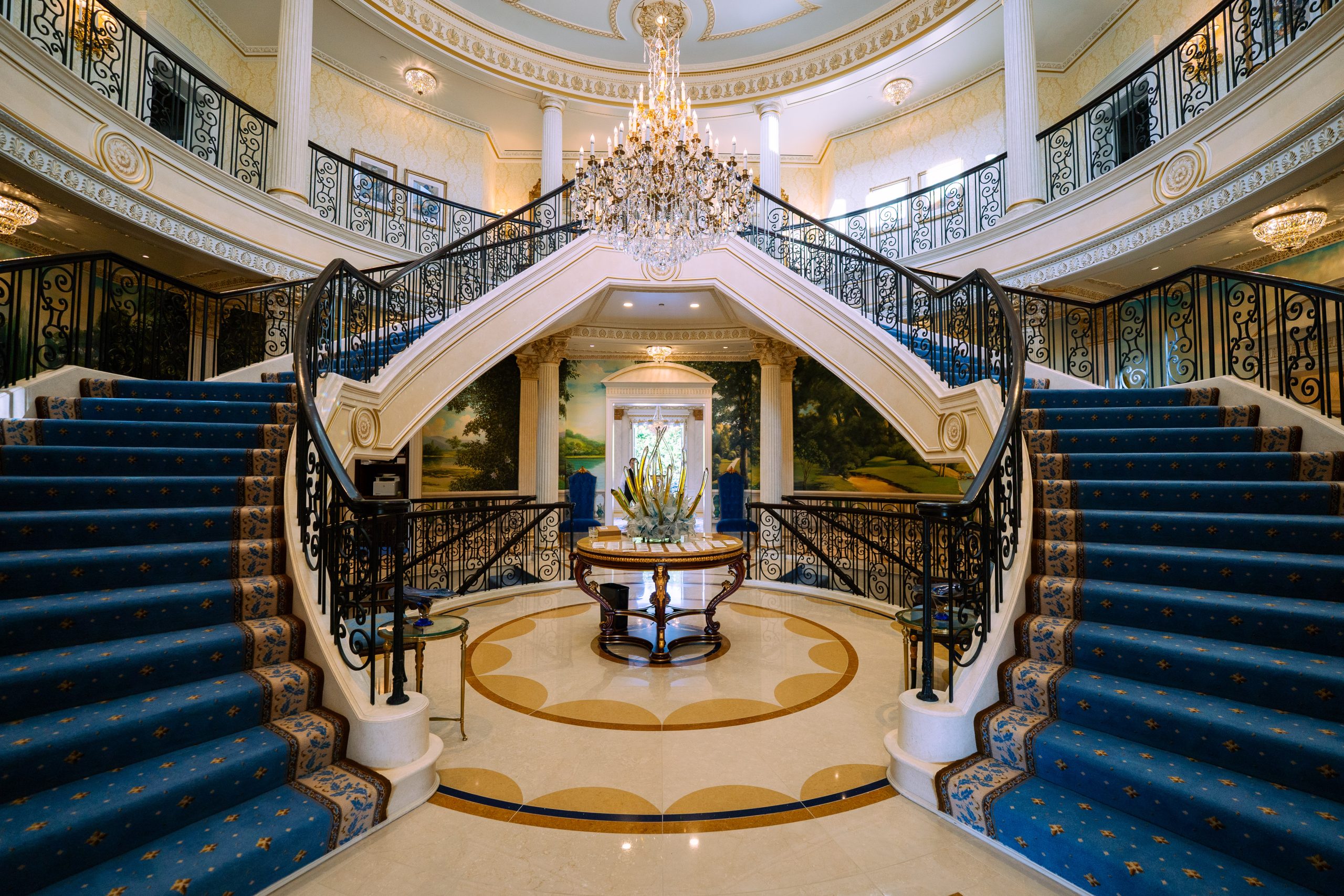
“We would refer to this as an American cottage, much like the way that we refer to Newport and all of those gorgeous mansions there as cottages,” interior designer Skip Sroka says about Norton Manor.
“So you know this is very much a Gilded-Age home.” And yet, for all its historic vocabulary, Norton Manor is not meant to feel frozen in time. Featured in the inaugural episode of The American Bazaar’s new documentary series, The Great Mansions, the estate is presented as a living space—one that carries its owners’ story forward rather than sealing it in the past.
The Gilded Age–inspired “American cottage” was built for modern convening. Located in Potomac, Maryland, one of the nation’s most affluent neighborhoods, Norton Manor is home to Frank F. Islam and Debbie Driesman, prominent Democratic fundraisers who have hosted countless political and civic gatherings over the years.
“There’s no shortage of famous people who have been here,” says Sroka.
The guest list reflects that legacy. Over time, the guest list at Norton Manor has included some of the Democratic Party’s most recognizable figures, from former President Bill Clinton and then–Vice President Joe Biden to former House Speaker Nancy Pelosi, Minority Leader Hakeem Jeffries, and a steady stream of members of Congress.
But the story Sroka tells is not primarily about politics. It’s about intention—about how a home can be deliberately designed to hold meaning, room by room, and to move people physically and emotionally through a sequence of beauty, scale, and atmosphere.
“Everywhere there is the hand of the artist,” he says, guiding viewers past towering figures in the entry. “Those keratids, which are the human creatures that are in robes, are 5 and 1/2t tall.”
From the first step inside, Norton Manor announces its ambition: a neoclassical house that behaves like a living museum but functions like a modern hosting machine. Sroka describes the experience in spatial terms—how the architecture directs attention, gathers conversation, and reveals itself in chapters.
“You walk through the grand staircase, drawing room to one side and a dining room to the other side,” he says. “That was actually one of Frank’s directives. He wanted every room to be a memory.”
A name, a road, and a vision
The estate’s identity begins with something deceptively simple: the name. The name Norton Manor, Sroka explains, derives from the name of the road, and “it’s a fabulous way of just making it the manor on the road.”
Sroka spent “three and a half years” working with Islam and Driesman on the project, which he notes was “6 and 1/2 years in the making” overall.
That long timeline mattered. Norton Manor was never conceived as a generic luxury build. “It’s pretty hard to build something this magnificent in less time than that,” he says. “It’s not like doing a drywall box.”
The process began with practical considerations—demolition, siting, and drainage— before giving way to the slower, more exacting work of artisanship and detail. That final phase is what transforms an expensive house into a fully realized world.
“This house is very, very neoclassical, and I think people feel that spirit every time
they come,” says Sroka.
A library that signals power
As the documentary unfolds, Norton Manor emerges not just as a residence but as a curated statement about American institutions. Some spaces feel almost cinematic in their symbolism, beginning with the library.
In the library, Sroka points to a replica of one of the most iconic pieces of American political furniture: “This room, which is the library, has a copy of the Resolute Desk.” He recounts its quirks and history: “Most people remember it as the desk that John F. Kennedy used when he was president.”
In a house known for political fundraisers, the desk is more than décor. It’s a signal—a shorthand for the worlds that intersect here: politics, philanthropy, public service, and private influence.
That signaling continues in the property’s entertainment and event spaces, where design is scaled up for crowds. “So, this is where the party starts,” Sroka says, introducing another chandelier by Barry Antner. “As we walk back into here, this is where the major events occur.”
The room is built to stage dinners and speeches at once: “This room is set up for a dinner,” he says, noting staff “cleaning up from the last dinner that was here.” Murals bring American civic imagery into the architecture: “We have the Jefferson [Monument], we have the White House, we have the U.S. Capitol, we have the U.S.
Institute for Peace.”
And then there’s the room that turns a mansion into a salon: a private screening space that doubles as a lecture hall. “We can show you any movie you’d like to see, but the sound quality in here is excellent,” Sroka says. “Also, sometimes Frank is giving lectures, or we have various speakers that come in here, and it is a wonderful art
deco.”
As Norton Manor unfolds, it becomes clear that the home isn’t only a backdrop for events; it’s also an archive of its owners’ lives. Sroka leads viewers into a more private corridor.
“This is very special. Very few people get to see what we’re going to see next,” he says. “So, this is all of Frank’s awards and some of his favorite people that he has supported in politics and favorite causes.”
The tour deepens into Islam’s private spaces: “This is Frank’s private conference room,” Sroka notes, and then offers a personal detail that reads like an ideological compass. “He greatly admires Lincoln and greatly admires Kennedy.”
A landscape built for instant maturity
A mansion like this doesn’t end at the front door. It extends into the grounds—where design becomes time.
Sroka credits the gardens to a specific team: “All of the gardens were designed by Lewis Aquatech and Don Gwiz.” But what impressed him most was the owners’ insistence on planting big from day one.
“Frank and Debbie wanted everything planted as large as it could be planted,” he says. “So they didn’t have to wait for everything to grow.”
The result, he explains, is that the estate arrived with an immediate sense of permanence. “From day one, when you came here, you felt like the house was much older.”
Sroka speaks with the certainty of someone who thinks in decades: “This house will age beautifully, and this house will be here for another century.”
Even the property’s privacy—its strategic concealment from the road—was part of the landscape plan. “There were trees on the property and there was a lot of effort made to retain all of the old trees,” he notes, especially in the woodland gardens, where “the large trees… were all existing.”
Watch the full documentary and step inside Norton Manor on The American Bazaar’s YouTube channel.
The post Inside Norton Manor: Potomac’s neoclassical home where design, memory, power converge appeared first on The American Bazaar.