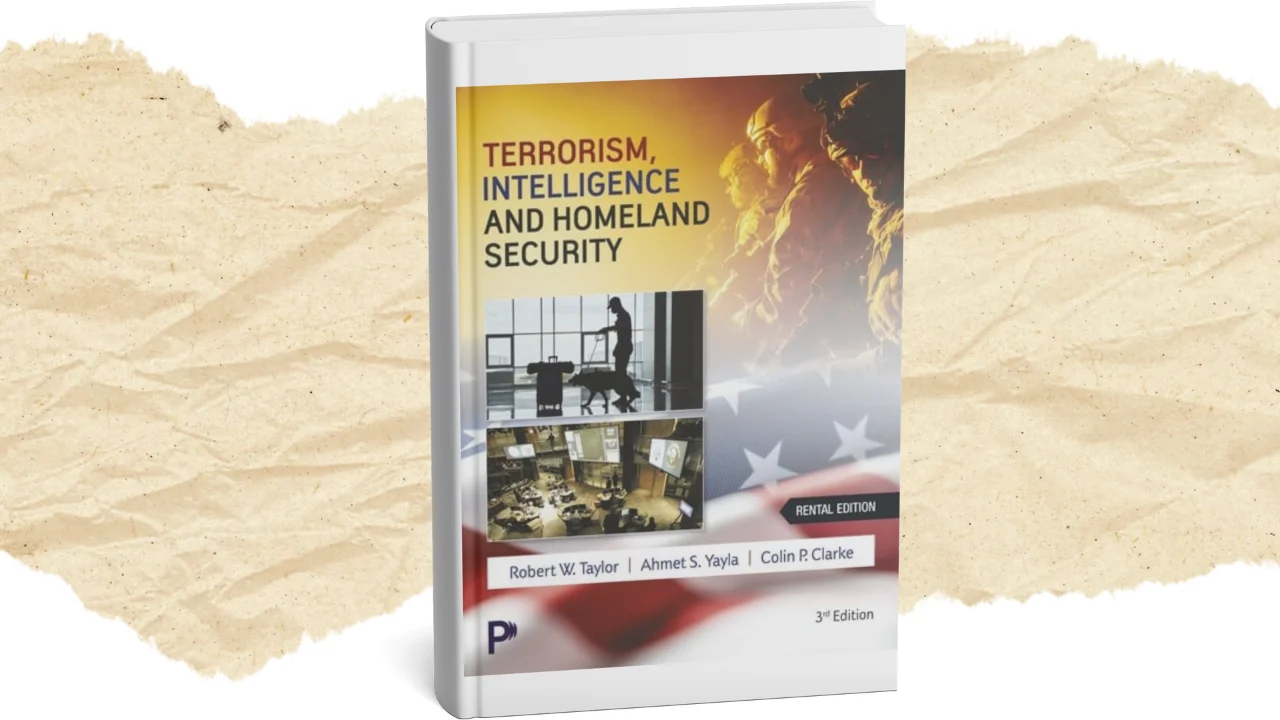
As a book you should anticipate reading, the third edition of the widely adopted textbook – “Terrorism, Intelligence and Homeland Security” – is set to publish February 27, 2026. Dr. Robert W. Taylor, Dr. Ahmet S. Yayla, and Dr. Colin P. Clarke have substantially revised and expanded their comprehensive examination of how terrorism, intelligence, and homeland security intersect in an increasingly complex threat environment.
What sets this edition apart is its responsiveness to the current landscape. The authors have restructured the text to place greater emphasis on homeland security topics while maintaining the historical foundation that gives context to contemporary challenges.
Of particular relevance to practitioners and students alike is the new coverage of the crime-terror nexus. The inclusion of material on transnational criminal organizations like Tren de Aragua and MS-13 – now designated as terrorist organizations under federal law – reflects the blurring boundaries that today’s homeland security professionals navigate daily. This isn’t merely an academic distinction; it speaks directly to operational realities facing agencies at federal, state, and local levels.
The updated chapter on intelligence analysis will address the technical dimensions of working in an automated, interconnected world: A topic that touches everything from information sharing to threat assessment. Meanwhile, expanded coverage of individual federal agencies and their strategic homeland security missions provides a valuable reference for those seeking to understand the institutional landscape.
The revised chapter on counterterrorism strategies and organizations provides a more detailed and structured overview of the U.S. counterterrorism apparatus. It traces the evolution of counterterrorism strategy (including the distinction between national security policy and strategy), emphasizes prevention-centered approaches alongside intelligence and enforcement, and outlines the roles and interagency coordination of key U.S. actors, along with the relevant legal frameworks that shape domestic counterterrorism operations.
The authors have also thoroughly revised their examination of future terrorism trends, incorporating recent developments involving al-Qaeda, the Islamic State, and the persistent challenge of domestic extremism. Their discussion of low-tech infrastructure attacks and assassination attempts as tactical choices reflects hard lessons from recent years.
For those teaching or studying terrorism studies, homeland security, intelligence, criminal justice, or international security, keep your eyes out for “Terrorism, Intelligence and Homeland Security,” available through Pearson on February 27.