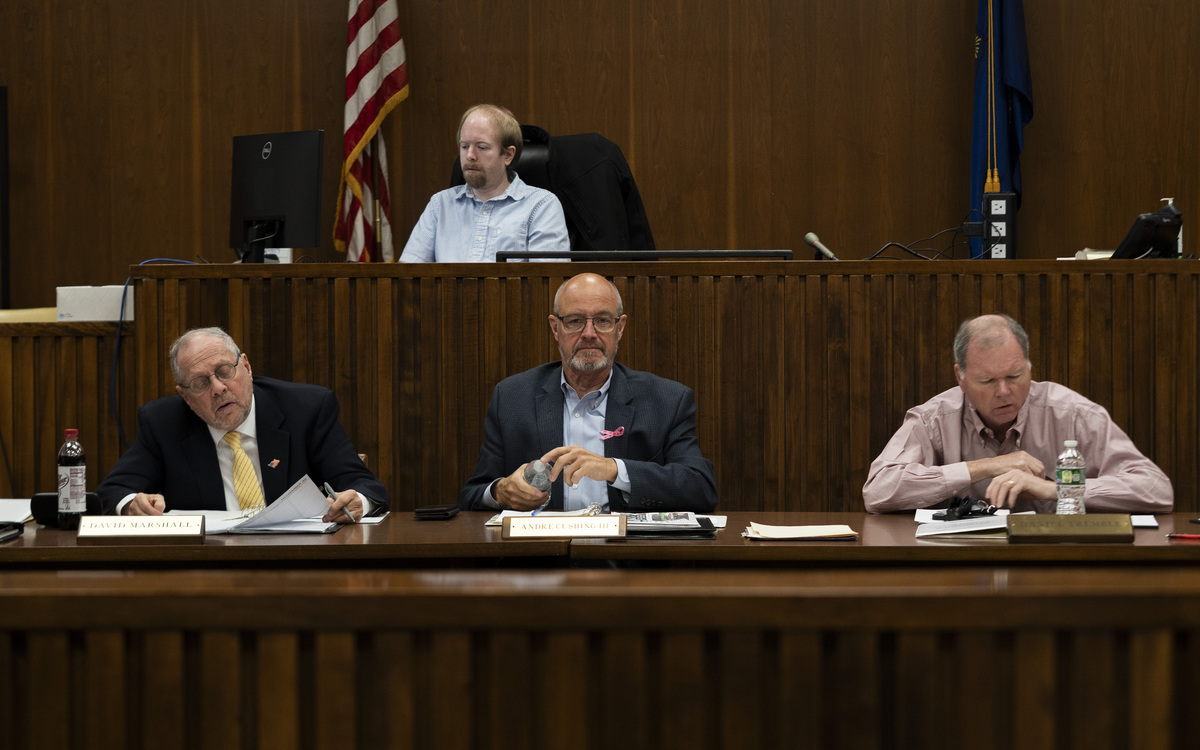

The Penobscot County commissioners may not slash $1 million from the proposed 2026 budget, despite the advisory committee telling them to.
The advisory committee last week approved a $35.1 million budget, but that budget only included one department’s funding. The motion instead pushed the responsibility to make specific cuts to the commissioners.
But commissioners may not be held to the motion, meaning the final budget could be more or less than the committee intended. The three commissioners, Andre Cushing, Dave Marshall and Dan Tremble, said finding $1 million to cut from the budget would be hard in what they said was already a lean year.
This is the first time commissioners or county officials knew of the committee approving a budget amount rather than a departmental budget. Approving an amount without line-item funding requires the commissioners to make cuts that would previously have been the committee’s decision. The commissioners spoke out against the large budget decrease during the December committee meeting but didn’t say if they would adhere to the motion or not.
The county’s proposed 2026 budget spiked from the previous year, mainly due to a $3.5 million shortfall as of the beginning of the year. Funding the jail through undesignated funds instead of budget funds in previous years has created a $7 million budget crisis.
The commissioners are expected to vote on the budget at their Wednesday meeting. There will be a public hearing on Dec. 23.
Cushing said he wants the budget to get “as close to the request as possible,” while Tremble said “reasonable reductions” would be made but may not amount to the committee’s motion.
“[The committee] sincerely wants to give us the opportunity to make decisions,” Cushing said.
The committee’s approved budget can be overruled by the commissioners if they vote unanimously, which commissioners seemed to agree to do.
Voting unanimously also avoids calling the committee back to pass a line-item budget, which may have been needed to move forward, according to Rudman Winchell attorney Tim Pease.
Pease advised the commissioners on what legitimacy the committee’s motion had before they moved forward. The motion is not direct, he said, partially because state statute isn’t clear if the committee has to pass just a budget figure or an itemized budget, but the commissioners have multiple options to move forward.
The three options Pease presented were that the 15-person committee could be called back to pass a cost-center budget, the commissioners could move forward based on the figures in the motion or they could vote unanimously.
The commissioners are looking into all possible options, not just voting unanimously, Marshall said.
Before discussing specific changes, Tremble brought up $465,000 in revenue from the fund balance that the county may not have. The funding hadn’t been brought up in the previous two committee meetings.
County officials don’t know what the fund balance is, County Administrator Gary Lamb said. They won’t know what the balance is until the 2023 audit is complete.
The 2023 audit is supposed to be finished in the coming months, Treasurer Glenn Mower said at the committee meeting last week.
Tremble and Lamb questioned if the fund balance would have the $465,000 budget for. Without knowing, the amount will be removed from revenue and be factored into the funds commissioners are looking to cut.
There are no determined changes to the budget, but commissioners spoke about multiple departments that would have their funding slashed.
That includes a possible $120,000 cut from building and improvement, $40,000 from the Penobscot Regional Communication Center, $26,000 in natural gas savings in county buildings due to new heating systems, and $40,000 from information technology.
Sheriff Troy Morton spoke about what possible cuts from his department and the jail could be.
The sheriff’s department could freeze one clerical position that paid $57,700, cut $15,000 from officer buyout funding and $25,000 from a part-time position fund, Morton said, saving nearly $100,000.
The jail could also save $60,500 by not funding a case manager, save another $60,500 by freezing a correctional position and remove $40,000 from capital expenses that would go toward buying a van in the coming years.
There was also discussion about dropping inmate boarding funding from $2.3 million for 65 inmates to either $2.1 million for 60 or around $2.2 million for 62.
“If you want to make a cut, this is the place that can be cut. This is historically how it’s happened. But you have to know that cutting this means that we can’t pay to board those inmates out,” Morton said.
It was unclear if the commissioners supported cutting boarding. It was also unclear what would happen to the inmates who would need to be boarded out if the funding was not available.
When discussing many of the possible changes, commissioners said the funding would need to return to current amounts or go up in future years because the cuts would only defer project funding to future budgets.
Discussion about departmental budgets ended after two hours as commissioners entered executive session for interviews with candidates for county administrator.