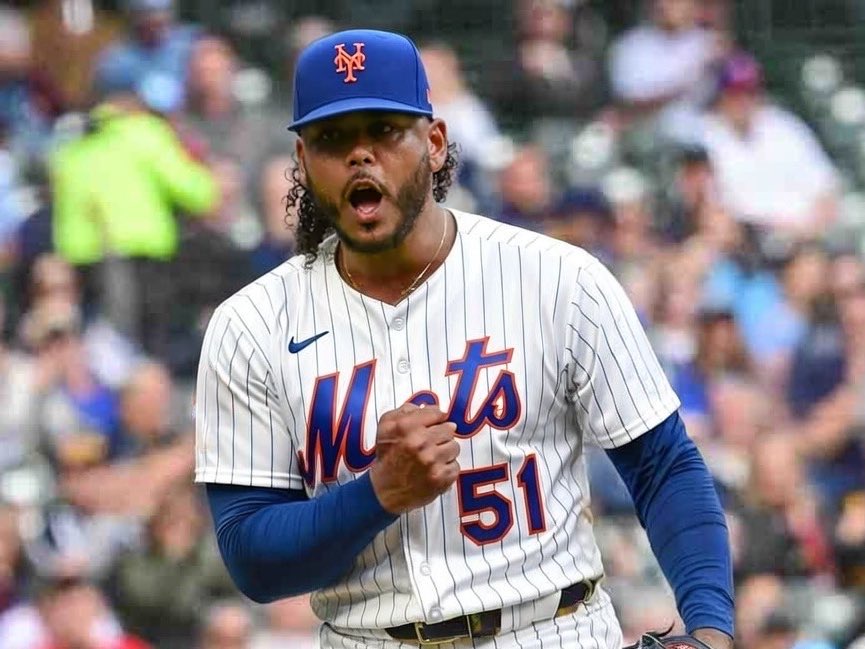
Brandon Nimmo was a great Met, one of the best to ever wear the orange and blue in terms of effort, consistency, and connection to the fanbase. The 13th overall pick in the 2011 draft, Nimmo embodied everything the organization wanted to project: professionalism, positivity, and relentless competitiveness. For parts of 10 seasons in Queens and 14 in the system, he represented the franchise with pride and class. A bona fide fan favorite, Nimmo had just wrapped up the third year of his eight-year contract, signed after his career-best 5.5 fWAR campaign in 2022.

Brad Penner-Imagn Images
There were plenty of signs that a Nimmo trade was on the table. Beyond the recent chatter, his eight-year, $162 million contract, signed before David Stearns arrived, was intended to keep him as the Mets’ long-term center fielder—or at least a really good corner outfielder. But since agreeing to that deal, Nimmo’s athleticism and sprint speed have steadily declined, pushing him into full-time left-field duty.
Offensively, Nimmo still produced, slugging a career-high 25 home runs with 92 RBI while hitting in the middle of the lineup. But his walk rate—his former calling card— fell sharply, from 11.6% (91st percentile) in 2024 to 7.7% (44th percentile) in 2025, and several underlying metrics suggested his .262/.324/.436 slash line slightly overstated the quality of his contact.
Even so, the announcement stunned many around baseball. Few expected the Mets to move a franchise cornerstone, especially in a one-for-one deal for a 35-year-old second baseman in Marcus Semien.
In Semien, the Mets are acquiring a player with a well-established reputation as one of the hardest workers in the sport and a strong clubhouse presence. A three-time All-Star, two-time Silver Slugger, and 2023 World Series champion, Semien has seen his offensive production dip sharply over the past two seasons. Even so, he remains an above-average defender at second base. He captured his second Gold Glove this past year, driven by elite performance metrics, finishing 92nd percentile in Outs Above Average (7) and totaling 5 Defensive Runs Saved across 127 games.
While the Mets shouldn’t expect Semien to rediscover his peak offensive form at age 35, there’s reason to believe he can be a more productive hitter in 2026. His expected metrics, while still below league average, point to some general misfortune: his .230 batting average and .364 slugging percentage both underperformed his .245 xBA and .392 xSLG. A .251 BABIP, similar to his 2024 mark but well below his career .280, offers further evidence that some positive regression could be coming.
There’s also a growing belief that Semien’s batted-ball profile fits Citi Field better than it fits Globe Life Field. According to Statcast’s expected home runs by park, Semien would have hit 35 homers at Globe Life over the past two seasons (he actually hit 38). At Citi Field, that number spikes dramatically to 50. While park-adjusted home run estimates aren’t perfect forecasts, they do highlight how well his combination of pull power and loft maps onto Citi’s dimensions.
Even if Semien’s bat never returns to its former level, the Mets believe his strong defensive metrics and still above-average athletic traits make him a safe bet to provide meaningful value for a team with championship aspirations. David Stearns has emphasized run prevention as the organization’s top priority this winter, and adding Semien materially improves the Mets in that department.
The financial component matters, too. By swapping a five-year commitment for a three-year one, the Mets take on a slightly higher AAV in the short term but gain significant long-term payroll flexibility, a key tenet of Stearns’ roster-building philosophy. Taken together, the trade leaves Stearns and his front office with a clear, urgent need for an outfielder, but also with far more freedom—financially and structurally—to address it.
Which leads to the obvious question: What do the Mets do next?

Marcus Semien by Roberto Carlo
Option 1: Free Agency
With Juan Soto locked into right field and Carson Benge expected to contribute in 2026, the Mets have a clear need for at least one outfielder and potentially two. Coming off a bounce-back year in the Bronx, Cody Bellinger already profiles as a strong fit thanks to his positional versatility and improved performance. In the post-Nimmo landscape, he becomes an even more logical target.
Defensively, Bellinger offers a clear upgrade. He posted 7 Defensive Runs Saved in left field last season and added 8 more in right despite fewer innings. Statcast supported the metrics, placing him in the 93rd percentile in Outs Above Average, with top-tier marks in both Arm Value (91st percentile) and Arm Strength (83rd). As a direct replacement for Nimmo, Bellinger would significantly boost the Mets’ outfield defense.
His offensive track record also stands out. Bellinger’s 2025 line (.272/.334/.480, 125 OPS+) comfortably outperformed Nimmo’s 114 OPS+, and over the last three seasons, he holds a 9% advantage in cumulative OPS+ (125 vs. 116). On the bases, both players stole 13 bags last year, but Bellinger’s superior athleticism (72nd-percentile sprint speed vs. Nimmo’s 47th) offers more lineup flexibility.
MLB Trade Rumors projects Bellinger for a five-year, $140 million deal, about $8 million more per year than what’s owed to Nimmo through 2030. But Bellinger is more than two years younger and possesses a stronger athletic profile, making him a safer bet to remain a capable defender into his mid-30s. And if his outfield range diminishes, the Mets would still have the option of moving him to first base, where he grades as an above-average defender.
Kyle Tucker represents the biggest free-agent swing. Set to play his age-29 season, Tucker has been one of MLB’s premier hitters since 2021, slashing .277/.365/.514 with a 145 OPS+. Offensively, he’d be a massive addition.
Defensively, however, the fit is more complicated. Tucker won a Gold Glove in right field in 2022 (15 DRS, 87th-percentile OAA), but his metrics have slipped since. In 2025, he posted -1 DRS and ranked in just the 26th percentile in Outs Above Average across 115 games. Any signing would require either Tucker or Soto to shift to left field, where neither is likely to provide above-average defense. Given the front office’s strong emphasis on run prevention, the defensive uncertainty may limit Tucker’s appeal.
The contract is another major factor. MLBTR projects Tucker to land an 11-year, $400 million megadeal, a franchise-defining commitment that would tie him to Soto for over a decade. While Steve Cohen is never shy about spending, such an investment only makes sense if the Mets are securing a meaningful two-way upgrade. With Tucker’s defensive trends pointing in the wrong direction, he may be more luxury than an ideal fit for the roster Stearns is trying to build.
Conveniently, we had two writers debate Bellinger vs. Tucker earlier today in a crossfire.

Kamil Krzaczynski-Imagn Images
Option 2: The Trade Market
Outside of Bellinger and Tucker, the remaining free-agent outfield options are largely uninspiring. Fortunately for the Mets, they have the prospect capital to pursue virtually any outfielder available via trade – and the trade market appears far richer than free agency this winter.
Steven Kwan
Steven Kwan is the cleanest fit for the Stearns model of run prevention. Entering his age-28 season, Kwan has accumulated 15.1 fWAR over four years with Cleveland while establishing himself as arguably the best defensive left fielder in baseball. He’s already won four Gold Gloves and compiled 68 DRS, including 22 this past season alone. Statcast backs it all up, with Kwan grading in the 90th percentile in OAA and 100th percentile in Arm Value.
Kwan isn’t a glove-only player, either. His career .281/.351/.390 line (109 OPS+) reflects elite contact and swing-decision skills rather than power. His whiff and strikeout rates sit in the 100th and 99th percentiles, and he sees nearly four pitches per plate appearance, identical to Brandon Nimmo. Acquiring Kwan would massively improve the Mets’ outfield defense, though he may not be a perfect long-term fit if the organization ultimately views Carson Benge as more of a corner outfielder than a true center fielder.
Jarren Duran
If the Mets want someone with extensive center-field experience, Jarren Duran presents a compelling alternative. Though he regressed in 2025 after a 6.8-fWAR breakout in 2024, he still posted a strong year (3.9 fWAR, 114 OPS+). Duran brings dynamic athleticism, including three straight seasons with at least 24 steals, elite sprint speed, and league-leading triples in consecutive years. His defense has fluctuated: elite in 2024 (23 DRS, 95th percentile OAA in CF), but far more average after shifting to LF full-time in 2025. Even so, he represents a clear upgrade over Nimmo on the bases, a likely upgrade in the field, and a comparable bat. With three years of team control and Boston’s outfield depth, he’s a logical and attainable target.
Byron Buxton
A higher upside swing comes in Byron Buxton, who remains one of the sport’s most electrifying talents when healthy. Buxton posted a .264/.327/.551 line with 34 homers, a 139 OPS+, and a perfect 24-for-24 steal rate last season. His underlying metrics were elite across the board, and despite mixed defensive reviews (81st percentile OAA but -5 DRS), he remains one of the fastest players in baseball entering his age-32 season.
Durability, however, is the concern. Buxton has played more than 102 games only three times in 11 years, with 2025 marking his highest total since 2017. His contract of $45.4 million over three years is reasonable, but any acquiring team must bake in significant injury risk. He also holds a full no-trade clause. If the Mets find the price palatable, the upside could be immense, but the volatility is higher than with Kwan or Duran.
Luis Robert Jr.
Luis Robert Jr. has been linked to the Mets dating back to last year’s trade deadline and remains one of the more intriguing buy-low options on the market. Defensively, he’s been a solid center fielder. Statcast is particularly bullish, grading him in the 93rd percentile in Outs Above Average, even as DRS viewed him as more neutral (0). Offensively, Robert has struggled the past two seasons, posting an 85 OPS+ with a .223/.288/.372 slash line. His underlying metrics hint at some positive regression, but his high chase rate and low walk rate create a volatile floor.
Robert will still be just 28 for most of the 2026 season and is only three years removed from a 4.9-fWAR season, a reminder of the star-level ceiling he still possesses. Among this group, he carries the most risk but is also likely to come at the lowest acquisition cost, making him a potential upside play if the Mets are willing to tolerate the variance.
Other trade options to pursue for the outfield include:
- Fernando Tatis Jr.
- Tyler Soderstrom
- Myles Straw
- Jake Mangum
- Jo Adell

Jerome Miron-USA TODAY Sports
Option 3: Internal Replacements
While it’s almost certain the Mets will turn to free agency or the trade market for outfield help, it’s worth considering the internal fallback options.
In the short term, Jeff McNeil would be the likeliest candidate to take over in left field, with either Tyrone Taylor or Carson Benge handling center. As the season progresses, the Mets could shift Benge to left and give center-field reps to one of their upper-tier prospects, Jett Williams or A.J. Ewing, both of whom project as capable outfield defenders. Nick Morabito was also added to the 40-man roster and projects as the best defensive outfielder in the system.
There’s a developmental upside to this approach: it would accelerate opportunities for the incoming wave of prospects, something David Stearns has repeatedly emphasized. That said, it comes with substantial risk. McNeil, despite producing a 111 OPS+ last season, would not represent a defensive upgrade over Nimmo and will be entering his age-34 season. Counting on Benge, Williams, or Ewing to shoulder everyday responsibilities in 2026 would place an extraordinary amount of pressure on inexperienced players at a time when the Mets are positioning themselves to contend. For a team with championship aspirations, the number of unknowns here is likely too high.
What Will They Do?
With Brandon Nimmo now in Texas, the Mets have a clear and urgent need to reshape their outfield, with multiple paths to do so. Free agency offers two premium options in Cody Bellinger and Kyle Tucker, though each comes with its own cost, risk profile, and fit considerations relative to Stearns’ run-prevention focus. The trade market, by contrast, may be the richer landscape, with Steven Kwan, Jarren Duran, Byron Buxton, and Luis Robert Jr. all presenting unique blends of upside, control, risk, and defensive utility.
Internal options exist, but they introduce more volatility than a win-now team can reasonably absorb. For a front office that has stressed athleticism, defense, and flexibility, it’s difficult to envision a scenario where Stearns stands pat.
In all likelihood, the Mets’ solution will come from outside the organization. The only question now is whether they opt for the safety of a glove-first player, the explosiveness of a high-ceiling bet, or the star power of a long-term cornerstone.
The post The Mets Traded Brandon Nimmo. Now What? appeared first on Metsmerized Online.