[What follows is one of the many merry articles in the Mercury's Winter Guide 2025. Find a print copy here, subscribe to get a copy mailed to you here, and if you're feeling generous this holiday season, support us here.—eds.]
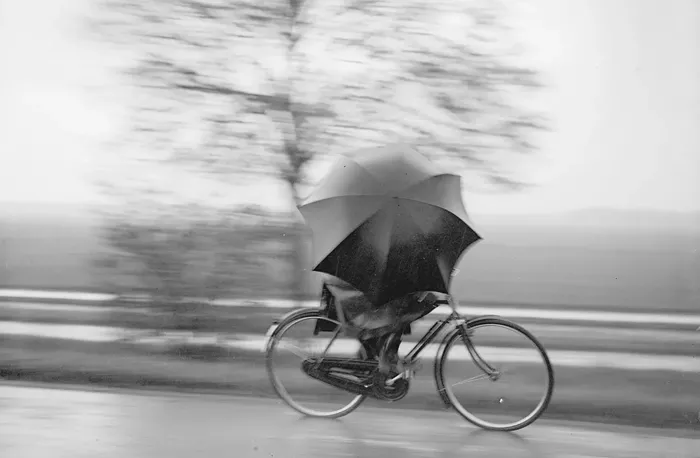
Riding your bike in the rain can suck. Still, it’s very possible to maintain your bike commute during the rainy months, and there are a lot of good reasons to do it. The benefits of biking for transportation—avoiding parking hassles and fees, bypassing traffic, saving gas money, helping the environment, moving your body, etc.—remain the same no matter what time of year it is. Plus, fresh air is good for the winter blues.
But you’ve got to come prepared. Here are my tips for what you need to convert from fair weather cyclist to year-round commuter.
Non-negotiables:
You don’t need a bunch of fancy and expensive gear to ride a bike. But there are some things you really do need to have if you’re going to survive a winter bike commute. (You can get most of this stuff secondhand, whether it’s at the Community Cycling Center, the basement of Next Adventure, Facebook Marketplace, or whatever thrift store you fancy.)
First thing’s first: You need fenders, and you need them on both your front and rear tires. Are they going to completely prevent you from getting splashed? No, but they’ll limit the damage, and they also ensure the people riding behind you don’t get sprayed with puddle water and mud. People act like it’s a huge hassle to deal with fenders every year, but guess what? You’re allowed to just keep them on in the summer. Problem solved.
You’ll also require proper footwear to keep your feet relatively dry. Everyone in Portland wears Blundstones. I like Sorel boots, which are a little less expensive (and sold at the Columbia employee store, if you have a pass). But whatever you choose, look for a properly thick sole (with enough traction to keep your feet on the pedals), a well-insulated lining, and quality stitching so water doesn’t seep in through the sides. If your socks get wet, you are immediately 10 times more likely to have a public meltdown, so keep that in mind.
When it comes to rain jackets, look for ventilation. Biking in the pouring rain is a much worse experience when you’re also sweating. I recommend a relatively light rain jacket with room for a sweater underneath, and ventilation zippers to let the air in. You can’t go wrong with local brand Showers Pass, but their products are admittedly pricey. (Cleverhood is another good choice for bike-friendly rainwear.)
Whatever jacket you choose, just make sure it at least pretends to be water resistant. When a fleece or denim jacket (even with sherpa lining) gets soaking wet, the coat becomes less of an object providing warmth, and more of a miserable burden to carry around. Wool is better, but it won’t hold up in bad squalls, and it takes a long time to dry. You’re better off with GORE-TEX or nylon.
(Note: Wearing a jacket hood almost always means sacrificing crucial peripheral vision. Some companies claim their jacket hoods don’t have this problem, but that’s a lie. A beanie will keep your ears warm, and you can get a rain cover for your helmet. Some people also like those little cloth cycling caps with the short bills. In my opinion, those don’t do much, but they do make you seem like a legit bicyclist who knows what they’re doing, and that’s worth something for some people.)
Bike lights are the last absolute must-have product. Rain reduces visibility for everyone, even during the day. Lights will help you see and be seen. Plus, you’ll need them for commuting home when it gets dark at 4:30 pm. My advice: Buy a few sets of inexpensive lights and keep them around. Don’t get too attached to any one light, because it’s pretty much inevitable it’ll get lost or stolen. And remember to charge them!
A few more tips:
• You won’t melt in the rain, but your stuff might get ruined if it gets wet. Avoid such a tragedy with dry bags, which have a very favorable peace of mind-to-cost ratio. The best combination is a relatively waterproof backpack/pannier/messenger bag with a couple dry bags inside.
• Keep every plastic bag you get for the rest of time. They are very helpful for winter cyclists. You can tie one around your bike seat if you have to leave it parked outside in the rain. You can put your wet clothes in them. You can wrap them around your shoes if you didn’t follow my earlier advice about footwear. It’s good to have a stash.
• If your socks get wet on the way to work (or wherever) and you don’t have a dry pair, consider your day ruined. Keep an extra pair somewhere to prevent this nightmare scenario from coming true. If you insist on wearing canvas shoes, you might want to carry around some dry shoes, too.
• If it’s raining hard, don’t bother with gloves if they’re not waterproof. They’ll get drenched and make you even colder. The only gloves that really keep your hands dry are heavy-duty winter mittens that you’d wear skiing.
• If it’s too rainy or cold, there’s no shame in dragging your bike on the bus or the MAX. It may seem scary to put your bike on the front rack of a bus, but it’s actually easy, and the bus driver will usually be patient while you figure it out.
This is a non-exhaustive list. As you get accustomed to riding in the rain, you’ll figure out your own tricks and habits. Remember: car companies want you to think you’re not tough so you’ll buy their vehicles with heated seats and sequester yourself off from the world. You don’t need that stuff. I believe in you.