There's a particular kind of dread that settles in when a beloved franchise hits its fifth installment. We've all seen the law of diminishing returns play out: the gang reassembles, the jokes get recycled, and the emotional beats that once devastated us get reheated until they're lukewarm. So let me say this plainly, and early: Toy Story 5 is not that movie. It is, somehow, the most urgent entry in the series since its inception as well as quite possibly its best.
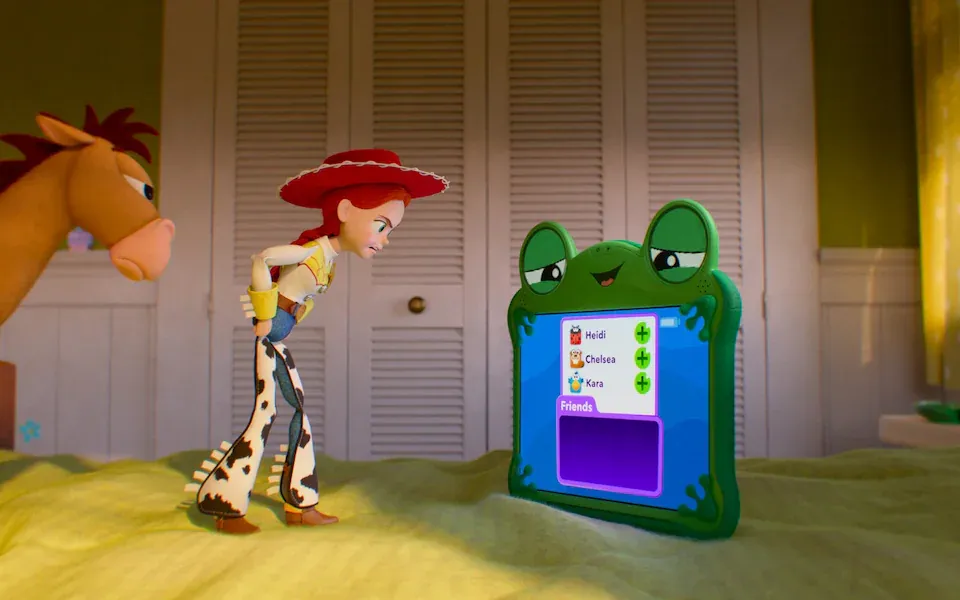
The premise is deceptively simple. Bonnie, now around eight years old, has a new obsession — and it isn't a toy at all. It's Lilypad, a frog-shaped electronic tablet voiced by Siri soundalike Greta Lee. Lilypad comes into Bonnie’s life after her parents notice that she is being bullied for still playing with toys. To their credit, Bonnie’s parents are hesitant about pulling their daughter into the digital world, but their desire for their daughter to be accepted wins out. And Bonnie discovers that Lily is patient, endlessly available (during screen time anyway), and allows Bonnie to connect with “new friends” from dance class. Whether or not these new friends are true friends is something you'll have to see for yourself.
Toy Meets Tech
The marketing has leaned on the "Toy meets Tech" tagline, and it would have been easy for the film to play that as a cheap technophobic screed — screens bad, toys good, the end. Instead, returning director Andrew Stanton (who wrote the first two films and directed Finding Nemo and WALL-E) and co-director Kenna Harris do something far more interesting. They let the question be genuinely hard. The traditional gang isn't just trying to survive Lilypad's arrival; they're forced to reckon with whether survival on those terms is even worth wanting. It's the same emotional intelligence that made Toy Story 3's incinerator sequence and Toy Story 4's quiet goodbye land like a gut punch — the comedy is the surface, and the surface exists to make the ache underneath hit harder.
Crucially, the film shifts its emotional center onto Jessie. After years of Woody and Buzz carrying the narrative weight, handing the reins to Joan Cusack's cowgirl pays off beautifully, continuing the arc that began all the way back in Toy Story 2 with that tear-jerking musical number that many moviegoers cite as the most emotional moment in a series filled with emotionally evocative moments.
Meanwhile, Woody — operating apart from the group since the end of Toy Story 4, staying in touch via gaint toy walkie-talkies while he helps abandoned toys find homes — comes running the moment he hears his friends have been effected by tech, which is ravaging the broader toy world. The reunion of Woody and Buzz after a six-year on-screen absence carries a charge the film earns rather than assumes. Tom Hanks and Tim Allen slip back into these voices like they never left.
A Voice Cast Stacked to the Rafters
Pixar has assembled a genuinely staggering ensemble here. Beyond the core gang, the new shed-dwelling community of forgotten toys gives the film its fresh blood: Bad Bunny turns up as the effortlessly cool "Pizza with Sunglasses," Conan O'Brien voices a know-it-all called Smarty Pants (although to be honest, if I hadn't known it was Conan, I wouldn't have guessed it), and Craig Robinson brings warmth to Atlas, a cheerful talking GPS hippo. Alan Cumming pops in as "Evil Bullseye," Bullseye's playtime alter ego, and the late Carl Weathers' Combat Carl is carried forward by Ernie Hudson. The returning bench — John Ratzenberger, Wallace Shawn, Annie Potts, Kristen Schaal, Tony Hale's Forky, Keanu Reeves' Duke Caboom — is as deep as the franchise has ever fielded.
Newman, Swift, and a Score That Lands
Randy Newman returns for his fifth Toy Story score, and his voice remains the franchise's emotional bedrock. The headline-grabber, though, is Taylor Swift's original song "I Knew It, I Knew You," written with Jack Antonoff and inspired directly by Jessie's journey. It's a deliberate return to Swift's country roots, and pairing it with the franchise's most heartfelt cowgirl is the kind of synergy that could feel calculated and instead feels genuinely fitting.
The Verdict
What elevates Toy Story 5 above mere nostalgia is its refusal to flatter the audience. It would have been so easy to coast on goodwill, on the warm familiarity of these characters, on the very funny image of a sentient frog tablet trying to oust a pull-string cowgirl. The film uses all of that — but in service of a question every parent is currently grappling with. What happens to the things we love when a glowing rectangle becomes the favorite thing in the room?
Pixar's answer is funny, generous, and even manages to come full circle. Thirty years after Woody first worried about being replaced by a shinier toy, the studio has found the most modern version of that fear imaginable — and made its most necessary film in a decade out of it.
Toy Story 5 opens exclusively in theaters June 19.