For ancient Greek history, the battle of Himera (480 BC) was a pivotal conflict that occurred in Sicily during the Greco-Persian Wars. While events such as the Battle of Thermopylae and the naval Battle of Salamis are often remembered as turning points that shaped the Golden Age of Greece, the Greeks of Italy faced their own significant challenges during this period.
Strategic alliances and the prelude to battle
The Battle of Himera was fought between the Greeks of Syracuse and Akragas on one side and the Carthaginians on the other near Himera in ancient Greek Sicily. According to Herodotus and Aristotle, the battle coincided with the naval Battle of Salamis.
On the other hand, Timaeus and Diodorus Siculus claim it took place during the Battle of Thermopylae. The poet Pindar also echoed these claims in his odes. The Greeks achieved a decisive victory, halting Carthaginian offensives in Sicily for the next 71 years.
As the Greco-Persian Wars raged, the Carthaginians reportedly aligned with the Persians to create a diversion and weaken the Greeks of Greater Greece (also know as Magna Graecia), according to Diodorus Siculus:
“The Carthaginians, we recall, had agreed with the Persians to subdue the Greeks of Sicily at the same time and had made preparations on a large scale of such materials as would be useful in carrying on a war. And when they had made everything ready, they chose for general Hamilcar, having selected him as the man who was held by them in the highest esteem.”
Herodotus provides further context, explaining that Theron, the tyrant of Akragas, expelled the tyrant of Himera, Teryllus. Teryllus then sought help from the Carthaginians. They seized the opportunity to intervene and prevent the unification of Sicily under Gelon, the tyrant of Gela and Syracuse.
Interestingly, Herodotus also notes that Gelon sent three ships to monitor the Persian invasion of Greece. He intended, if the Persians were victorious, to offer them “land and water” (a token of submission) and a large sum of money to Xerxes.

Hamilcar’s campaign and Gelon’s strategic counterattack
The leader of the Carthaginians was Hamilcar, who, according to historians of the time, commanded a force of approximately 300,000 men and 200 ships. The Carthaginian fleet primarily consisted of mercenaries from various regions across the Western Mediterranean.
The Carthaginians landed in what is now Palermo, where Hamilcar decided to allow his men three days of rest, as many ships had been lost during a storm in the Libyan Sea. From there, they advanced toward Himera, causing panic among the locals, who sought help from Gelon, the tyrant of Syracuse.
Gelon assembled an army of 50,000 men and 5,000 horsemen, primarily composed of mercenaries. He employed a “scorched earth” strategy, instructing his cavalry to devastate the surrounding countryside to hinder the enemy’s resupply efforts.
During this time, Gelon’s forces intercepted a messenger carrying a letter to Hamilcar from the Greek colony of Selinus. The letter revealed that the Selinuntians had agreed to send horsemen to aid the Carthaginians on a specified date. Seizing the opportunity, Gelon devised a plan to take the Carthaginians by surprise.
Instead of allowing the reinforcements to arrive, he sent his own horsemen disguised as the Selinuntians. This enabled him to launch an unopposed attack on the Carthaginian camp.
The battle of Himera
Herodotus focused primarily on the two commanders, Gelon and Hamilcar, portraying both as noble men. Regarding Hamilcar’s self-immolation following his defeat in battle, the Carthaginians honored his act by establishing ruler cults in his name.
Diodorus Siculus, writing four centuries later, provides more detailed accounts of the battle. He states that Gelon’s army numbered 50,000 men. The Greek general hurried to Himera and quickly fortified the town. The Greek army captured the Carthaginians who had wandered too far from their camp. From them, Gelon learned that the enemy was expecting reinforcements from the town of Selinus.
Gelon devised a clever plan. Ηe sent his cavalry to the Carthaginian camp and instructed them to pose as reinforcements from Selinus. Once inside the camp, the Greeks set fire to the enemy’s ships.
Seeing the flames, Gelon’s army launched a full assault on the Carthaginian camp. The Carthaginians, already in panic from the fire and the oncoming Greek forces, rushed to the walls in disarray. According to Diodorus, Hamilcar was conducting a ritual to Poseidon during this chaos, and the Greeks killed him.
Despite their leader’s death, the Carthaginians fought valiantly. However, as the flames of their fleet grew and the news of Hamilcar’s demise spread, their morale collapsed. Gelon ordered his army to take no prisoners, and they slaughtered the Carthaginians. Diodorus claims that not a single man who landed in Sicily returned to Carthage.
Impact of the glorious victory in Himera
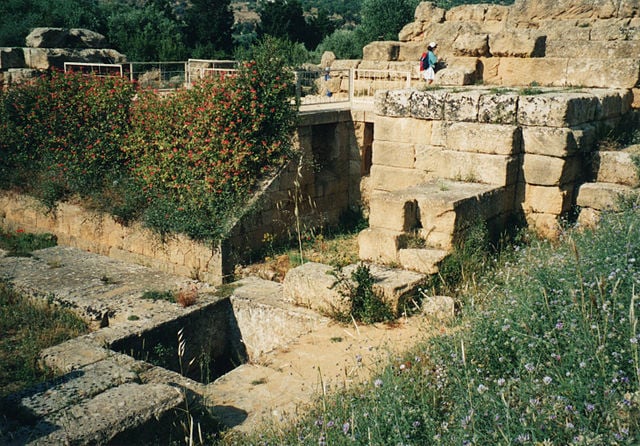
After the Greeks’ victory, Syracusan dominance in Sicily and the Mediterranean was established for the next seven decades. To commemorate this crucial achievement, the Greeks built a temple at Himera.
Gelon celebrated the event by dedicating a monument at Delphi, spreading the news of Greek supremacy in the Mediterranean to the wider Greek world.
While modern historians often focus on mainland Greece and the Persian Wars, ancient historians viewed the Greek battle against the Carthaginians in Himera as equally significant. Both Herodotus and Diodorus Siculus regarded this war as just as glorious as the Greek victories against Persia.
Diodorus, who places the Battle of Himera on the same day as the Battle of Thermopylae, wrote:
“Now it so happened that Gelon won his victory on the same day that Leonidas and his soldiers were contesting against Xerxes at Thermopylae. As if the deity intentionally so arranged that both the fairest victory and the most honorable defeat should take place at the same time.”
Herodotus, on the other hand, claims that the battle occurred on the day of the Greek victory at Salamis. In any case, this battle indisputably remains one of the most glorious events in Greek history.
In fact, Diodorus does not even so much as separate the two wars. He asserts that the Persians conspired with Carthage, coordinating their invasion with the Carthaginians in an attempt to destroy the Greek world once and for all.
This war decisively secured Greek supremacy in the Mediterranean. In the ancient world, it was regarded as a pivotal event that established Greece’s dominance at sea. For this reason, the Battle of Himera was instrumental in fostering the growth of Greek civilization during the Golden Age and, consequently, changed the course of history.