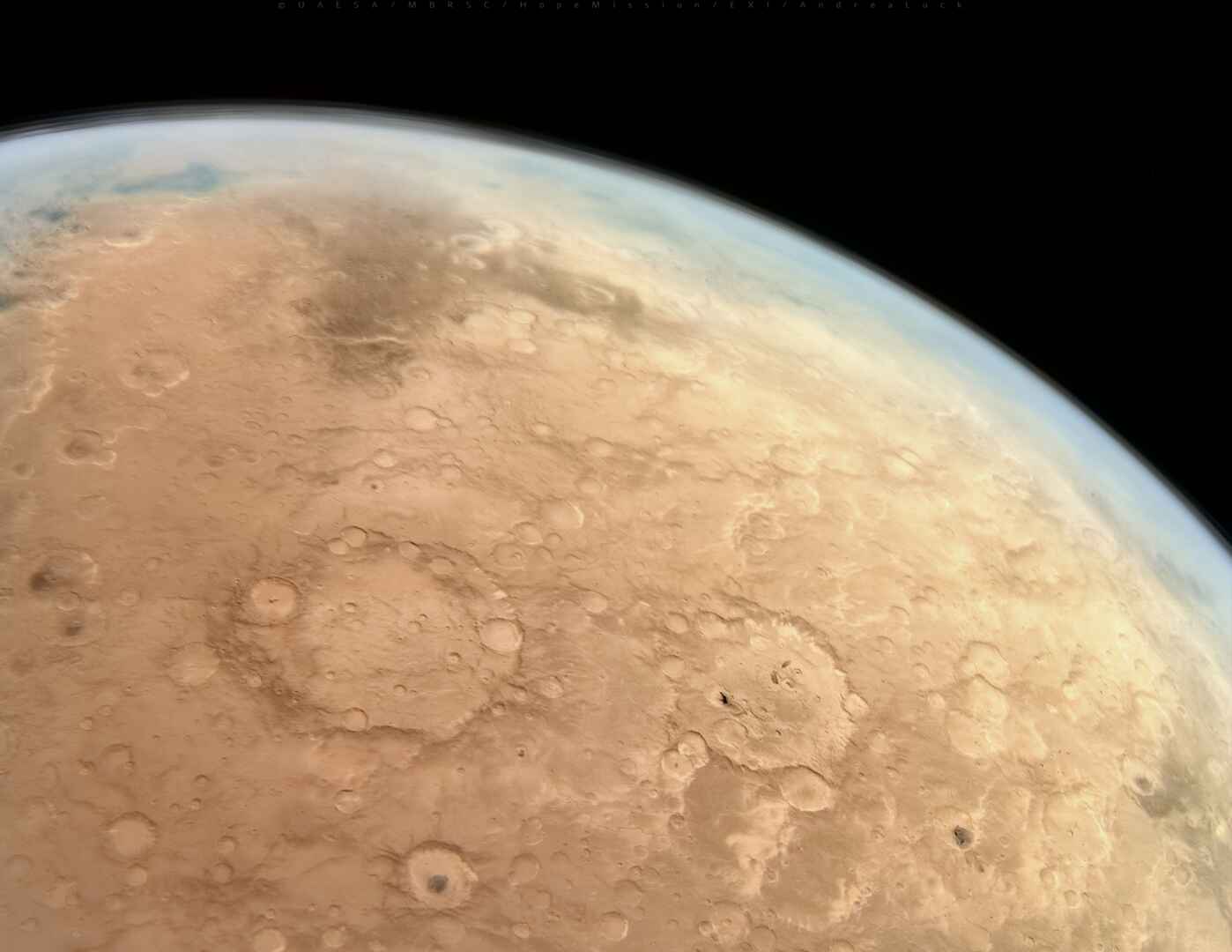
A group of researchers has identified what could be the first water-carved caves on Mars, raising new possibilities in the search for signs of past life. These formations, located in the planet’s northwestern region of Hebrus Valles, suggest that liquid water once shaped the Martian crust.
If life ever existed on Mars, scientists say it may have taken refuge in these caves, which offer protection from surface conditions such as intense radiation, extreme temperatures and frequent dust storms.
The team, led by Chenyu Ding from Shenzhen University in China, examined eight large depressions, or skylights, previously mapped by NASA missions. Their findings, published in The Astrophysical Journal Letters, suggest that these pits formed through a process similar to karst cave development on Earth, where water dissolves soluble rocks and causes the surface to collapse.
Discovery points to karstic formations, not volcanic origins
Most caves found on Mars to date have been linked to volcanic activity, often taking the form of lava tubes. However, this study presents evidence for a different origin.
The researchers propose that the newly identified formations are the result of ancient water dissolving carbonate and sulfate-rich rocks in the Martian crust. These minerals are known to break down easily in water, forming underground voids over time.
Scientists have found possible water-carved caves on Mars that may have once sheltered life — and could protect future astronauts. A major step in the search for life beyond Earth.
#Mars #Space #Astrobiology pic.twitter.com/aegPa1MhtM
— Tom Marvolo Riddle (@tom_riddle2025) November 12, 2025

The study points out that the collapse of these voids likely created the circular, steep-sided pits observed in Hebrus Valles. Unlike impact craters, the pits lack raised rims and scattered debris, further supporting the idea that they are natural sinkholes rather than results of collisions.
To reach their conclusions, the team analyzed data from the Thermal Emission Spectrometer aboard NASA’s Mars Global Surveyor. They also used high-resolution images to create 3D models of the structures. These models revealed features consistent with caves formed by erosion and collapse, not by volcanic or tectonic forces.
Caves on Mars formed by water may hold clues to past life
Ding explained that these skylights mark a new type of cave system on Mars, distinct from any previously recorded. He said their formation through water activity could make them valuable targets in the ongoing search for Martian life.
The scientists believe these locations should be prioritized for future missions, whether robotic or crewed. Even if no signs of life are found, the caves could serve a practical role by offering natural shelter for astronauts against the planet’s harsh environment.
With defined targets now available, the search for life on Mars could become more focused, and caves shaped by water may be the key.