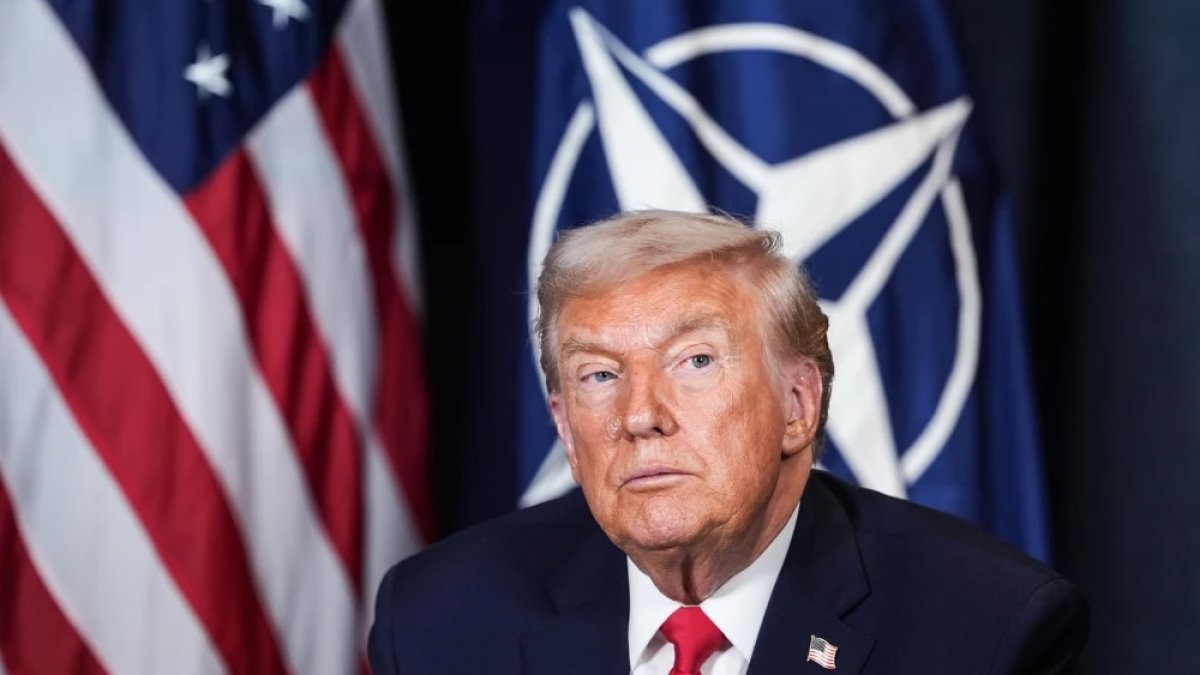
President Donald Trump on Wednesday promised there would be no need for American military might to take Greenland, a nation whose population is about the same as suburban Berwyn and has no independent fighting force.
By the afternoon it appeared the president’s deal was accomplished simply by pulling back threatened tariffs on European nations in exchange for greater U.S. influence over the world’s largest island.
“It’s a deal that people jumped at. Really fantastic for the USA,” Trump said as he was leaving an economic summit in Davos, Switzerland. “Gets everything we wanted, including, especially, real national security and international security. It’s a long-term deal. It’s the ultimate long- term. I think it puts everybody in a really good position. Especially as it pertains to security and minerals…”
In a post on his social media site, Trump said he had agreed with the head of NATO on a “framework of a future deal” on Arctic security, potentially defusing the tense situation.
Trump also said more talks would also occur on Greenland’s place as part of the Golden Dome missile defense program, a massive system that would put U.S. weapons in space for the first time.
Half-a-world away, U.S. military aircraft are still stationed at a U.S.-operated air base in Greenland, where the American flag is firmly planted in frozen Arctic soil. But scenes of U.S. forces and fighters in Greenland aren’t new.
It’s been that way for decades, with the U.S. signing treaties with the kingdom of Denmark, which governs and funds Greenland. The treaties give the U.S. wide defensive military latitude and have ever since World War II, through the Cold War and right up to the present.
Hundreds of U.S. service personnel regularly rotate through deployments in the frigid nation, with tons of equipment are in place at American facilities including sophisticated missile tracking systems. Ongoing training is also underway in Greenland, led by U.S. and NATO forces.
Those facts lead some experts to question why the Trump administration wants to outright own Greenland, when treaties with Denmark successfully allow protection from foreign threats.
“Well, that is the thing that’s a bit confusing about this whole brouhaha, because America has had military bases in Greenland for decades,” said Craig Kafura, director for public opinion and foreign policy at the Chicago Council on Global Affairs. “The U.S. by treaty since the 1950’s has had extensive military access to Greenland. Greenland is covered under NATO obligations, and the U.S. And its NATO allies have been conducting operations, increasingly so, in Greenland and from the Arctic more generally. So the idea of needing to conquer Greenland, needing Greenland to be part of the United States for U.S. national security just isn’t true. It doesn’t hold water.”
There is idyllic scenery along Greenland’s waterfront, against a backdrop of snow-capped mountains. A population of less than 60,000 people don’t want additional American presence or control, and neither do a majority of Americans according to research by the Chicago Council on Global Affairs.
“In the polling that we’ve seen, Americans don’t favor purchasing Greenland either,” said Kafura. “Of course, if you ask Greenlanders, they’re perfectly happy with the current arrangement. You know, being affiliated with Denmark, being EU citizens, this is not something that they are interested in changing.”
The details of the deal have not been made public, and some parties to the discussions tonight say that’s because they haven’t been ironed out. All of this is unfolding in Davos, Switzerland where Trump and many other global leaders were attending the annual World Economic Forum on Wednesday.