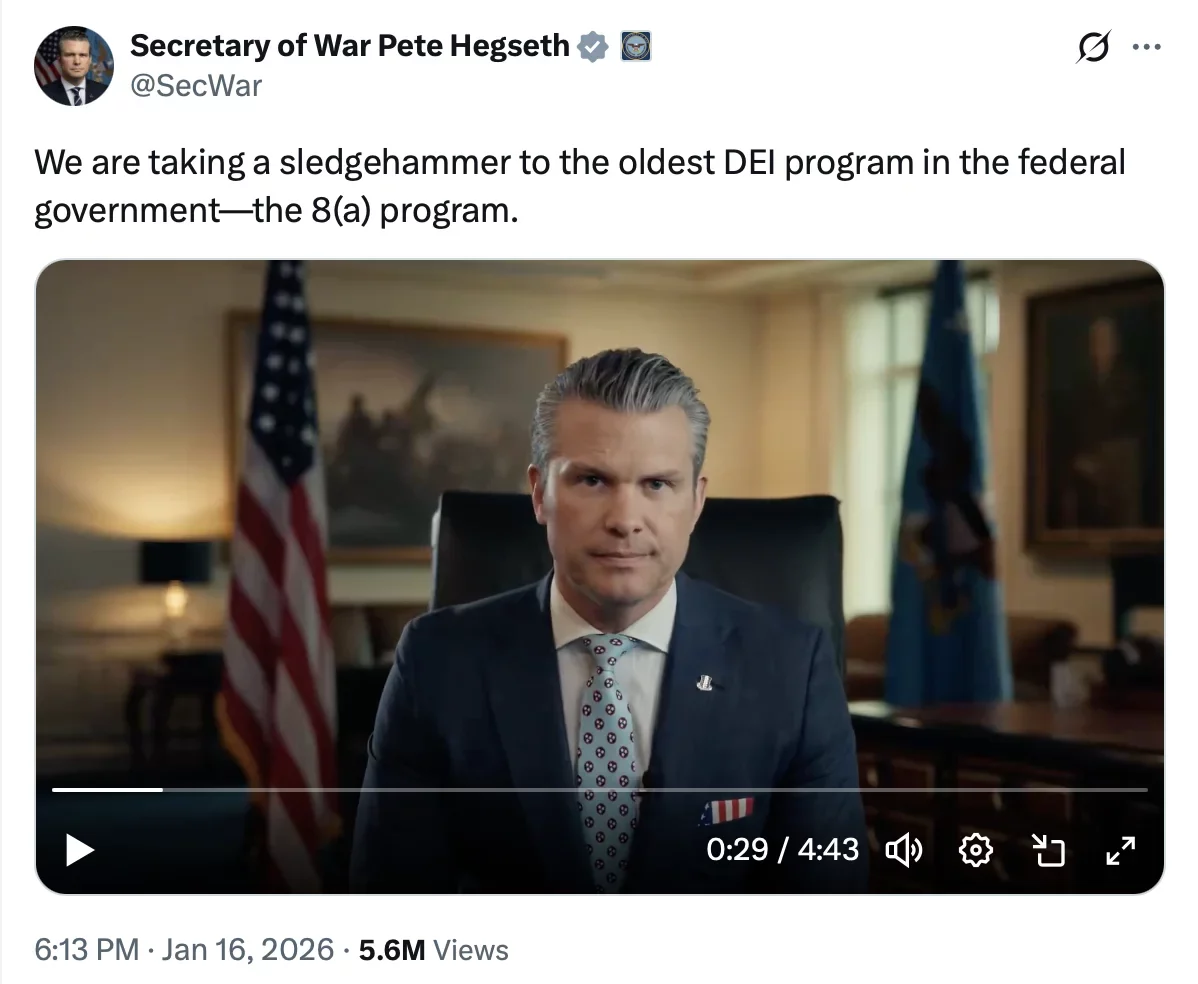

On January 16, 2026, Secretary of War Pete Hegseth announced that the Department of War will be conducting a comprehensive review of contracts awarded under the Small Business Administration’s 8(a) Business Development Program. The announcement, delivered via video on social media platforms, represents the latest action in the administration’s broader efforts to reform federal contracting practices.
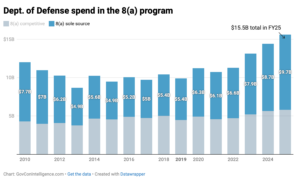
The 8(a) program, administered by the Small Business Administration, was established to assist small businesses owned by socially and economically disadvantaged individuals or tribes. Through the program, certified firms receive access to federal contracting opportunities, including sole-source contracts that can be awarded without competitive bidding. The Department of War (DOW) is the largest user of 8(a) contracts among federal agencies, with Hegseth noting that the Pentagon conducts approximately $100 billion in small business contracting annually, including 8(a) awards.
DOW Actions Follow Wider Government Audits
Secretary Hegseth ordered a line-by-line review of every sole-source 8(a) contract over $20 million, with smaller contracts also subject to examination. The review will assess two primary areas: whether contracts contribute to military readiness and lethality, and whether 8(a) firms are performing the contracted work themselves or operating as intermediaries. Hegseth specifically criticized arrangements where small businesses allegedly collect fees ranging from 10% to 50% before passing contracts to larger consulting firms.
The DOW announcement follows significant enforcement activity across the federal government regarding the 8(a) program. In June 2025, the Department of Justice (DOJ) secured guilty pleas in a case involving over $550 million in contracts that were allegedly steered through bribery and fraud involving a United States Agency for International Development (USAID) contracting officer and multiple 8(a) contractors. Following this investigation, SBA Administrator Kelly Loeffler ordered a full-scale audit of the 8(a) program, directing examination of high-dollar and limited-competition contracts going back 15 years.
In December 2025, the SBA issued letters to all 4,300 current 8(a) participants requiring production of three years of financial records, contracting agreements, and employment records by January 5, 2026. The Department of Treasury also announced a separate audit of preference-based contracting totaling approximately $9 billion across its bureaus.
Defense Budget Context
The 8(a) review occurs amid broader defense budget restructuring as well. In February 2025, Secretary Hegseth directed Pentagon leadership to develop plans for cutting 8% from the defense budget in each of the next five years. According to Pentagon officials, these reductions are intended as offsets to fund administration priorities including border security, missile defense systems, and the elimination of diversity, equity, and inclusion programs.
The bipartisan FY 2025 National Defense Authorization Act authorized a defense budget of approximately $850 billion. If the 8% annual reduction were applied over five years, projections suggest approximately $300 billion less in cumulative military spending through fiscal year 2030 compared to a flat budget scenario, though Pentagon officials have characterized the approach as reallocating funds rather than reducing total defense spending.
Legal and Statutory Framework
The 8(a) program is established by statute, and the Secretary of War does not have authority to eliminate the program itself. However, DOW possesses investigatory and contract termination powers that can be exercised within existing legal frameworks. The department’s review will focus on compliance with program requirements and contract performance standards rather than challenging the statutory basis of the 8(a) program.
Government contracting attorneys have noted that DOJ prosecutes pass-through fraud under both criminal wire fraud statutes and the civil False Claims Act. Indicators of improper arrangements can include employees of subcontractors using prime contractor email addresses, direct communication between subcontractor personnel and government clients, and other evidence suggesting the 8(a) firm is not actually controlling or performing the work.
In the May 2025 case of Kousisis v. United States, the defendants won a contract by falsely representing they would partner with a certified disadvantaged business – as stipulated by the government contract – when they only used them as a pass-through entity. When discovered, what followed was prosecution and two convictions for wire fraud and conspiracy.
What This Means for Government Contractors
Small businesses holding DOW 8(a) contracts should anticipate increased documentation requirements and compliance scrutiny. Industry analysts suggest that firms demonstrating verifiable past performance, documented performance of core contract work, and clear contribution to defense missions may be better positioned during the review period.
Recommended preparatory steps for 8(a) contractors include: reviewing existing contracts for compliance with limitations on subcontracting requirements; ensuring documentation demonstrates that the 8(a) entity performs the primary and vital contract work; and preparing records that show how contract activities support defense readiness objectives.
Plan Long-Term: Invest in in-house capabilities to reduce subcontracting reliance. Build a track record in merit-based competitions for post-graduation positioning.
The coordinated enforcement actions across DOW, SBA, DOJ, and Treasury signal sustained federal focus on 8(a) program integrity. Contractors should monitor Defense Federal Acquisition Regulation Supplement (DFARS) updates, SBA guidance, and agency communications for additional requirements. The review outcomes may influence both immediate contract decisions and longer-term acquisition policy development.