Le Journal

Crews battle large fire at Public Storage facility in Richmond

Pluribus Season 1 Finale's Alternate Ending Explained By Creators
Pluribus season 1 ended exactly as it should, but series creator Vince Gilligan originally had a different idea for the finale.

Sci-Fi Fans Are Saying The Same About Alien: Earth After A Viral Social Media Post

From boom to slowdown: How India transformed US international student mobility and why the momentum is shifting

Trump’s hiring campaign for ‘Tech Force’ draws around 25,000 applications
Around 25,000 people have expressed interest in joining the “Tech Force,” a cadre of engineers to be hired by the Trump administration as it looks to install staff with artificial intelligence expertise in federal roles. The Trump administration will use that list to recruit software and data engineers, in addition to other tech roles, said Scott Kupor, director of the U.S. Office of Personnel Management, in a post on X. The 25,000 figure has been provided by a senior Trump administration official, according to a Reuters report. The program was announced by the Office of Personnel Management, and aims to recruit approximately 1,000 engineers, data scientists, and AI specialists to work on what officials describe as critical technology projects across the government. Participants, called “fellows,” will tackle assignments including AI implementation, application development, and data modernization. READ: Trump warns against over-regulating AI, urges unified federal oversight (November 19, 2025) “The interested candidates will compete for 1,000 spots in the first Tech Force cohort. The recruits will spend two years working on technology projects inside federal agencies, including the Departments of Homeland Security, Veterans Affairs, and Justice, among other government offices,” Kupor said previously. Tech Force members will commit to a two-year employment program working with teams that report directly to agency leaders in “collaboration with leading technology companies,” according to an official government website. The private sector partners include Amazon Web Services, Apple, Dell Technologies, Microsoft, Nvidia, OpenAI, Palantir, Oracle, Salesforce, and numerous others. Once the two-year program is over, they can seek full-time jobs with those companies, who have committed to consider the programs’ alumni for employment. The private partners can also nominate their employees to do stints of government service. This initiative was announced four days after President Donald Trump signed an executive order aimed at blocking state AI regulations, and creating a single national law. It showcases the Trump administration’s increasing efforts to ensure American dominance in the AI race. Annual salaries will likely fall in the range of $150,000 to $200,000, plus benefits, according to CNBC. Applications opened on Monday through federal hiring channels, with OPM conducting initial résumé screenings and technical assessments before agencies make final hiring decisions. Kupor said his goal is to have the first cohort onboarded by the end of March 2026. READ: Study shows AI companies’ safety practices fail to meet global standards (December 4, 2025) There has been some criticism regarding the timing and structure of the initiative. Max Stier, CEO of the Partnership for Public Service, a nonprofit that advocates for federal workers, told Axios, “They are establishing a new program that seems to significantly overlap with the previous initiatives undertaken by USDS before this administration disbanded it.” Rob Shriver, former acting OPM director and current managing director at Democracy Forward, told Nextgov his first concern was “What are the rules that are in place to guard against conflicts of interest?” When asked about private sector employees working on government projects while maintaining their company stock holdings. The post Trump’s hiring campaign for ‘Tech Force’ draws around 25,000 applications appeared first on The American Bazaar.

US judge halts Texas law requiring app store age verification

Millions of student loan borrowers could see paychecks cut in January

Johnson & Johnson to pay $1.56 billion to a talc plaintiff in largest ever award

US bars former EU commissioner, citing ‘censorship of Americans’
European officials pushed back sharply on Wednesday after Washington moved to deny U.S. visas to five people, among them a former European Union commissioner over allegations of censorship. The Trump administration announced visa restrictions against Thierry Breton, who as an EU commissioner played a central role in shaping the bloc’s Digital Services Act, along with four figures linked to anti-disinformation initiatives. U.S. officials said the action was taken in response to what they described as efforts to suppress free speech on American social media platforms, a claim European leaders rejected as unfounded and politically motivated. “The State Department is taking decisive action against five individuals who have led organized efforts to coerce American platforms to censor, demonetize, and suppress American viewpoints they oppose,” as Secretary of State Marco Rubio stated in a statement. The Digital Services Act, meanwhile, requires major technology companies such as Google and Meta to step up their monitoring and removal of illegal content, with the threat of steep financial penalties if they fail to comply. Rubio further stated, “these radical activists and weaponized NGOs have advanced censorship crackdowns by foreign states—in each case targeting American speakers and American companies.” READ: EU ready to retaliate with 30% tariffs in response to Trump (July 23, 2025) U.S. officials argue that allowing such figures to travel to America could carry “potentially serious adverse foreign policy consequences,” he said. “Based on these determinations, the Department has taken steps to impose visa restrictions on agents of the global censorship-industrial complex who, as a result, will be generally barred from entering the United States.” Breton, who served as an EU commissioner from 2019 to 2024, pushed back publicly on X, asking: “Is McCarthy’s witch hunt back?” He also underscored the political backing for the law in Europe, writing: “As a reminder: 90% of the European Parliament — our democratically elected body — and all 27 Member States unanimously voted the DSA.” “To our American friends: “Censorship isn’t where you think it is.”” The European Commission reacted swiftly, saying on Wednesday that it “strongly condemned” the U.S. decision. “Freedom of expression is a fundamental right in Europe and a shared core value with the United States across the democratic world,” it said in a statement, further adding that “the EU is an open, rules-based single market, with the sovereign right to regulate economic activity in line with our democratic values and international commitments.” “Our digital rules ensure a safe, fair, and level playing field for all companies, applied fairly and without discrimination.” The Commission said it has sought clarifications from U.S. authorities on the decision. France also weighed in, with President Emmanuel Macron condemning the visa restrictions. READ: Big Tech braces for impact as EU’s AI Act takes effect (February 24, 2025) “These measures amount to intimidation and coercion aimed at undermining European digital sovereignty,” Macron said in a statement on X. He emphasized that “the European Union’s digital regulations were adopted following a democratic and sovereign process by the European Parliament and the Council,” pushing back against suggestions of political targeting. Macron added that the DSA is not aimed at any particular third country but is meant “to ensure that what is illegal offline is also illegal online.” The move comes as President Donald Trump continues to tighten travel rules for foreign visitors while stepping up his criticism of Europe. Secretary of State Marco Rubio did not name the individuals targeted by the State Department, but Under Secretary for Public Diplomacy Sarah Rogers later identified them in a post on X. Among those sanctioned were Josephine Ballon, co-leader of HateAid and a member of Germany’s Advisory Council on the Digital Services Act, who has…

Artificial intelligence in 2025: A year in review
From hype cycles to supply and demand In 2025, artificial intelligence stopped behaving like a futuristic software story and more like an economics problem. Demand was no longer the challenge. Enterprises wanted AI. Governments wanted AI. Investors wanted AI. The constraint that defined the year was supply compute, chips, electricity, skilled labor, physical infrastructure and of course, capital and data. AI ran into the real, physical limits of the world being able to feed its enormous appetite. That realization quietly reshaped the entire conversation. The central question shifted from “what can these systems do?” to “how much of it can we actually build, power, govern, and afford?” AI in 2025 revealed itself not as a lightweight digital layer but as an industrial-scale system that has infinite potential. This year-in-review looks at AI through that lens. Not as hype and fear but as something already operating at scale that measurable in megawatts consumed, chips allocated, dollars invested, revenues generated, and institutions disrupted. The defining story of AI in 2025 is one of demand accelerating faster than supply, and society racing to adapt to that imbalance of power. Investment shifts: Capital chases constraint Global private investment in artificial intelligence reached $103.4 billion in 2024, according to the Stanford AI Index 2025, with early indications suggesting that 2025 modestly exceeded that figure. What mattered far more than the total amount of capital was where it was spent. Roughly $58–62 billion, nearly 60% of all AI investment, flowed into infrastructure rather than applications or experimentation. Cloud providers alone reported more than $180 billion in capital expenditures in 2025, with 30–35% tied directly to AI-related infrastructure. Just a few years earlier, the emphasis had been on software and model development. AI investment began to resemble industrial investment. Data centers, power purchase agreements, cooling systems, networking hardware, and semiconductor supply contracts became as critical as algorithms. The market was no longer just testing whether AI would be adopted. It was testing whether the physical world could sustain the pace of adoption. READ: US launches review of advanced Nvidia chip sales to China (December 19, 2025) Revenue growth, monetization, and the supply-side ceiling Generative AI revenue reached approximately $67.2 billion globally in 2025, up from $44.8 billion the previous year. About 72% of that revenue came from enterprise customers. Businesses were no longer experimenting with AI on the margins; they were integrating it directly into core workflows. Enterprise AI startups reflected this shift. Median annual recurring revenue reached $3.1 million within the first year, nearly double the $1.6 million median for non-AI software firms. Demand was real, sustained, and growing but profitability remained uneven. As noted in Harvard Business Review, many AI companies found that subscription pricing and usage-based models struggled to keep up with the cost of compute, infrastructure, and talent. This exposed a defining economic reality of 2025: AI companies were not demand-constrained; they were supply-constrained. As OpenAI CEO Sam Altman noted, additional compute could be monetized immediately but the bottleneck was infrastructure. In that sense, AI economics became less about finding customers and more about expanding supply fast enough to meet existing demand. Compute, chips, and concentration risk Training frontier AI models in 2025 required unprecedented resources. Individual training runs routinely involved 15,000 to 25,000 advanced GPUs, with costs ranging from $120 million to $450 million. This scale concentrated meaningful AI capability in the hands of a small number of firms with access to capital, chips, and long-term supply agreements. More than 92% of advanced AI training workloads relied on chips produced by just two manufacturers which systemic risk. AI…
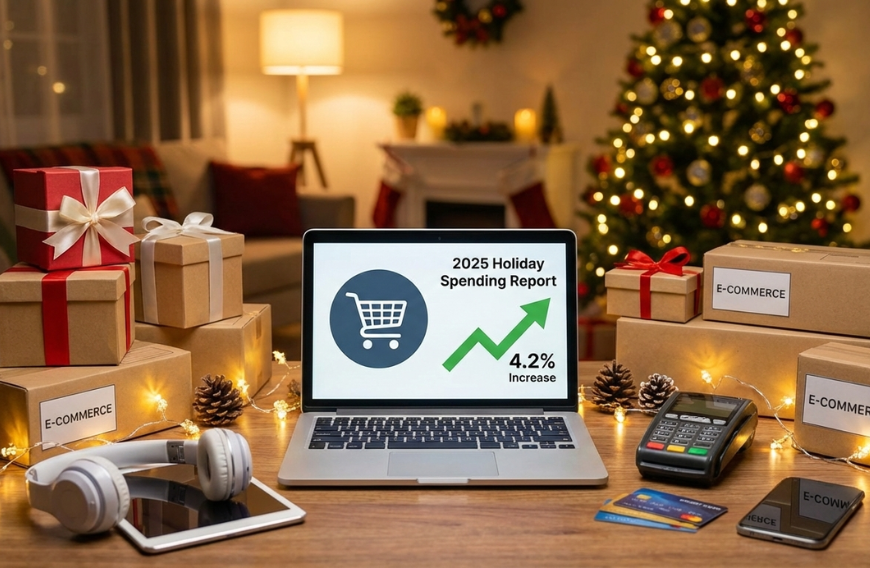
Holiday spending rises 4.2%, led by e-commerce and electronics: Visa
A report released on Tuesday by Visa Consulting and Analytics showed that retail spending has gone up by 4% this holiday season, despite lingering economic headwinds. Shoppers were spending the most on electronics and personal goods. The findings come from payments tracked over a period of seven weeks beginning on Nov. 1 using a subset of Visa payments network data in the U.S. and cover core retail categories, excluding spending on automotive, gasoline and restaurants. The figures have not been adjusted for inflation. In-store shopping constituted 73% of total retail payment volume, while the remaining 27% consisted of online transactions. However, despite in-store shopping being responsible for the bulk of spending, e-commerce has been recognized as a driver of growth. Online sales have risen by 7.8% since last year, reflecting a demand for convenience and early-season promotions, according to CNBC. READ: Halloween spending soars to $13.1 billion, turning holiday into major retail event (September 25, 2025) “The underlying surprise here … is that consumer spending is holding up reasonably well in light of softer consumer confidence than we had this time last year and a number of headwinds and concerns about inflation,” Michael Brown, principal U.S. economist at Visa, told CNBC. Brown also noted the shift in consumer behavior due to the influence of artificial intelligence in shopping. “We are seeing consumers use AI in a big way in comparison shopping and then helping to narrow down that perfect gift,” Brown said. “This is the first holiday shopping season where roughly half of the consumers in that survey responded that they are going to leverage AI for one of those two tasks.” The breakdown of spending categories indicate a shift towards personal goods and convenience, and away from home renovation projects. Electronics emerged as the season’s top-performing category, with sales climbing 5.8%. Visa attributed this jump to a refresh cycle driven by “high-performance devices in the AI era.” READ: Why artificial Christmas tree prices are rising in 2025 (November 17, 2025) Apparel and accessories also posted strong numbers, rising 5.3%. General merchandise stores which offer a “one-stop” experience saw a 3.7% rise. On the other hand, the home improvement sector struggled during the holidays. Spending on building materials and garden equipment fell 1%, suggesting consumers prioritized gift-giving and gadgets over home maintenance as the year closed out. Furniture and home furnishings remained essentially flat, with a 0.8% gain. While this indicates an overall positive for the retail sector, the lack of inflation adjustment means the “real” growth volume will be more modest depending on the final Consumer Price Index readings for the period. Currently, Brown said, real spending growth adjusted for inflation is still up about 2.2% this season. “That’s not too bad in light of a lot of uncertainty this year,” Brown said. “The consumer is uncertain, they’re cautious, but they’re also smart about how they’re spending their money.” The post Holiday spending rises 4.2%, led by e-commerce and electronics: Visa appeared first on The American Bazaar.