
Le Journal

Susan Collins’ vote on Venezuela was a needed vote to reclaim congressional authority
The BDN Opinion section operates independently and does not set news policies or contribute to reporting or editing articles elsewhere in the newspaper or on bangordailynews.com Bill Burgess of Portland is a partner with North Bridge Venture Partners. He currently serves on the board of Issue One, a crosspartisan political reform group, and is co-chair of The Council for American Democracy, a nationwide coalition of citizens dedicated to preserving our democracy. For decades, Congress has steadily surrendered one of its most solemn but important constitutional responsibilities: deciding when the United States goes to war or launches consequential military operations. Presidents of both parties have filled that vacuum — ordering strikes and sending our uniformed citizens into harm’s way with little oversight or accountability from the legislative branch. What was meant to be a shared, deliberative process has increasingly become an executive prerogative. The Senate’s recent, final vote rejecting a resolution that would have prevented President Donald Trump from engaging in further military operations in Venezuela without congressional approval is an unfortunate continuation of this trend. However, it is not a reason for despair because the final vote was extremely close. Three Republican senators — including Maine Sen. Susan Collins — joined Democrats in voting for the proposal, showing bravery by standing up to party pressure to protect our democracy. Since she is the only one of the three Republicans running for reelection this year and the president has repeatedly criticized her and called on his base to boot her out, Collins especially deserves recognition for upholding the constitutional obligation of Congress. The founders were very clear about this: They vested the power to declare war with Congress precisely because decisions of war and peace were never meant to rest with one person alone. James Madison warned that the executive is “most prone” to war, and concentrating such power in a single office posed a grave threat to liberty. Congress was meant to serve as the people’s voice — debating and authorizing the use of military force in concert with the commander in chief. Yet over time, Congress has too often stood on the sidelines. Lawmakers have ceded their constitutional authority to the executive branch, allowing presidents of both parties to unilaterally order military force without seeking congressional input or authorization. This abdication has eroded our system of checks and balances and concentrated dangerous amounts of power in the executive branch. If the Venezuela war powers resolution had passed, it would have allowed our elected representatives to reassert a basic truth: Congress is not a spectator. It is a co-equal branch of government designed to serve as a check on executive power. Furthermore, this congressional action would have gone a long way to reassert the founders’ view that Congress, and not the president, is the leading branch of government when it comes to the use of military force. The founders deeply understood that when this power is vested in one person, it creates the possibility for abuse. The presidency has mostly been occupied by men with deep respect for the Constitution, the separation of powers, the rule of law, and long-held customs of behavior. President Trump has increasingly ignored or violated these “rules of the road,” viewing them as annoying barriers to doing whatever he wants, regardless of what the people want or the price we pay for his actions. This is why the people’s branch, Congress, must once again reassert its constitutional role. Congress should take additional action by advancing the National Security Powers Act, which would restore Congress’ constitutional role over war-making, emergency powers, and military deployments. As a recent nationwide poll conducted by Issue One — a leading crosspartisan political reform group — revealed, American voters are…

Why right now is the time to buy a crossbow

Letter: Heartened to join in calling for peace, equality and justice

Letter: Slow down and pay attention in work zones
Letters submitted by BDN readers are verified by BDN Opinion Page staff. Send your letters to letters@bangordailynews.com I am a 43-plus year veteran of the Maine Department of Transportation, having worked in bridge maintenance my first five years. I have personally been involved in several near misses with traffic inattention. One was at the southbound on-ramp to Interstate 95 from Hammond Street in Bangor. A very similar setup that happened in Waterville just the other day. It is a cloverleaf on-ramp to the interstate where traffic was to stop before entering the passing lane traveling underneath the Hammond Street overpass. A lady did not stop, and a tractor trailer almost hit her from behind. Luckily, we were painting the steel beams underneath the bridge and not in the coned off area at that time. I see the traveling public every day speeding through the Broadway overpass on I-95 not slowing down one bit. The signs say “Fines Double” but to no avail they keep on trucking. Maybe the fines should be quadrupled. I think maybe MaineDOT, along with the construction industry, should have short TV safety commercials on how to navigate different scenarios the travelling public may encounter daily. My heart and soul goes out to the families of the two killed and the two highway maintenance workers injured in Waterville. To the traveling public, please slow down and pay attention to the work zone safety signs. Terry WhiteHermon

Letter: New school milk law a win for cows
It’s nearly impossible to get a primary care doctor in Bangor

State to start evaluating future of 89-year-old coastal Maine bridge

He’s a force on Maine basketball courts. He does it mostly with one arm.
Lennon McAfee took the court for Foxcroft Academy on Thursday night sporting a black eye — a parting gift from a collision in his team’s game the night before against Hermon High School. But neither that shiner nor the fatigue of back-to-back games could slow the senior forward down. That might be because McAfee has been dealing with much larger obstacles his whole life. And rather than impede his growth as a basketball player, they have helped forge him into a force to be reckoned with in Maine’s Class C North region. While many high school players have a dominant hand that they use more than the other, McAfee has an arm that he can’t really use much at all. He suffered what’s known as a brachial plexus injury at birth, and despite several surgeries, has been left with about 15% usage in his right arm. “I was past due, and what they had to do — instead of breaking the collarbone, they ripped on my shoulder and it caused me to have my shoulder come out of place,” he explained about those birth complications. That means he has to do almost everything on the court with his left hand. For some, it might be a disadvantage. For McAfee, it’s fuel. “I think I definitely feel like I have a chip on my shoulder,” McAfee said. “Obviously I know some of my limitations, but I’m not going to let that just stop what I feel like I’m able to do and able to contribute to the team.” And boy does he contribute. McAfee is averaging more 18 points while hauling down around six rebounds and adding roughly three steals per game for the Ponies, who he has helped lead to a 10-2 record so far this season. Foxcroft Academy’s Lennon McAfee strips the ball from Central’s Carter Sheaff in a game at Central High School on Thursday. Credit: Linda Coan O’Kresik / BDN “He really is the heart and soul of our team and of our program,” said Foxcroft coach Charles Beale. “The amount of time that he’s spent and how much passion and effort that he gives, it’s pretty remarkable.” That passion and effort was evident right from the get-go on Thursday against Central High School of Corinth. McAfee set the tone early for the ponies by knocking down a couple of three-pointers, causing havoc on the defensive end and turning several turnovers into easy layups. He had 10 points in that first quarter and a game-high 22 at the end of the night. And he didn’t even play in the fourth quarter as Foxcroft sailed to its 10th win of the season to stay unbeaten in Class C play up to that point. Its only two losses as of Friday were at the hands of Class B Hermon. “In my opinion, Lennon is the most complete player in Class C in the state,” Beale said. “He rebounds it at a high rate. I think he’s leading Class C in steals. He’s shooting from beyond the arc at 50%. His field goal percentage is close to 60%.” Beale said that McAfee’s condition doesn’t make it easy to play basketball, but while other young players might be deterred by the cards he has been dealt, McAfee has embraced the hard path in front of him with a relentless work ethic. Foxcroft Academy’s Lennon McAfee takes a shot in a game against Central High School on Thursday. Credit: Linda Coan O’Kresik / BDN “He’s had this disability his whole life. He really can’t use his left arm for much more than like a support,” Beale explained. “He can’t dribble with it. He can’t, you know, lift it up. He can’t catch with it, so we can only pass it to him really 50% of his body. Most of the time he’s literally playing with one arm. It’s pretty amazing to see.” What’s even more amazing doesn’t just succeed mostly with his left arm, he does so with opponents knowing that he favors his left. Beale said he can’t help but laugh when he hears opponents and their fans thinking they can swarm McAfee on his left — something that is easier said than done, according to the coach. “One of my favorite things when we play basketball is, people from the crowd and other coaches just say like, ‘Take away the left, he can only go left.’ Kyle Corrigan, the…

One rural Maine hockey program is in early stages of a comeback
The current US political climate is spurring a ‘reclaim’ and rallying on the MLK holiday

Patriots overcome fumbles to beat Texans for trip to AFC title game
’60 Minutes’ airing report on Trump deportations that was suddenly pulled a month ago
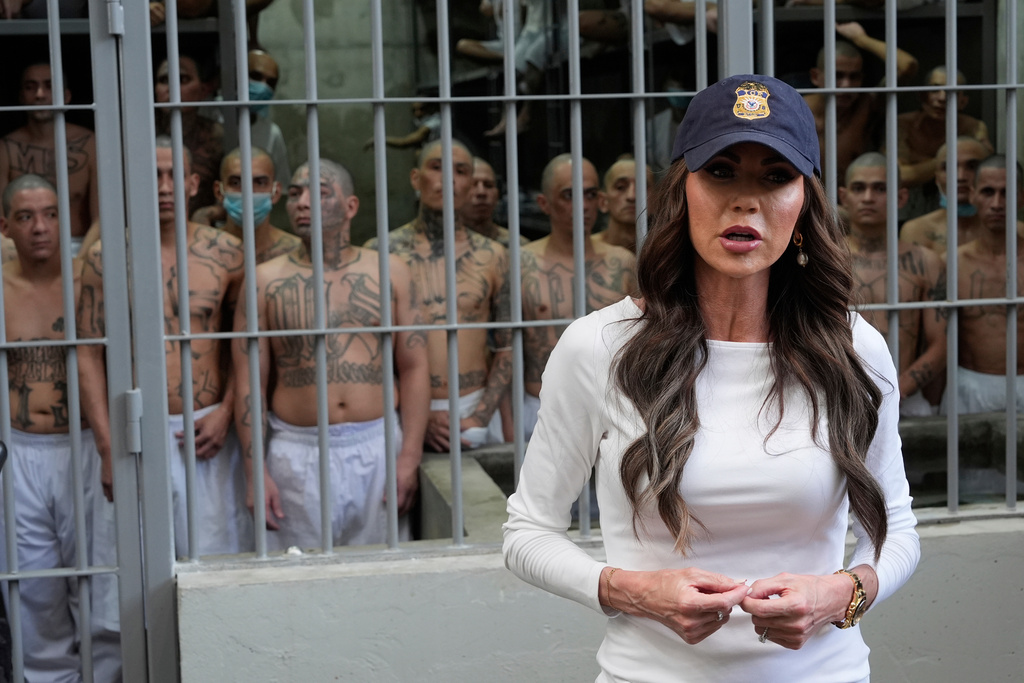
“60 Minutes” on Sunday plans to air a story about Trump administration deportations that was abruptly pulled from the newsmagazine’s lineup a month ago, sparking an internal battle about political pressure that spilled out into the open. In the story, correspondent Sharyn Alfonsi spoke to deportees who had been sent to El Salvador’s notoriously harsh CECOT prison. When the segment critical of the administration was struck from the Dec. 21 episode on order of new CBS News editor-in-chief Bari Weiss, Alfonsi told her “60 Minutes” colleagues that it “was not an editorial decision, it was a political one.” Weiss argued that the story did not sufficiently reflect the administration’s viewpoint or advance reporting that had been done by other news organizations earlier. The story was updated to include Trump administration statements, although it has no new on-camera interviews. Alfonsi was also set to give more details about the two migrants that she interviewed about their experiences in the prison, according to someone familiar with the broadcast who spoke under condition of anonymity because the person was not allowed to give details in advance. “CBS News leadership has always been committed to airing the ”60 Minutes” CECOT piece as soon as it was ready,” the news division said in a statement. “Tonight, viewers get to see it, along with other important stories, all of which speak to CBS News’ independence and the power of our storytelling.” The decision became a flashpoint for critics who said the appointment of Weiss, founder of the Free Press website who had no previous experience in television news, represented an attempt by the network’s new corporate leadership to curry favor with Trump. Alfonsi said in her email that administration officials had declined to make anyone available for an on-camera interview, calling that a tactical maneuver designed to kill the story. While pulled from the broadcast in December, Alfonsi’s original story mistakenly became available online. CBS News had fed a version of the newsmagazine to Global Television, a network that airs “60 Minutes” in Canada, which posted it on its website before the last-minute switch removing the piece. That enabled sharp-eyed viewers to see what Weiss had rejected, offering the opportunity to compare it to what “60 Minutes” eventually put on the air. In the version shown in Canada, Alfonsi said the administration declined requests for interviews and referred questions about the prison’s operation to the government of El Salvador, which did not respond to “60 Minutes.” The story included a brief clip of President Donald Trump saying the prison operators “don’t play games,” and one from White House press secretary Karoline Leavitt saying that “heinous monsters, rapists, murderers, sexual assaulters, predators who have no right to be in this country” were sent there. Since Weiss’ appointment, Trump administration officials have been more visible on CBS News, in interviews that she sometimes helped arrange. The president himself was interviewed by Norah O’Donnell on “60 Minutes” on Nov. 2. The New York Times reported Saturday that after Trump was interviewed last week by new “CBS Evening News” anchor Tony Dokoupil, Leavitt told the network that “we’ll sue your ass off” if the exchange wasn’t aired in full. All of the 13-minute interview was shown Tuesday, an unusual step for one of the broadcast networks’ evening newscasts, a half hour summary of the day’s big stories. CBS told The Times that it had decided to run the interview unedited at the time it was booked. ___ David Bauder writes about the intersection of media and entertainment for the AP. Follow him at http://x.com/dbauder and https://bsky.app/profile/dbauder.bsky.social.