Le Journal

Animal Crossing’s new update has revived my pandemic sanctuary

Municipales à Ascain : la majorité lâche l’affaire, Jean-Louis Laduche revient



I Do review – immersive hotel drama as wonderful as a real wedding day

‘The rise of fascism makes our work even more important’: Montez Press, champions of queer, feminist art
They published a raunchy book inspired by the Guardian’s Owen Jones; broadcast interviews with obscure punk legends; and make calendars to navigate the world of underground art. Now they’re going globalStuart McKenzie turns towards a fan on a makeshift stage so his long brunette hair blows in the wind. The artist is dressed in a power suit with thick rimmed glasses, flamboyantly smoking a cigarette as he performs the confessional poetry he’s been writing since the 80s. “Stuart is this fantastic London staple who is just coming out of the woodwork now,” says Emily Pope, the director of Montez Press, who hosted the fundraiser where McKenzie performed to support their queer, feminist press and radio.McKenzie is a typical Montez Press collaborator: an experimental artist who doesn’t fit neatly into either art, literary or music spaces (although he did recently support the indie band Bar Italia). He’s later in his career than some of the emerging artists they collaborate with but he has Montez Press’s “desire to push boundaries and ask questions,” as Anna Clark, one of the organisation’s founding members, puts it. Continue reading...
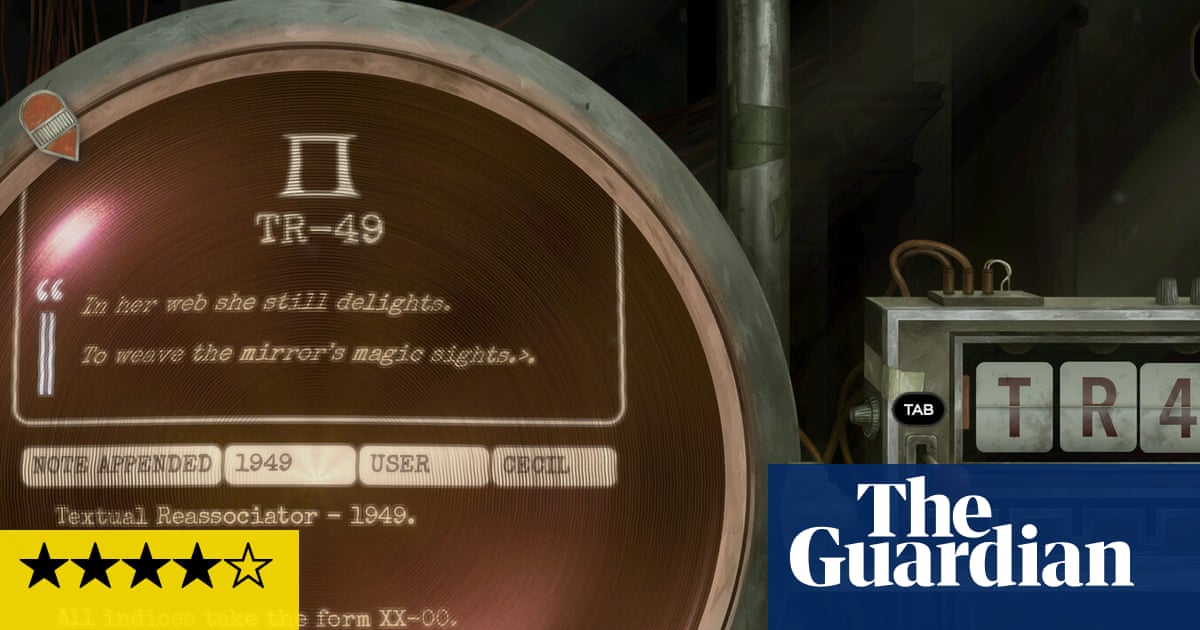
TR-49 review – inventive narrative deduction game steeped in the strangest of wartime secrets
PC; InkleThe UK game developer’s latest is a database mystery constructed from an archive of fictional books. Their combined contents threaten to crack the code of realityBletchley Park: famed home of the Enigma machine, Colossus computer, and, according to the premise of TR-49, an altogether stranger piece of tech. Two engineers created a machine that feeds on the most esoteric books: treatises on quantum computing, meditations on dark matter, pulp sci-fi novels and more. In the mid-2010s, when the game is set, Britain finds itself again engulfed by war, this time with itself. The arcane tool may hold the key to victory.You play as budding codebreaker Abbi, a straight-talking northerner who is sifting through the machine now moved to a crypt beneath Manchester Cathedral. She has no idea how it works and neither do you. So you start tinkering. You input a four-digit code – two letters followed by two numbers. What do these correspond to? The initials of people and the year of a particular book’s publication. Input a code correctly and you are whisked away to the corresponding page, as if using a particularly speedy microfiche reader. These pages – say, by famed fictional physicist, Joshua Silverton – are filled with clues and, should you get lucky, further codes and even the titles of particular works. Your primary goal is to match codes with the corresponding book title in a bid to find the most crucial text of all, Endpeace, the key to understanding the erudite ghosts of this machine. Continue reading...

‘A new form of theater’: can Ian McKellen, 52 cameras and ‘mixed reality’ reinvent a medium?
At the Shed in New York, attendees wearing enhanced glasses are witnessing an experimental new play where actors appear in video formYou sit in a circle at the Shed, the cultural center in Manhattan’s futuristic Hudson Yards, waiting for the show to begin. Through your enhanced glasses, you see four empty chairs facing you, just out of reach. You watch strangers look out for the actors to arrive. As they do, one at a time, you feel unsettled – each locks eyes with you, specifically. “Don’t panic,” the esteemed British actor Ian McKellen assures you, as the actors take their seats.Except the actors are not there, really – McKellen, along with co-stars Golda Rosheuvel, Arinzé Kene and Rosie Sheehy, appears in An Ark, a new play at the Shed, in video form, a nearly opaque specter overlaid on the candy-apple red carpeting and crisp white walls of the theater and the outlines of your 180 or so fellow audience members. The experimental new play, written almost entirely in the second person by Simon Stephens (whose most recent show, the Andrew Scott-starring Vanya, wowed audiences at the Lucille Lortel theater last year), is one of the first so-called “mixed reality” shows staged in New York, blending physical experience with digital elements. Over 47 minutes, the actors address you, the viewer, directly. Their gaze remains trained on you. Don’t panic, they repeatedly assure. (Though due to some technical malfunctions at the preview I attended, there was some panicking.) Continue reading...

‘Soviet attitudes framed local culture as backward’: the record label standing up to Russian imperialism

Goodbye, Queer Eye: pure comfort TV that’s too fabulous to exist in this world any more

Saipan review – Roy Keane and Mick McCarthy’s epic spat becomes amusing state-of-the-nation psychodrama