
Le Journal

Bayer Shares Surge After Supreme Court To Hear Roundup Appeal; Is The Decade-Long Bear Market Over?
Bayer Shares Surge After Supreme Court To Hear Roundup Appeal; Is The Decade-Long Bear Market Over? Bayer AG shares moved higher in European trading after the U.S. Supreme Court agreed to hear its appeal of a Roundup verdict, raising new hopes the ruling could undermine thousands of related lawsuits over cancer risks. Last Friday, the Supreme Court said it would hear an appeal from Bayer, which petitioned the court last year. Bayer argues that users of the weedkiller shouldn't be able to sue the company for failure to warn about cancer risks because federal regulators have determined that Roundup's main chemical, glyphosate, does not require a cancer warning. The case challenges a $1.25 million Missouri jury award over claims Bayer failed to warn that Roundup causes cancer. Bayer argues the claims are preempted by federal law and maintains the product is safe. The Wall Street Journal noted, "The Supreme Court will likely hear arguments in the case this spring, with a ruling expected by early July. If Bayer prevails, it could help lead to the dismissal of thousands of cases against the company." The lawsuit stems from Bayer's $63 billion acquisition of Monsanto, the developer of Roundup, in 2018. Glyphosate remains the most heavily used herbicide on American farms, with 300 million pounds applied annually. The Roundup litigation sent Bayer shares in Europe into a decade-long bear market. In 2025, what appears to be a bottoming year, the stock troughed near 2004 levels around 20 euros and has since more than doubled to roughly 44 euros. Shares are up more than 7% on Monday. "The Supreme Court decision to take the case is good news for U.S. farmers, who need regulatory clarity," Bayer CEO Bill Anderson told WSJ in a statement. "It's also an important step in our multi-pronged strategy to significantly contain this litigation." Last month, the Trump administration urged the Supreme Court to take up the Roundup case. The EPA has "repeatedly determined that glyphosate is not likely to be carcinogenic in humans, and the agency has repeatedly approved Roundup labels that did not contain cancer warnings," Solicitor General John Sauer wrote in a December legal brief. "A manufacturer should not be left subject to 50 different labeling regimes prescribing different requirements," Sauer said. Bayer said it expects a Supreme Court decision by summer. Watch shares of the company likely squeeze higher. Tyler Durden Mon, 01/19/2026 - 09:25
Futures, Global Markets Sink, Gold Soars On Trump Tariff Threat

Trump To Norway: No Nobel, No Greenland? The Letter That Has Shocked Europe

Chaos By Design
Chaos By Design Authored by Jerry Rogers via American Greatness, Over and over again, we’re told to be outraged. An individual is detained by Immigration and Customs Enforcement (ICE). He is later released. And before the facts can catch their breath, Democratic politicians and activist megaphones are already screaming ‘abduction’, ‘fascism’, and ‘state violence’. Cue the mob. Cue the cameras. Cue the chaos. It plays out over and over again. Remember the viral video of a woman screaming ‘I’m a U.S. citizen’ as ICE agents pulled her from a car in the Florida Keys? The media and politicians pounced – ICE ‘arrested an American citizen’. Turns out this person was detained by ICE because she refused to identify herself and was driving her boyfriend’s vehicle. Afterwards, reports disclosed that the boyfriend was in the country illegally. She chose not to comply. Perhaps she wanted the situation to escalate? Much of the debate about ICE has become political theater. Let’s slow this down and apply something increasingly rare in modern politics: the facts. ICE detains individuals pursuant to its lawful authority. That happens every day. Sometimes people are held. Sometimes they’re released. Detention and release are not evidence of wrongdoing by law enforcement—they are the process. But in today’s political climate, process doesn’t matter. Optics do. Rage does. And outrage is politicized and monetized. What does make these encounters dangerous is not ICE. It’s the reckless rhetoric that surrounds them. When Democratic elected officials tell people that law enforcement officers are ‘kidnappers’ or ‘stormtroopers’, when they suggest citizens have a moral duty to interfere with federal agents, they are not encouraging peaceful protest—they are inciting confrontation. And when mobs take that cue and physically obstruct officers doing their jobs, the risk to everyone involved skyrockets. This is not complicated. What happens? Lawful orders are given. They’re ignored. Resistance follows. A crowd interferes. Officers are forced to manage a volatile situation that never needed to exist in the first place. If individuals simply comply with lawful commands—no dramatics, no resistance, no posturing—these could be routine encounters. No drama; no chaos, no violence. If the mob allows officers to do their work instead of inserting themselves into a federal enforcement action, there would be no spectacle, no video clips, no political fundraising emails. But compliance doesn’t trend on social media. What we’re witnessing is a dangerous feedback loop. Politicians inflame tensions with extreme language. Activists show up looking for confrontation. Law enforcement is placed in an impossible position. Then, when things escalate—as they predictably do—the very people who lit the fuse rush to the microphones to condemn the explosion. That’s not leadership. That’s negligence. No one is above the law, but justice isn’t served when the law is deliberately obstructed either. ICE officers are not free agents; they operate under rules, supervision, and due process constraints. Pretending otherwise may be politically useful, but it is factually false—and dangerously so. If Democrats truly cared about safety, about de-escalation, about justice, they would stop encouraging resistance and obstruction. They would tell their supporters the truth: you don’t get to decide, in the moment, which laws you’ll obey and which officers you’ll recognize as legitimate. These incidents don’t have to happen. They are not inevitable. They are manufactured—by irresponsible rhetoric, by mob interference, and by a political class more interested in chaos than consequences. And the next time it happens—and it will—remember who made it dangerous. Tyler Durden Mon, 01/19/2026 - 08:15

Market Risk Returns As Tariff Shock Jolts Stocks; Goldman Maps Three Retaliation Paths Against Trump Over Greenland

Kurds Withdraw From Syria's Largest Oil Field As Jolani Forces Move In

Pornographic 'Groomer' Books On Prominent Display In Kids' Reading Room At London Museum

Germany Forces Lexus To Deactivate Remote Start With Over-The-Air Update
Germany Forces Lexus To Deactivate Remote Start With Over-The-Air Update Germany - whose chancellor just admitted they made a 'serious strategic mistake' chasing green unicorns when they shut down their nuclear plants - has just forced Lexus to deactivate the remote start feature which pre-warms an owner's car so they don't freeze their nethers off first thing in the morning in the winter. BILD reader Stephan P. from Berlin is plagued by a problem with the stand-alimonization of his Lexus – and he is not alone in the problem Toyota spokesman Ralph Müller confirmed the measure, telling BILD that the pre-heating feature, which was previously free via MyToyota or Lexus Link Plus apps - is now deactivated on all combustine-engine vehicles across the country, as legislators consider remote engine warm-up "unnecessary running" that creates "avoidable exhaust pollution." What's more, Toyota has used remote access to disable the function to comply with the order, protecting owners from potential penalties by German authoritarian regulatory enforcers. The feature is still available on pure EVs and plug-in hybrids, which allows for cabin heating without starting the combustion engine. 🇩🇪‼️🚨 BIG BROTHER: German authorities forced Lexus to turn off the parking heating in Lexus cars! Just when it got cold and people needed it! Imagine you bought a car and paid for specific features, but the government just turns it off because it’s NOT GREEN! I’m not joking,… pic.twitter.com/x3wMmwVCNu — Lord Bebo (@MyLordBebo) January 15, 2026 As Gadget Review notes further, Car idling bans stem from Germany’s broader assault on fossil fuel heating systems. This crackdown connects to Germany’s Building Energy Act, requiring 65% renewable energy in new heating systems by 2024. The law aims to phase out gas and oil heating by 2045, but critics highlight massive costs and slow adoption rates—gas still heats 56% of Germany’s 43 million apartments. Coalition plans to reform the controversial “heating law” by February 2026 promise more flexibility and technology openness. But car owners are collateral damage in this green transition, where authorities apparently can’t distinguish between heating a building and de-icing a windshield. Your luxury car just became the latest battlefield in Europe’s climate wars, where bureaucrats decide which buttons work in your own vehicle. The real question isn’t whether remote start causes pollution—it’s whether you still own the features you bought. Tyler Durden Mon, 01/19/2026 - 05:45

PCR: The EU Elite Have Banned European Democracy

Brits Hold Mass Protest Against Chinese 'Super-Embassy' In London

Trump's Planned Mediation Between Egypt & Ethiopia Might Worsen Regional Tensions
China Tech Boom Leaves Economic Malaise Behind
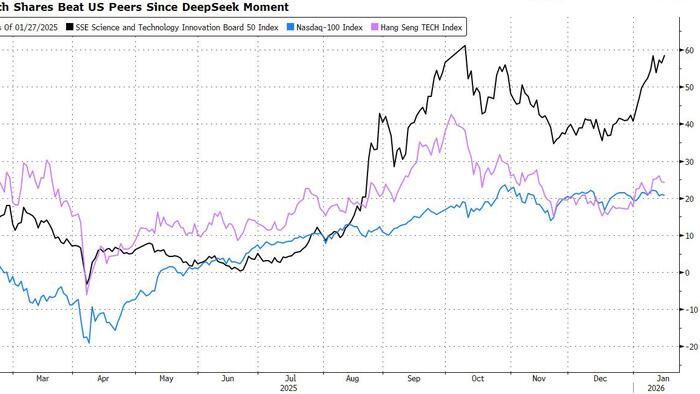
China Tech Boom Leaves Economic Malaise Behind By Jeanny Yu, Bloomberg Markets Live strategist and reporter Nearly a year after DeepSeek’s AI breakthrough rattled global markets, China is entering 2026 with a fresh wave of technological advances that are powering a stock rally, even as its economy remains fragile. Thanks to fresh progress in sectors from commercial rockets to robotics and flying cars, Chinese tech shares have begun the new year with a bang. An onshore Nasdaq-like tech gauge has shot up almost 13% so far this month, while a measure of Hong Kong-listed Chinese tech firms has climbed nearly 6%. Both have outperformed the Nasdaq 100. Enthusiasm about homegrown technologies has been the single biggest driver of China’s equities bull run since April, even as the world’s second-largest economy remained mired in a housing slump and anemic consumption. The momentum may gain further support in the coming months as DeepSeek rolls out a new AI model and China unveils a five-year economic blueprint prioritizing technological self-reliance. “The stock market is telling us that what China is doing in technology sector is going to be very exciting going forward,” Mark Mobius, managing director of Mobius Emerging Opportunities Fund, told Bloomberg TV on Friday. “You must remember China’s goal now is to overtake the US in technology, in high-level chips, in all kinds of AI. So the money is going in that direction.” Since DeepSeek shocked global markets with its cheap and equally well-performing AI models on Jan. 27 last year, fellow Chinese firms have accelerated efforts to develop their own versions. Adoption of generative AI has also surged among the country’s Internet giants from Alibaba Group Holding Ltd. to Tencent Holdings Ltd. Elsewhere, Chinese robots have competed in marathons, sparred in boxing matches and performed folk dance routines. In manufacturing, large language models are being embedded into advanced equipment, such as flying taxis and precision machine tools. The developments are recasting China in investors’ eyes from a low-cost manufacturing base into a credible challenger to US tech leadership, just as global capital hunts for the next growth engine. In a basket of 33 Chinese AI stocks tracked by Jefferies Financial Group Inc., the rally in the past year expanded their combined market value by about $732 billion, the brokerage said in a Jan. 13 report. Jefferies said it sees further upside because China’s AI’s market capitalization represents only 6.5% of the US’s. The exuberance is spilling beyond the secondary market. A flurry of recent listing debuts of Chinese AI-related companies posted blockbuster gains, emboldening their peers to tap public markets. Among those in the pipeline are Xpeng’s flying-car unit, rocket maker LandSpace Technology and BrainCo, a potential rival to Neuralink Corp. “Looking ahead, we anticipate that the next major breakthrough in AI will occur at the application layer,” said Joanna Shen, JPMorgan Asset Management’s emerging market and Asia Pacific equities investment specialist. “China, in particular, is well-positioned to lead this evolution, given its vast array of user cases across wearables, edge devices, and internet platforms.” To be sure, the stellar rally has triggered concerns about stretched valuations. Cambricon Technologies Corp., an AI chipmaker that competes with Nvidia Corp., is trading about 120 times to forward earnings. A gauge tracking Chinese robots is trading at more than 40 times forward earnings, higher than the Nasdaq 100’s 25 times. Beijing’s latest decision to tighten margin financing was also a sign of authorities’ growing unease with speculative excess, especially in pockets of the technology sector. That said, some investors remain optimistic about the industry’s prospects due to advantages such as a low-cost base and strong state backing and planning. “China’s low-cost model for AI may well pay off faster” than its US peers, Gavekal Research’s…