Le Journal
Where The Department of Energy Is Investing
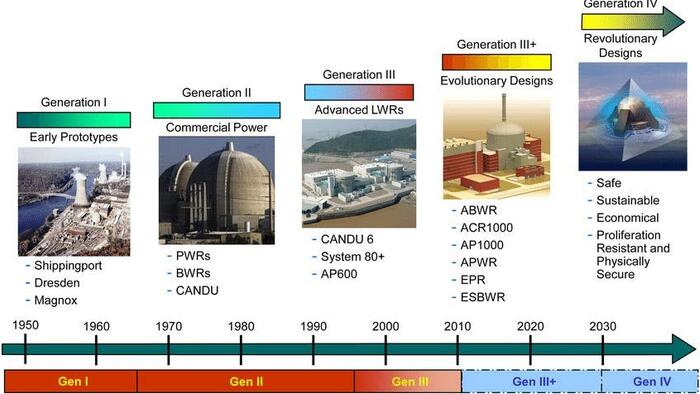
Where The Department of Energy Is Investing Submitted by Tight Spreads The DOE has been flooding their sites with white-papers and latest Fusion Science and Technology Roadmap (FS&T Roadmap) are not just a scientific plan, but an industrial policy designed to transition fusion from the laboratory to the commercial market by the mid-2030s. The DOE has prioritized its actions to align with the aggressive “fast-track” development cycles of nuclear fission and fusion companies: Near-Term (Next 2-3 Years): Digitalization & Infrastructure Prep AI-Fusion Convergence: Launch the AI-Fusion Digital Convergence Platform to use machine learning to speed up materials discovery and predict plasma behavior. Infrastructure Start: Build small-to-medium test facilities and complete the design for large-scale “First-of-a-Kind” (FOAK) facilities. Regulatory Frameworks: Finalize licensing and safety standards to give investors, consumers, and citizens alike certainty on how these plants will be regulated. Mid-Term (3-5 Years): Prototype Integration Pilot Plant Construction: Support the private sector in constructing the first fusion pilot plants (FPPs). Fuel & Materials Testing: Delivery of integration platforms for testing tritium fuel cycles and materials under intense radiation. Supply Chain Seeding: Support domestic manufacturing for high-heat components and superconducting magnets. Long-Term (5-10 Years): Grid Delivery & Scale-Up Commercial Operation: The first fleet of pilot plants begins delivering power to the grid. Commercial Maturity: Expand public infrastructure to support a global market, focusing on lowering the levelized cost of energy to make fusion competitive with other generation technologies today. The Six Core Technical Challenge Areas These are the gaps the DOE is prioritizing through its public research budget to ensure relevant companies succeed. Structural Materials: Developing metals that won’t become brittle or weak after years of intense neutron bombardment. Metals such as Reduced Activation Ferritic Martensitic (RAFM) steels can withstand intense neutron damage without swelling or becoming brittle. Plasma-Facing Components (PFCs): Creating “first walls” that can survive heat fluxes equivalent to the surface of the sun. Confinement Systems: Optimizing magnets and lasers to hold the superheated fuel stable for long periods. Relevant companies: BRKR, COHR Fuel Cycle & Tritium Processing: Establishing a closed loop fuel system to breed, recover, and recycle tritium fuel, as it is extremely scarce in nature. Relevant companies: OKLO, ASPI, BWXT Blankets: Engineering the wrapper around the reactor that captures heat for electricity and breeds the fuel. Plant Engineering & Integration: Linking a fusion reactor to standard turbines and maintenance via robotics. Relevant companies: NVDA, IBM The Future of Energy: Understanding the Mechanics of Fusion To grasp the next frontier of the energy transition, we need to distinguish between the nuclear power we use today and the “holy grail” of energy: Nuclear Fusion. Nuclear fusion is the process of combining two light atomic nuclei to form a single, heavier nucleus. This process releases a massive amount of energy as it typically uses two hydrogen isotopes for fuel: Deuterium and Tritium (D-T fuel). Nuclear Fission is the splitting of heavy atoms, such as the current method of commercial nuclear power plants with Uranium. What is Plasma? We are typically taught that there are three states of matter: solid, liquid, and gas. Plasma is the fourth state, and it is the most common form of matter in the visible universe. Plasma is created when a gas is heated to such extreme temperatures that the electrons are stripped away from their parent atoms. This results in an “ionized” gas—a hot, soup-like mixture of free-moving positively charged nuclei (ions) and negatively charged electrons. It is highly conductive and can be manipulated and shaped by magnetic fields.…
NatGas Futs Erupt As Arctic Air Invasion Penetrates Deep Into US South
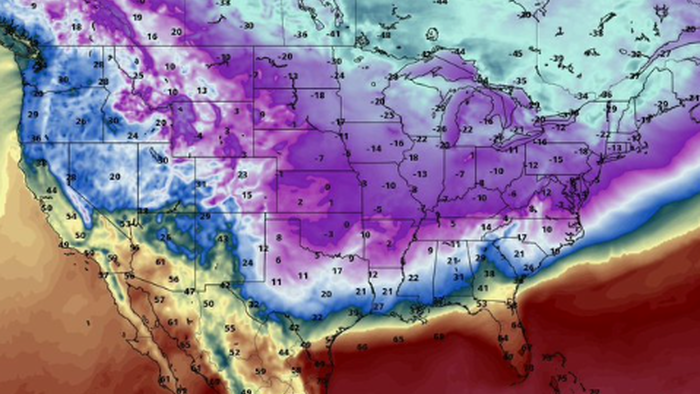
NatGas Futs Erupt As Arctic Air Invasion Penetrates Deep Into US South US natural gas futures erupted Monday morning as some of the coldest Arctic air of the Northern Hemisphere winter season poured into the eastern half of the Lower 48. Snow threats across the region are increasing through the end of the month. Average temperatures across Washington, DC, are plunging and could average around 10°F by the weekend. This cold blast is far more extreme than the one in the first half of December. Notably, this period typically coincides with the most intense part of winter. "DANGEROUS COLD is likely on Saturday across much of the United States, with wind chills forecasted to fall below zero for over 100 million people," weather observer Max Velocity wrote on X. "Additionally, wind chills could be as low as 60 DEGREES below zero in the far Northern Plains at this same time. This dangerous cold will likely set up a rare Southern USA Winter Storm on Friday and Saturday." DANGEROUS COLD is likely on Saturday across much of the United States, with wind chills forecasted to fall below zero for over 100 million people. Additionally, wind chills could be as low as 60 DEGREES below zero in the far Northern Plains at this same time. This dangerous cold… pic.twitter.com/xbtm2nsQdv — Max Velocity (@MaxVelocityWX) January 19, 2026 Private weather forecaster BAM Weather warns of increasing risks of winter activity across the eastern half of the US this week: A storm will develep Friday night into Saturday across the deep south and track northeast with a tap to the Gulf of America allowing plentiful moisture to produce a large area of a high impact winter storm. Strong high pressure will come south from Canada and bring Arctic air with it allowing there to be plenty of cold air available to produce snow and ice across several thousands of miles in the central and eastern US. Winter Storm Scenario #1 Winter Storm Scenario #2 The cold blast has sent heating demand through the roof. NatGas futures in the US are up 18% as of early Monday, the largest intra-day jump since October 2024. NatGas prices surging again. Cold air is in place. The weather pattern is set. Map showing the chances for at least three inches of snow through Monday. That's a lot of real estate ❄️ High chances for accumulating snow in the Southern Plains, Mid-South, Appalachians and Mid-Atlantic this weekend. Lots of ice possible in the South. pic.twitter.com/yrtTYn4h8F — Ben Noll (@BenNollWeather) January 19, 2026 All eyes are on the next possible major snowstorm targeting the Southern Plains, Mid-South, Appalachians, and Mid-Atlantic by next week. Tyler Durden Mon, 01/19/2026 - 10:55

Greenland Is Very Nice...
Greenland Is Very Nice... By Benjamin Picton, senior markets strategist at Rabobank If Mighty Ducks 2 taught me anything it’s that “Greenland is covered with ice, and Iceland is very nice.” While that might be a handy geographic mnemonic, for the purposes of US national security policy it is, in fact, Greenland that is very nice.. Over the weekend President Trump announced additional tariffs of 10% from February 1st – rising to 25% from the 1st of June – for eight European countries resisting US efforts to acquire Greenland. The affected countries are Denmark, France, Germany, the UK, the Netherlands, Sweden, Norway and Finland. Trump said via Truth social that the tariffs would remain in place until a deal for the sale of Greenland to the United States is concluded. Consequently, gold is hitting fresh record highs, long yields are rising, equity futures point negative and both Cable and EURUSD have opened the Asian session well bid. Japanese long yields are surging for idiosyncratic reasons, but should be getting high enough to worry even the most sedate money managers. One can probably imagine the reaction in European capitals. The Financial Times is reporting that the EU is preparing €93bn in retaliatory tariffs to give European leaders “leverage” in negotiations with Trump at the World Economic Forum in Davos this week. Emmanuel Macron was quick out of the gates with a representative of his office saying that the French President will be arguing for the EU to deploy its much-vaunted ‘trade bazooka’ (known less sensationally as the anti-coercion instrument) while Politico quotes former French diplomat Jeremie Gallon as saying “I am convinced that we must not give in... Resisting a new attempt at humiliation and vassalization is the only way Europe can finally assert itself as a geopolitical actor.” Resistance is all well and good, but effective resistance requires the means to resist – and Europe does not have it. An ECB report released in February of last year noted that 61% of all card payments in Europe are processed by international (read: US) card schemes while thirteen EU countries are solely reliant on international schemes like Visa, Mastercard and ApplePay for electronic payment processing. Likewise, since the start of the war in Ukraine Europe has become dependent on American energy as it attempts wean itself off Russian supplies. Before the war it was already dependent on the Eurodollar market for capital and on the American consumer for export earnings as deflation and state mercantilism in China diminished that alternative. Over the weekend German Chancellor Merz conceded that Germany’s shutdown of its nuclear energy industry was a “serious strategic mistake” that has left the country with insufficient energy generation capacity. As a consequence of cumulative strategic mistakes, European industry is now being squeezed between the pincers of loss of input sovereignty and loss export markets. Loss of domestic industry is another way of saying loss of industrial sovereignty (for more on that, see Sky News’s excellent exposé on the parlous state of UK industry) – and industrial sovereignty is requisite for dreams of strategic autonomy. Furthermore – and though it hardly bears saying – the EU under NATO remains a US garrison state with major US bases in the Netherlands, Germany, Spain, Italy, Poland, Belgium, Portugal, Greece and Norway. Without the US security umbrella, the EU nuclear deterrent collapses into internecine politicking over France’s willingness to play guarantor for other member states who – once upon a time – France was sceptical about admitting to the EU in the first place. This is important in a context where – as ECB’s Kazaks pointed out overnight – Europe is already at war with Russia. Herein lies the Achilles Heel for Europe in seeking genuine strategic autonomy: the lack of political union makes it all too easy for great powers like the United States or China play member states off against…

Putin Offered Seat On Trump's Gaza Peace Board, Kremlin Says
Putin Offered Seat On Trump's Gaza Peace Board, Kremlin Says Russia has been invited to take part in the new US-backed 'Peace Board' put forward by President Donald Trump to oversee post-conflict governance and reconstruction in Gaza, Kremlin spokesman Dmitry Peskov has announced, in a somewhat surprising and hugely symbolic diplomatic move and overture. Peskov told reporters Monday that President Vladimir Putin had received an invitation through diplomatic channels. "We are studying the details of the proposal. We hope to hold contacts with the US side to clarify all the nuances," he said, but did not disclose any additional details. Source: Expresso The Putin invitation has yet to be publicly acknowledged by Washington, and Western mainstream media is likely to go into a frenzy over it. Press reports have highlighted that Putin was invited to oversee 'peace' but is still active in directing the Ukraine invasion. For example, The Guardian frames the peace board as but a Trump vanity project, writing "The invitation to Putin, which has yet to be confirmed by Washington, raises more questions about the intended agenda for the board. It was originally part of Trump’s ceasefire proposals for the Gaza war, and was supposed to oversee the transition to a lasting peace in the territory and supervise the work of a committee of Palestinian experts, also announced last week, who would take care of the day-to-day running of Gaza." The report adds, "The vaguely described scheme was endorsed in a UN security council resolution in November" - and draws parallels to the desire to takeover Greenland, which is intent to "cement Trump’s place in the history books." Invitations have been sent to a broad group of countries in Europe, the Middle East, and Asia, including US allies and key regional players. Already, countries and leaders as different and geographically distant as Hungary under Prime Minister Viktor Orban and Vietnamese Communist Party chief To Lam have accepted their invitations. It is shaping up to be a 'mini UN' of sorts, as the peace board plan calls for an international council to manage reconstruction financing, security coordination, and political cooperation in Gaza - all while working in cooperation with a Palestinian technocratic administration. Yet there are other peculiar aspects. For example Bloomberg reported over the weekend that the Trump administration is asking nations interested in holding a permanent seat on a proposed Gaza Strip "Board of Peace" to pledge at least $1 billion in funding. Otherwise they will just hold a three-year seat, according to some initial details. ❗️Trump invited Putin to join Gaza 'Peace Board' — Kremlin spokesman 'At the moment, we are studying all the details of this proposal. We hope for contact with the American side to clarify all the nuances' pic.twitter.com/ZghZSU8gU0 — RT (@RT_com) January 19, 2026 The intent of the funding threshold is reportedly to ensure that participating countries have substantial financial involvement in stabilizing the territory and supporting long-term redevelopment. It is unclear whether Russia will accept its invitation, or whether it is willing to pony up $1 billion. Washington seems to be arguing that spreading the financial burden internationally is critical to preventing American taxpayers from shouldering most of the reconstruction costs. Sadly, this was of no concern when the same taxpayers were footing the bill for billions in weaponry and foreign aid for Israel over prior years - even as Palestinian neighborhoods got flattened by US bombs. Tyler Durden Mon, 01/19/2026 - 10:05

FBI Announces $100,000 Reward After Government Vehicles Broken Into In Minneapolis
Bayer Shares Surge After Supreme Court To Hear Roundup Appeal; Is The Decade-Long Bear Market Over?
Futures, Global Markets Sink, Gold Soars On Trump Tariff Threat

Trump To Norway: No Nobel, No Greenland? The Letter That Has Shocked Europe
Chaos By Design
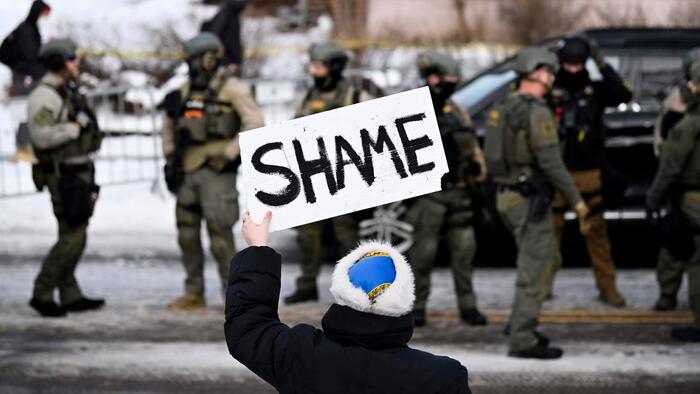
Chaos By Design Authored by Jerry Rogers via American Greatness, Over and over again, we’re told to be outraged. An individual is detained by Immigration and Customs Enforcement (ICE). He is later released. And before the facts can catch their breath, Democratic politicians and activist megaphones are already screaming ‘abduction’, ‘fascism’, and ‘state violence’. Cue the mob. Cue the cameras. Cue the chaos. It plays out over and over again. Remember the viral video of a woman screaming ‘I’m a U.S. citizen’ as ICE agents pulled her from a car in the Florida Keys? The media and politicians pounced – ICE ‘arrested an American citizen’. Turns out this person was detained by ICE because she refused to identify herself and was driving her boyfriend’s vehicle. Afterwards, reports disclosed that the boyfriend was in the country illegally. She chose not to comply. Perhaps she wanted the situation to escalate? Much of the debate about ICE has become political theater. Let’s slow this down and apply something increasingly rare in modern politics: the facts. ICE detains individuals pursuant to its lawful authority. That happens every day. Sometimes people are held. Sometimes they’re released. Detention and release are not evidence of wrongdoing by law enforcement—they are the process. But in today’s political climate, process doesn’t matter. Optics do. Rage does. And outrage is politicized and monetized. What does make these encounters dangerous is not ICE. It’s the reckless rhetoric that surrounds them. When Democratic elected officials tell people that law enforcement officers are ‘kidnappers’ or ‘stormtroopers’, when they suggest citizens have a moral duty to interfere with federal agents, they are not encouraging peaceful protest—they are inciting confrontation. And when mobs take that cue and physically obstruct officers doing their jobs, the risk to everyone involved skyrockets. This is not complicated. What happens? Lawful orders are given. They’re ignored. Resistance follows. A crowd interferes. Officers are forced to manage a volatile situation that never needed to exist in the first place. If individuals simply comply with lawful commands—no dramatics, no resistance, no posturing—these could be routine encounters. No drama; no chaos, no violence. If the mob allows officers to do their work instead of inserting themselves into a federal enforcement action, there would be no spectacle, no video clips, no political fundraising emails. But compliance doesn’t trend on social media. What we’re witnessing is a dangerous feedback loop. Politicians inflame tensions with extreme language. Activists show up looking for confrontation. Law enforcement is placed in an impossible position. Then, when things escalate—as they predictably do—the very people who lit the fuse rush to the microphones to condemn the explosion. That’s not leadership. That’s negligence. No one is above the law, but justice isn’t served when the law is deliberately obstructed either. ICE officers are not free agents; they operate under rules, supervision, and due process constraints. Pretending otherwise may be politically useful, but it is factually false—and dangerously so. If Democrats truly cared about safety, about de-escalation, about justice, they would stop encouraging resistance and obstruction. They would tell their supporters the truth: you don’t get to decide, in the moment, which laws you’ll obey and which officers you’ll recognize as legitimate. These incidents don’t have to happen. They are not inevitable. They are manufactured—by irresponsible rhetoric, by mob interference, and by a political class more interested in chaos than consequences. And the next time it happens—and it will—remember who made it dangerous. Tyler Durden Mon, 01/19/2026 - 08:15

Market Risk Returns As Tariff Shock Jolts Stocks; Goldman Maps Three Retaliation Paths Against Trump Over Greenland

OM Mercato : le club officialise une arrivée de premier plan au Vélodrome, accord total annoncé pour Abdelli !