Le Journal

Why the Sequel to Last Year’s Brightest Film Took a Dark Turn

Women Keep Ruining the Workplace!!

The CDC’s Website Is Anti-Vaccine Now
If Robert F. Kennedy Jr., the secretary of Health and Human Services, did bother to ask CDC scientists about using their website to turn anti-vaccine talking points into agency guidance, it didn’t matter much. “My understanding is that none of the leadership were asked about it, or if they were asked about changing the website, they did not agree with the change,” Daniel Jernigan, the former director of the National Center for Emerging and Zoonotic Infectious Diseases, told me. But as of last night, there it was: The CDC’s new official stance is that “studies have not ruled out the possibility” that routine childhood immunizations contribute to autism.A senior CDC scientist told me that many people at the agency heard about the change only yesterday evening, hours before the revamped website launched. The decision appears not to have passed through the normal channels, which would involve staff at the Immunization Safety Office, Jernigan said. When asked via email whether CDC scientists had been bypassed, Andrew Nixon, an HHS spokesperson, didn’t answer. Instead, he reiterated bullet points from the website update, including the claim that studies supporting a link between autism and vaccines “have been ignored by health authorities”—essentially, the CDC accusing itself of having disregarded scientific evidence.The new language appears in the “Vaccine Safety” section of the agency’s website. Until yesterday, that page laid out autism researchers’ long-standing consensus that vaccines do not cause the disorder. It noted that no link has been found between vaccine ingredients and autism, and that a National Academy of Medicine review of eight routine immunizations found that, “with rare exceptions, these vaccines are very safe.” The website’s affirmation that vaccines do not cause autism was important enough that during Kennedy’s confirmation process earlier this year, Senator Bill Cassidy, a physician, made him promise not to remove it. But instead of keeping his promise, Kennedy—who oversees the CDC as head of HHS—appears to be using the CDC website to advance his own anti-vaccine beliefs.Technically, the statement “Vaccines do not cause autism” has not been removed from the CDC website. Instead, it has been appended with an asterisk, which is explained at the bottom of the page: “The header ‘Vaccines do not cause autism’ has not been removed due to an agreement with the chair of the U.S. Senate Health, Education, Labor, and Pensions Committee that it would remain on the CDC website.” That asterisk is an obvious farce, because the page is now devoted to undermining the scientific consensus. “‘Vaccines do not cause autism’ is not an evidence-based claim,” the site now states, despite the fact that multiple large studies have found no such association. The site notes that reviews on the measles, mumps, and rubella vaccine concluded that there is no association between the MMR vaccine and autism—but goes on to criticize those reviews as methodologically flawed. It also asserts that the rise in autism rates “correlates with the rise in the number of vaccines given to infants.”In fact, autism researchers attribute much of that increase to improved screening and broader diagnostic criteria. Studies suggest that about 80 percent of a person’s autism risk comes from inherited mutations in their DNA. (The webpage doesn’t mention genes.) And yet, parents considering whether to vaccinate their child and seeking the CDC’s advice will now get the impression not only that the jury is out on whether vaccines cause autism but also that there is reason to believe they do.[Read: The U.S. is going backwards on vaccines, very fast]Kennedy himself has suggested as much for years in books and interviews, and as chair of the anti-vaccine nonprofit Children’s Health Defense. Such statements raised Cassidy’s suspicions during Kennedy’s confirmation process, though Cassidy still voted him into office. Demetre Daskalakis, who was the director of the…
To Get Happier, Make Yourself Smaller

When Border Patrol Comes to Town

Espion à l’ancienne : une saison 3 est-elle possible sur Netflix ?
La saison 2 d’Espion à l’ancienne est désormais disponible sur Netflix, un an après l’arrivée remarquée de la première. Cette nouvelle salve d’épisodes relance la question du devenir de la série de Mike Schur et Ted Danson. Le service de streaming n’a, pour l’heure, rien officialisé, mais l’attention portée au programme dans les premières semaines […] Cet article Espion à l’ancienne : une saison 3 est-elle possible sur Netflix ? est apparu en premier sur Netflix News : toute l'actualité de vos programmes Netflix.
How to Fix the Mess of College Sports
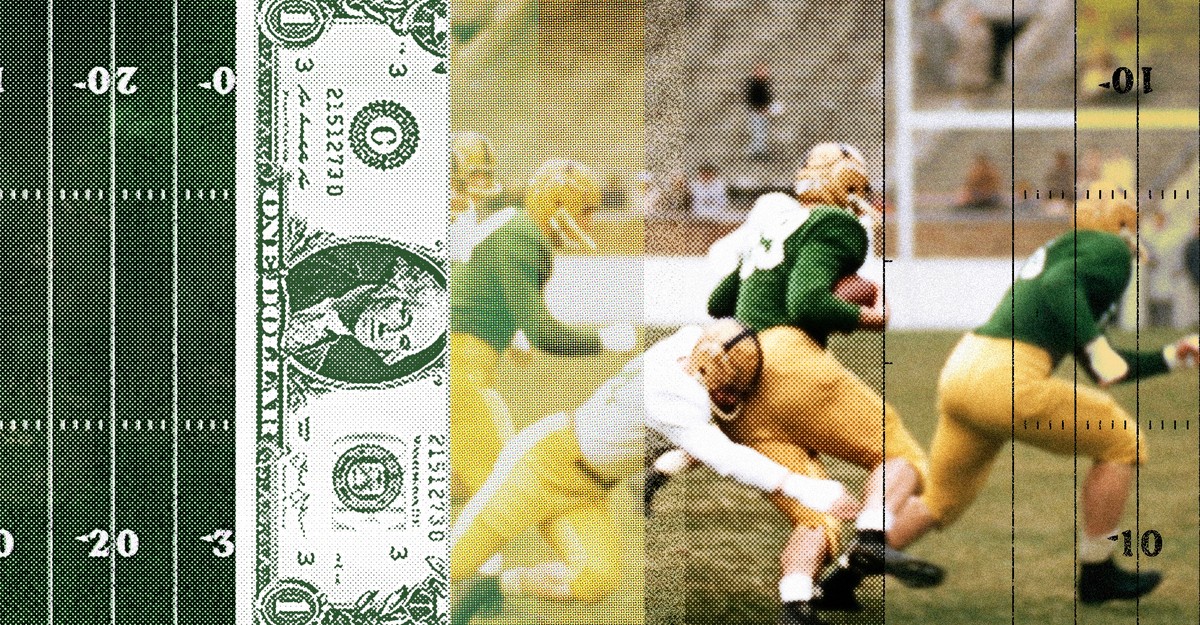
Here’s an idea for overhauling the mess that is money in college sports: For every dollar that a university athletic department spends on coaching salaries fatter than a duke’s inheritance, or locker rooms as luxurious as Hadrian’s villa, a dollar should go toward academic funding—to faculty salaries, library maintenance, and other necessities that benefit all students, athletes included.Such an arrangement might help reform a truly broken system, which demands compulsive, destructive overspending—on coaching, facilities, and more—in a cycle of one-upmanship. The problem is most acute in football, which is the largest moneymaker in college sports but also the most egregious cost driver. Total revenue shared by the 136 major schools that compete in the top-tier Football Bowl Subdivision amounted to about $11.7 billion in 2024. The money comes from media rights—such as the College Football Playoff’s $1.3 billion yearly deal with ESPN—along with ticket sales, corporate sponsors, donor gifts, and, in some cases, student fees and state funds. These schools tend to spend most of (and, in some cases, more than) what they take in—on waterfalls and golf simulators, on $700 showerheads, on wood-paneled locker rooms with custom pool tables, and, most disproportionately, on a handful of coaches.Efforts to curb all this spending are rarely directed at the spenders themselves. Instead, athletes are routinely cast as culprits for demanding to be paid and thus in need of strict oversight to keep them pure, an attitude that President Donald Trump expressed last week in an interview with ESPN’s Pat McAfee. “It is a very serious problem because even football, where they give quarterbacks $12 million, $13 to $14 million,” Trump said, “all of a sudden you’re going to be out of control.” But the behavior that needs correcting in this era of billion-dollar-a-year TV contracts and other accelerant revenues is that of shopaholic college administrators, whose expenditures have become so untethered from any scholastic purpose. Regulate them.Nine head football coaches at major universities began this season with an annual salary of more than $10 million, and 46 others are scheduled to make at least $4 million. Coaches’ pay is the second-biggest athletic expense at Football Bowl Subdivision schools, behind only facility costs. Many of these coaches will collect millions even if they fail. In 2021, for example, Louisiana State University granted Brian Kelly a 10-year, guaranteed contract worth $95 million—only to dismiss him after the team started 5–3 this season. His firing triggered an almost $54 million buyout clause, and a lawsuit over what he is owed. Since the College Football Playoff system was launched in 2015, public universities are on pace to pay more than $1 billion in severance to coaches, according to a report from the Knight Commission on Intercollegiate Athletics, a think tank that studies educational reforms in sports. To repeat: Public universities are paying more than $1 billion in just 10 years to a handful of fired gym teachers. “The severance payments,” the Knight Commission’s CEO, Amy Privette Perko, told me, “have really put an exclamation point on the problem.”[Read: The shame of college sports]In a normal business, this would be irrational behavior. But the administrators who make these deals are simply responding to extreme forces in an abnormal market. College athletic departments are caught in an asymmetrical situation: They are part of institutions that are legally defined as educational nonprofits, yet they operate in a kill-and-eat environment awash in torrents of profit. They must spend to win and spend to force their competitors to fail. It’s a “zero-sum game,” Kevin Blue, a former UC Davis athletic director, told me. From a “behavioral economics perspective,” Blue has written, college sports’ financial decision makers are “acting rationally.”But unlike conventional businesses, athletic departments have no owners or…

Mr Mercedes : la trilogie criminelle de Stephen King trouve une seconde vie sur Netflix
La mise en ligne des trois premières saisons de Mr Mercedes sur Netflix ramène dans la conversation une série jusque-là confidentielle en France. L’adaptation de David E. Kelley, longtemps cantonnée à Audience Network puis à StarzPlay, circule désormais auprès d’un public sensiblement plus large. L’occasion de revenir sur ce thriller méthodique, tiré de la trilogie […] Cet article Mr Mercedes : la trilogie criminelle de Stephen King trouve une seconde vie sur Netflix est apparu en premier sur Netflix News : toute l'actualité de vos programmes Netflix.

(Some) MAGA Girls Just Wanna Have Fun

Democrats Finally Realize It Isn’t 2016 Anymore

Hunger Games 6 : le jeune Haymitch se dévoile dans la bande-annonce de "Lever de soleil sur la Moisson"